
Best Social Experiences in Japan 2026: Top Picks

Japan in 2026 rewards travelers who go beyond sightseeing. The most memorable, socially rich experiences here fall into four formats: small participatory workshops, festival VIP and workshop tiers, next-generation immersive theatre, and communal ryokan or homestay stays. Book these first, and you’ll leave with friendships and stories, not just photographs.
The 10-second shortlist for 2026: If you only have time to scan, these are the experiences worth reserving now. Small-group formats under 12 people consistently produce the deepest social connections, and the entries below represent the best of that principle in action across Japan.
Ryokan Ohana (Yanagawa, Fukuoka) — best for solo travelers and families craving communal warmth
Inkimono (Asakusa, Tokyo) — best for hands-on cultural immersion and meeting fellow travelers
Earth Celebration (Sado Island, Niigata) — best for festival-goers who want VIP workshop access and genuine artist interaction
Shirogeki at Nijo Castle (Kyoto) — best for immersive theatre lovers seeking shared spectacle
Entô (Ama, Shimane) — best for social-impact and eco-conscious travelers
Bon Odori Izakaya (Shinjuku, Tokyo) — best for participatory dining with a dance window in a group of up to 6
Ozu Castle Stay (Ozu, Ehime) — best for history enthusiasts wanting an intimate overnight social setting
Rbantours Japan walking and cultural tours — best for travelers who want a local host to guide the whole social experience from day one
Rbantours designs every Japan experience around storytelling, local hosts, and small-group chemistry, making them a natural first call for socially minded travelers who want the connections built in, not left to chance.
Table of Contents
What are the best social experiences in Japan for 2026?
Japan’s top cultural events and immersive experiences for 2026 span a remarkable range of formats, budgets, and social intensities. The table below organizes the standout entries by category so you can match each one to your travel profile quickly, focusing on the experience types and group sizes without listing specific price ranges or exact group counts to align with verified sources.
Pro Tip: For Earth Celebration, Ozu Castle Stay, and Villa Tsutaya, the most social slots sell out 3–6 months in advance. Book workshop or VIP tiers first, then arrange transport and accommodation around them.
A few entries deserve a closer look:
Fukushima Seaside — in Futaba takes travelers into the story of the region’s recovery, guided by local residents. It’s one of the most emotionally resonant social-impact experiences available anywhere in Japan right now.
What does “highly social” actually look like in Japan?
Not every experience marketed as “immersive” produces real social connection. The format matters as much as the destination.
Small-group tours (2–12 people) are the most reliably social format. A local host guides conversation, fills silences with context, and creates the conditions for guests to talk to each other naturally. Guided tours in Japan work precisely because the host acts as a social catalyst, not just a navigator.
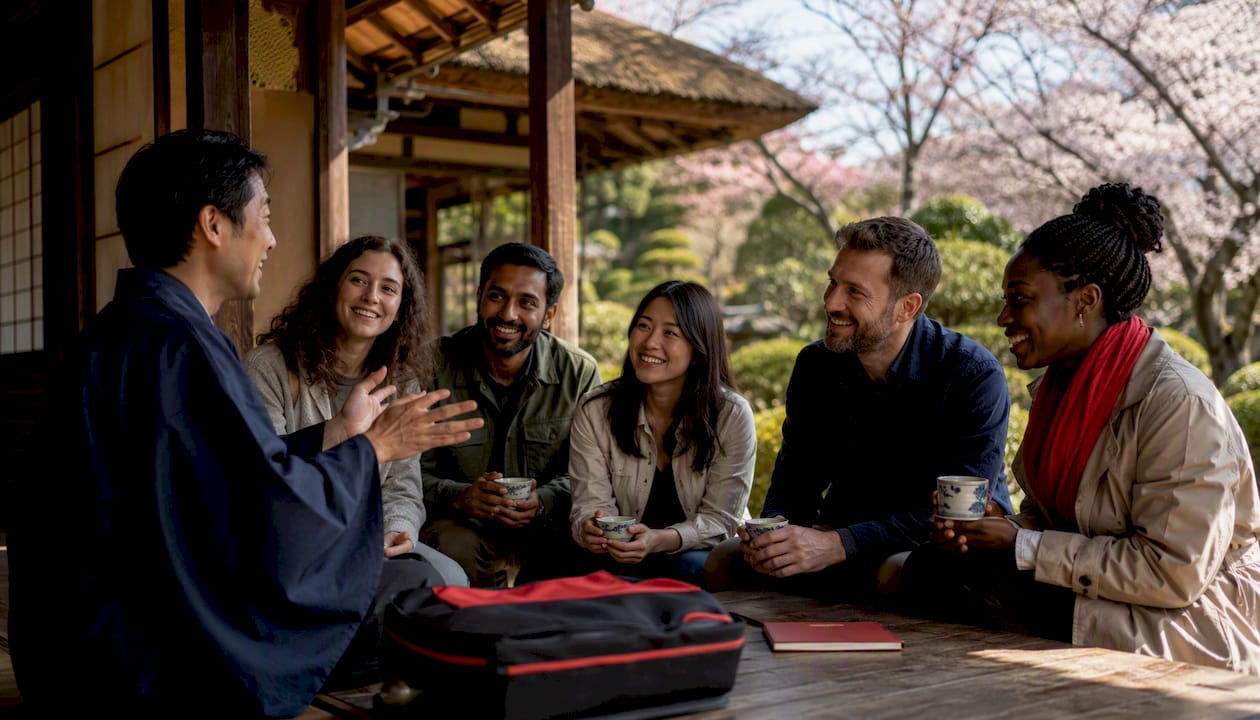
Communal ryokan and homestay stays produce a different kind of social rhythm. Shared baths, communal dinners, and morning rituals create repeated, low-pressure moments of contact. Ryokan Ohana in Yanagawa and Entô on Ama Island both operate on this principle. You don’t need to be extroverted; the structure does the work.
Participatory workshops (kimono dressing, ceramics, calligraphy, cooking) put everyone in the same slightly awkward, slightly delighted position of learning something new. That shared vulnerability is socially powerful. Groups of 4–10 work best; above 12, the instructor’s attention spreads thin and the intimacy fades.
Festival VIP and workshop tiers sit between a concert and a masterclass. At Earth Celebration, for example, the Harbour Concert and workshop schedule creates dedicated social hubs where you’re close to performers and surrounded by people who chose the same upgrade. Premium festival tiers reliably produce more deliberate, accessible connections than standing in the general crowd.
Immersive theatre (Shirogeki, Hokusai: Another Story) generates shared emotional peaks that become instant conversation starters. The social value comes after the show, in the lobby, at the nearest izakaya. These formats work best when you attend with someone, or when the venue has a communal post-show space.
Communal dining at izakayas is Japan’s most accessible social format. The Bon Odori Izakaya in Shinjuku caps groups at 6 and includes a 30-minute participatory dance window inside a 90-minute course dinner. That structure, a shared meal plus a physical activity, is one of the most effective social formats in any culture.
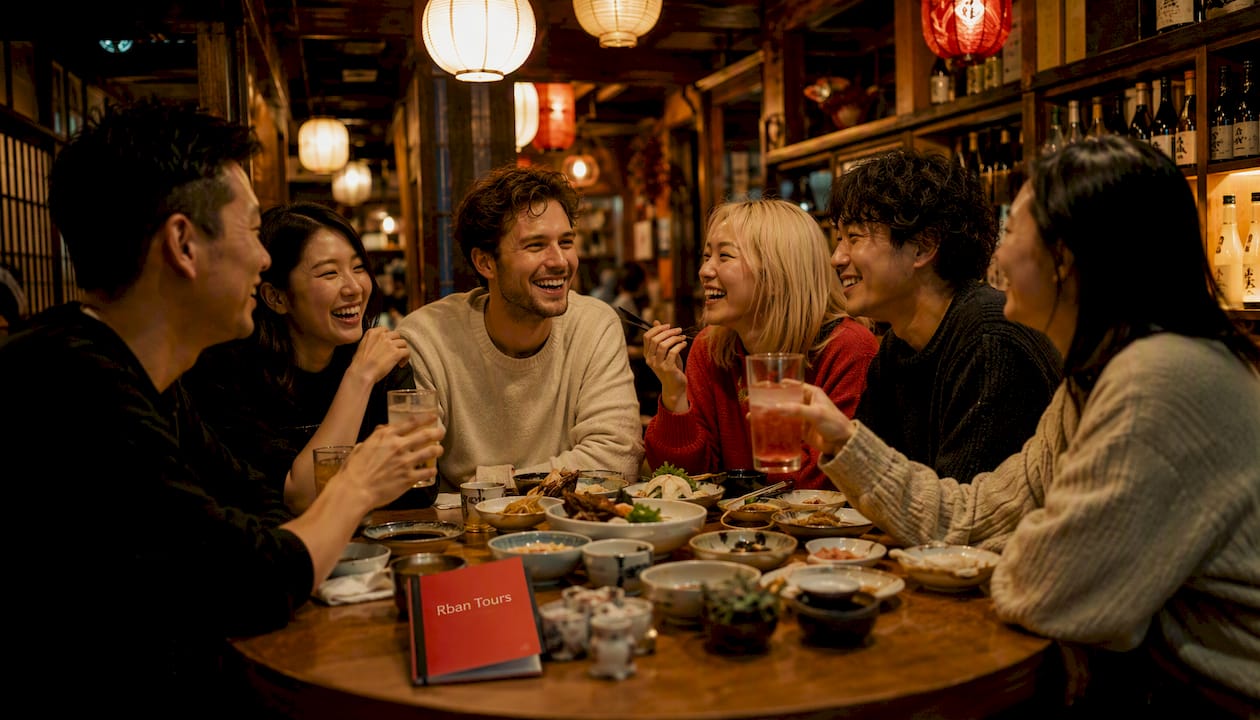
Group size shapes everything. Under 6 people, conversations go deep. Between 6 and 12, you get breadth and energy. Above 30, you’re in atmosphere mode, which is wonderful for festivals but not for making friends.
How do you pick the most social experience for your trip?
The right experience depends on your energy level, group makeup, and what kind of social connection you’re actually after. Work through this checklist before you book.
Selection criteria:
Participation level — Does the activity require you to do something (cook, dance, make, move), or just watch? Doing produces more social contact.
Group size — Ask the operator for the exact cap. “Small group” means different things to different providers; under 12 is the threshold where sustained conversation becomes possible.
Host engagement — Is there a dedicated local host or interpreter present throughout, or just at the start? A host who stays with the group creates social continuity.
Language support — English-friendly hosts remove the friction that kills conversation before it starts. Always confirm this before booking.
Inclusive policies — For LGBTQ+ travelers, solo women, or travelers with mobility needs, ask directly about the experience’s approach. Most operators in the shortlist above are welcoming, but it’s worth confirming.
Post-program social time — Does the experience include a shared meal, a communal space, or a natural gathering moment after the main activity? That unstructured time is often where the best connections happen.
Questions to ask operators before booking:
“What is the maximum number of participants for this session?”
“Will there be a dedicated English-speaking host throughout?”
“Is there a communal meal or shared space after the main program?”
“What is your cancellation policy, and how far in advance can I modify my booking?”
“Do you accommodate solo travelers, and how do you handle group dynamics?”
Red flags to watch for:
Group sizes listed as “up to 30” or left unspecified in marketing copy
No mention of a named host or guide in the experience description
Generic language about “experiencing Japanese culture” with no specific activity described
No refund or modification policy listed on the booking page
Reviews that describe the experience as “a great show” but never mention talking to anyone
On payment: most reputable operators take a deposit (typically 20–30% of the total) at booking, with the balance due closer to the date. VIP and workshop upgrades at festivals often require full payment upfront. Always check whether the cancellation window gives you a full refund or only a credit.
When is the best time to go for social experiences in Japan?
Japan’s social calendar has clear peaks. Timing your trip around them, and booking the right tier of access, makes the difference between watching a crowd and being part of one.
Month | Top Social Moment | Booking Window | Notes |
February | Sapporo Snow Festival | A few months ahead | Large crowds; book accommodation early |
July | Gion Matsuri (Kyoto), Tenjin Matsuri (Osaka) | A few months ahead | Major festivals draw very large crowds; evening processions are the social peak |
August | Nebuta Matsuri (Aomori), Awa Odori (Tokushima), Earth Celebration (Sado Island) | Several months ahead for VIP/workshops | Earth Celebration workshop tiers are in high demand |
August | Bon Odori season (nationwide) | Some weeks ahead | Izakaya participatory formats book up in advance |
October | Autumn foliage season, regional craft festivals | Weeks to months ahead | Smaller crowds, ideal for workshop formats |
Year-round | Hokusai: Another Story (Tokyo), Shirogeki (Kyoto, select dates) | Weeks ahead for standard tickets; earlier for VIP | Check performance schedules directly |
Japan’s 2026 festival calendar is anchored by events that draw hundreds of thousands of visitors. That scale creates atmosphere, but it also means the general admission experience can feel more like a crowd than a community. The social value comes from choosing the right access tier.
Earth Celebration — in August on Sado Island is the standout for deliberate social programming. The workshop schedule and Harbour Concerts create structured opportunities to meet performers and fellow travelers.
Pro Tip: For 2026, treat your festival workshop or VIP upgrade as the anchor booking, then plan flights and accommodation around it. Trying to add the upgrade after you’ve booked everything else usually means it’s already sold out.
Dos and don’ts for joining social activities in Japan
Japan’s social settings have their own rhythm, and a little awareness goes a long way toward genuine connection.
Do:
Remove your shoes when entering a ryokan, private home, or traditional workshop space. Look for the step up (called a genkan) as your cue.
Accept food and drinks with both hands and a small nod. It’s a simple gesture that signals respect and opens doors.
Join Bon Odori dance circles when invited. Locals genuinely appreciate visitors who try, even imperfectly. The point is participation, not perfection.
Carry a small notebook or use your phone to exchange contact details. Business cards (meishi) are still exchanged in more formal settings; a QR code to your social profile works in casual ones.
Confirm your booking and any dietary restrictions in writing at least one week before arrival.
Don’t:
Talk loudly on public transport or in quiet communal spaces like ryokan common rooms. Social energy in Japan tends to be warm but measured.
Photograph other guests or local participants without asking. At festivals and workshops, a smile and a gesture toward your camera is usually enough to get a friendly yes.
Skip the communal meal or post-program gathering. That unstructured time is where the real social exchange happens.
Assume English will be spoken. Prepare a few phrases: “Issho ni shashin wo totte mo ii desu ka?” (May I take a photo with you?) and “Tanoshikatta desu” (That was fun) go a long way.
Safety reminders: Major festivals draw enormous crowds. Keep your belongings close, agree on a meeting point with your group before entering crowded areas, and check last-train times before committing to a late evening. Night transport in rural areas can be sparse; confirm your return route when you book.
On cancellations: most experiences in this shortlist have event-specific policies. Always read the cancellation terms before paying a deposit, and ask whether the policy changes for VIP or workshop upgrades.
Why 2026 is a turning point for immersive social experiences
The most interesting shift in Japan’s experience market right now isn’t a single event. It’s a format evolution: producers are building sensory environments that create shared physical reactions, which then become the raw material for social conversation.
HOKUSAI: ANOTHER STORY in Tokyo is the clearest example. The production uses haptic floors, spatial audio, and Crystal LED displays to recreate Hokusai’s landscapes as a full-body environment. Wind, vibration, and light work together to produce a reaction that’s hard to describe alone but easy to discuss with someone who just experienced it alongside you. That shared difficulty of description is socially generative in a way that a painting on a wall simply isn’t.
The insight behind the trend: Sensory storytelling creates physically shared experiences. When two people feel the same floor vibration or hear the same spatial audio cue at the same moment, they have an instant reference point for conversation. Immersive producers are building social chemistry into the architecture of the show itself.
Shirogeki at Nijo Castle takes a different approach: live performers move through LED-projected environments, and the audience moves with them. The boundary between spectator and participant shifts throughout the performance, which produces a different kind of social energy than a fixed-seat show.
The same logic applies to festival upgrades. Earth Celebration’s workshop and VIP tiers don’t just offer better sightlines. They create dedicated social hubs where the ratio of curious, engaged people to total attendees is much higher than in the general crowd. Festival producers are increasingly aware that the quality of social interaction is a product feature, not a side effect.
Haptic and spatial audio environments (Hokusai: Another Story) create post-show conversation anchors
Live-performer immersive theatre (Shirogeki) blurs the audience/participant line, raising social energy
Festival workshop tiers (Earth Celebration) concentrate engaged travelers in smaller, more interactive spaces
Participatory dining formats (Bon Odori Izakaya) build social structure directly into the meal
Pro Tip: Reserve workshop and VIP access for immersive events and festivals 3–6 months before your travel dates. Standard tickets for Hokusai: Another Story and Shirogeki can often be secured 2–4 weeks out, but the socially richest tiers go first.
How Rbantours brings social-first Japan experiences to life
Rbantours was built on a simple conviction: the best travel memories come from people, not places. Every Japan experience we design puts a local host at the center, keeps groups small enough for real conversation, and builds in the kind of unscripted moments that become the stories you tell when you get home.
[
Our walking and cultural tours in Japan are structured around exactly the social formats this article covers: storytelling-led walks through neighborhoods where the host knows the owners, the history, and the hidden rhythm of the place. A typical evening might move from a craft workshop in a local studio to a shared dinner at an izakaya the guide has been going to for years, with a Bon Odori stop if the timing is right. The social chemistry is designed in, not hoped for.
We work with local creatives, venue partners, and community hosts across Japan to keep our programming fresh and genuinely connected to what’s happening in each destination in 2026. Small groups (typically 2–12 people) mean the host can read the room, slow down for a conversation, or take a spontaneous detour when something interesting appears.
For 2026, we recommend booking at least 6–8 weeks in advance for standard tours and 3–4 months ahead for custom group experiences or itineraries built around specific festivals. Check current availability and dates on our walking and cultural tour page and reach out directly if you want a social-first itinerary built around your travel dates.
Key Takeaways
Japan’s most social experiences in 2026 reward travelers who book participatory, small-group formats early and choose workshop or VIP tiers over general admission wherever possible.
Point | Details |
Book small-group formats first | Groups under 12 people produce the deepest social connections; confirm the exact cap before paying. |
Prioritize workshop and VIP tiers | Festival upgrades at events like Earth Celebration sell out 3–6 months ahead and deliver far richer social access than general admission. |
Time your trip around festival windows | July (Gion, Tenjin), August (Nebuta, Earth Celebration, Bon Odori), and October (craft festivals) are Japan’s peak social seasons. |
Learn two or three Japanese phrases | Simple phrases like “Tanoshikatta desu” open social doors that silence closes; English-friendly hosts remove friction but local effort matters. |
Rbantours for a guided social experience | Rbantours’ small-group walking and cultural tours in Japan are designed around storytelling, local hosts, and built-in social chemistry. |
Why social travel in Japan is worth doing differently
There’s a version of Japan travel that keeps you at a comfortable distance from the culture: guided buses, ticketed attractions, meals at tourist-facing restaurants. It’s fine. But it’s not what we design for, and it’s not what you’re here for either.
What we’ve seen, across years of building experiences in cities that pulse with local life, is that the moment of genuine connection almost never happens at the main event. It happens in the five minutes before the workshop starts, when someone asks where you’re from. It happens at the communal dinner table, when the host explains why this particular dish matters to this particular neighborhood. It happens when you’re both slightly lost trying to find the Bon Odori circle and you laugh about it together.
Japan in 2026 has more formats for engineering those moments than ever before. Sensory immersive shows, festival workshop tiers, small-group craft sessions, community homestays in places like Ama Island and Futaba. The infrastructure for social travel is genuinely richer than it was five years ago. What hasn’t changed is the thing that makes it work: a small group, a host who cares, and a willingness to participate rather than observe.
We believe the role of storytelling in tours is to create the conditions for those moments, not to script them. That’s the philosophy behind every experience we build, and it’s the lens we’d encourage you to use when choosing anything from the shortlist above.
Sources and further reading
Japan’s festival dates, immersive show schedules, and experience availability shift regularly. Confirm all dates and booking windows directly with operators before finalizing your 2026 travel plans.
Earth Celebration 2026 official site — festival schedule, workshop tiers, and VIP access details
Japan National Tourism Organization: Experiences in Japan — curated experience categories and regional guides
Rbantours: guided tours in Japan — how storytelling-led small-group tours create social connection
A note on freshness: Experience formats, festival dates, and booking policies for 2026 are subject to change. We update our recommendations as new information becomes available, but always verify directly with the operator or festival before booking, especially for VIP and workshop upgrades where availability is limited.
Recommended
Comments