
City Immersion Explained: How to Feel Local Fast
- Rban Tours

- 12 hours ago
- 10 min read
City immersion means engaging with a city’s daily rhythm, not just its landmarks. Instead of checking off monuments, you participate in the routines, spaces, and social textures that locals actually live. Here’s how to start on your next trip:
Install two anchors. Pick a café and a market you’ll return to each morning. Repetition reveals rhythm.
Ride one transit line end to end. Buses and metro cars show you how the city moves, who lives where, and what neighborhoods feel like between stops.
Make one low-effort human contact. Order in the local language, ask a vendor what’s fresh, or nod to a regular. Small moments compound fast.
Rbantours offers curated entry points for travelers who want a guided start into any of these habits.
Key Takeaways
City immersion means participating in a city’s daily rhythm through anchors, transit, local contact, and curated experiences rather than covering landmarks.
Point | Details |
Install two anchors | Return to the same café and market each morning to observe how the city’s rhythm shifts. |
Use transit as a tool | Riding one line end to end reveals social geography that no map or taxi can show you. |
Book small-group experiences | Groups of eight or fewer allow genuine conversation with hosts and flexible pacing. |
Motivation drives learning | Research shows motivation predicts what you retain from city games and structured activities. |
Rbantours as entry point | Rbantours offers curated, host-led experiences in five destinations designed to accelerate felt familiarity. |
Table of Contents
What does city immersion actually mean?
Sightseeing is about coverage. City immersion is about depth. The distinction sounds simple, but it changes everything about how you plan a trip.
Dimension | Sightseeing | Cultural tourism | City immersion |
Time horizon | Hours per site | Day trips | Repeat visits, a few days |
Social engagement | Passive observation | Guided interpretation | Active participation |
Typical activities | Monuments, museums | Festivals, heritage tours | Markets, transit, workshops, errands |
Primary outcome | Photos, milestone check | Cultural knowledge | Felt familiarity, local rhythm |
The benefits of choosing immersion over sightseeing are tangible. Memories formed through participation tend to stick longer than those formed through observation. You leave with recommendations that actually mean something to the people you share them with. Local routines, from street food to public transit, often cost a fraction of tourist-facing alternatives. And the low-stakes social contact of daily life, a bakery exchange, a transit seat neighbor, builds confidence in unfamiliar places without pressure.
Understanding city immersion starts with one shift: choosing one neighborhood to learn rather than trying to cover the whole city.
Which curated experiences accelerate immersion the most?
Structured experiences are the fastest bridge between arriving as a visitor and feeling genuinely oriented. They give you access to places, people, and stories that are difficult to reach independently.
The most effective curated formats include:
Private guided walks through residential neighborhoods, led by hosts who live or work there
Cooking in a local home, which combines gastronomy as an immersion entry point with direct human connection
Craft and artisan workshops where the skill itself is the cultural text
Small-group creative sessions like painting, ceramics, or music, where shared focus reduces social friction naturally
Street food tours that move through market stalls and vendor relationships rather than restaurant menus
What makes curated formats work is the vetted host. A local who knows which alley has the best morning light, or which vendor will actually talk to you, compresses weeks of independent discovery into a single afternoon. Authentic local venues, from artisans’ studios to neighborhood community centers, create the kind of direct interaction that staged tourist settings simply cannot replicate.
Pro Tip: When booking a first curated experience, look for groups of eight or fewer. Smaller groups mean more conversation with the host, more flexibility to linger, and a far better chance of genuine exchange rather than a scripted performance.
Daily habits that build a local rhythm
The A.N.C.H.O.R. method is the most practical framework we’ve found for turning a short visit into something that feels lived-in: Anchors, Constraints, Human contact, Infrastructure observation, and Recording patterns. It works because rhythm appears through repetition, not through coverage.
Here’s what a well-structured immersion day can look like. You start at your anchor café by 8 AM, ordering the same thing twice so the barista registers you as a regular. You walk to a nearby market, not to buy much, but to watch what’s moving and who’s shopping. Mid-morning, you take the metro two stops past your comfort zone and walk back, noting the shift in architecture, noise level, and street-level commerce. After lunch at a spot with no English menu, you join a workshop or a guided walk. Late afternoon, you run one infrastructure errand, a pharmacy, a hardware store, a neighborhood grocer, which puts you inside the functional city rather than its tourist surface. You return to your anchor café at dusk. The second visit is already different from the first.
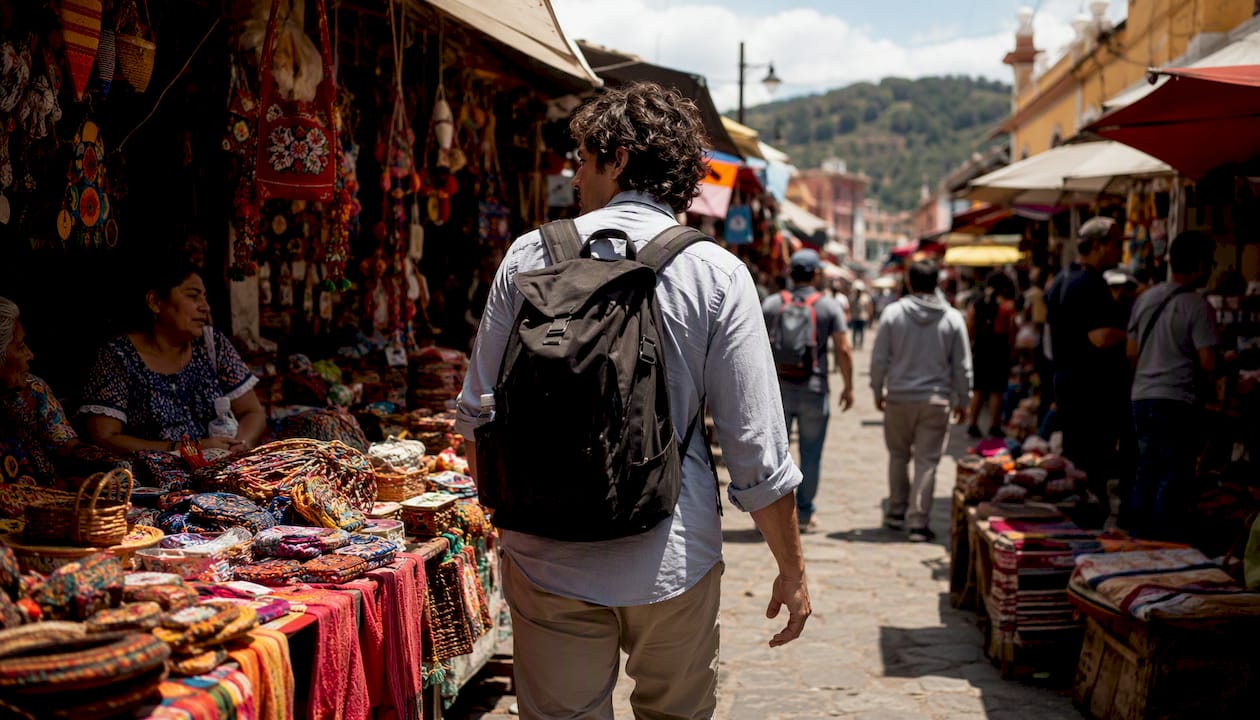
Walking and public transit are not just transport choices. They are observational tools. A bus ride exposes commuter patterns, informal social hierarchies, and the city’s actual geography in ways a taxi never does.
Pro Tip: Return to the same anchor at a different time of day on day two or three. School pick-ups, bakery lines, and commuter flows that repeat reveal how the city actually operates, which is the closest thing to a local’s mental map you can build quickly.
How to plan your timeline and budget
A few days are typically needed to notice a city’s rhythm; shorter stays provide impressions, while longer visits deepen understanding.
Template | Anchor activities | Curated experience | Free observation |
— | 1 anchor café, 1 market walk | 1 guided walk or food tour of a few hours | 1–2 hrs transit ride + neighborhood walk |
Several days | Multiple anchors, daily visits | A combination of workshops and private tours | Unstructured observation time |
One week or more | Multiple anchors across neighborhoods | Multiple immersive experiences | Extensive time in residential areas |
Curated immersive experiences generally range from affordable group tours to more exclusive private options with varying costs depending on city and format.
Reserve curated experiences at least 48–72 hours in advance, especially for small-group formats that cap at six to eight people. Leave mornings partially open for anchor visits. Pack a reusable bag (markets), a transit card or cash for buses, and a notebook for pattern recording.
How do you choose a reputable immersive experience?
Not every experience labeled “local” delivers genuine access. Here’s what to look for:
Host provenance: Does the guide actually live or work in the neighborhood? Local knowledge is specific, not generic.
Small group size: Eight or fewer is the threshold where real conversation becomes possible.
Agenda transparency: A good operator tells you exactly where you’ll go and what you’ll do, including the meeting point with a photo.
Real places, not staged settings: The experience should take you to venues locals use, not replicas built for tourists.
Community benefit: Does the experience support local artisans, vendors, or venues directly?
Questions worth asking before booking: What will we actually do? Who are the hosts and what’s their connection to this neighborhood? Where exactly do we meet and go? What’s the refund policy?
Red flags include vague meeting points (“near the main square”), groups larger than fifteen, scripted performances marketed as “authentic,” and no clear cancellation or health policy. Traveling with local hosts is one of the clearest trust signals an operator can offer.
How city games make immersion feel effortless
An exploratory study from Uppsala University found that participant motivation significantly predicted learning outcomes in city-based educational games, while broad measures of engagement did not. For travelers, this means the design of a city game matters more than its novelty.
City games differ from scavenger hunts in one key way: the tasks are anchored to real places and real social contexts, not just physical coordinates. A well-designed city game asks you to observe a vendor’s morning setup, decode a neighborhood’s architectural logic, or navigate using only transit signage. The cognitive challenge is situated, which means the learning sticks.
To choose or design one: start with a clear goal (understand one neighborhood’s history, find three examples of a specific craft tradition), add a constraint that forces you off the obvious path (no maps for thirty minutes, only ask locals for directions), build in at least one moment of genuine human contact, and use local cues, street art, market stalls, transit stops, as your checkpoints rather than tourist landmarks.
Immersive experiences by traveler type
Solo travelers benefit most from experiences that create low-stakes social entry. A small-group cooking class or a shared workshop puts you in a room with strangers around a common task, which removes the pressure of initiating conversation cold. The shared focus does the social work for you.
Families with children find that hands-on formats, pottery, bread-making, neighborhood scavenger games, hold attention across age groups while delivering genuine cultural content. The physical engagement keeps younger travelers present rather than restless.
Groups traveling together, whether friends, colleagues, or celebration parties, often get the most from private formats. A private guided walk or a bar-hopping route designed around the group’s interests lets the experience move at the group’s pace, with conversation woven in rather than interrupted by a fixed script.
How to connect with local communities authentically
Authentic integration takes patience, but practical immersion steps are more accessible than most travelers expect. Learning five to ten phrases in the local language, even imperfectly, signals respect and opens doors that English alone keeps closed. Staying in residential neighborhoods rather than hotel districts puts you inside daily life from the moment you wake up.
Volunteering for a morning with a local organization, a community garden, a food bank, a neighborhood cleanup, offers structured contact with residents around a shared purpose. Local events, neighborhood festivals, open-air markets, amateur sports matches, are low-pressure entry points where your presence as an interested outsider is welcome rather than intrusive. Joining a running club or a language exchange meetup via local social tags can embed you in a routine within a single visit.
The goal is not to pass as a local. It’s to show up with curiosity and respect, which locals in almost every city recognize and respond to warmly.
How to find neighborhoods that feel genuinely lived-in
The clearest signal of a residential neighborhood is its service-to-souvenir ratio. Streets lined with laundromats, hardware stores, small grocers, and neighborhood pharmacies are functioning communities. Streets dominated by souvenir shops and restaurant menus in six languages are tourist infrastructure, not city life.
Ask your host or a local contact which neighborhood they actually live in, then spend a morning there with no agenda. Walk slowly. Note what’s open at 7 AM versus noon. Look for the bakery with a line of people who clearly know each other. These are the textures that don’t appear on any map.
Off-the-beaten-path doesn’t always mean remote. In Milan, it might be a courtyard two blocks from the Duomo that no tour bus stops at. In Barcelona, it’s the market that residents use rather than the one that appears in every travel guide. The difference is almost always foot traffic and noise level.
Balancing immersion with safety and comfort
Immersion does not require discomfort. The goal is genuine engagement, not endurance. A few practical calibrations keep the experience both rich and safe.
Stay oriented by learning one or two transit lines well rather than trying to navigate the whole system. Share your daily anchor locations with someone at home. In unfamiliar neighborhoods, trust your instincts about timing: early evenings in residential areas are generally safe and lively; late nights in areas you don’t know warrant more caution.
Dietary and accessibility needs are worth communicating directly to any curated experience operator before booking. Good operators accommodate them without drama. If a neighborhood or experience feels off, stepping back is not a failure of immersion. It’s good judgment.
How to prepare before you arrive
The most useful mental shift is moving from “what will I see” to “how will I spend a morning.” That reframe changes your packing list, your research, and your expectations.
Practically: download an offline map and the local transit app before you land. Research one neighborhood in depth rather than skimming ten. Learn five phrases beyond “hello” and “thank you,” specifically how to order, how to ask for directions, and how to say you don’t understand. Pack a reusable bag, comfortable walking shoes, and a small notebook.
Culturally: read one novel or watch one film set in the city before you go. It primes your eye for details you’d otherwise miss. Arrive with the assumption that the city has a logic you haven’t learned yet, and that learning it is the point.
Our perspective: what immersion actually requires
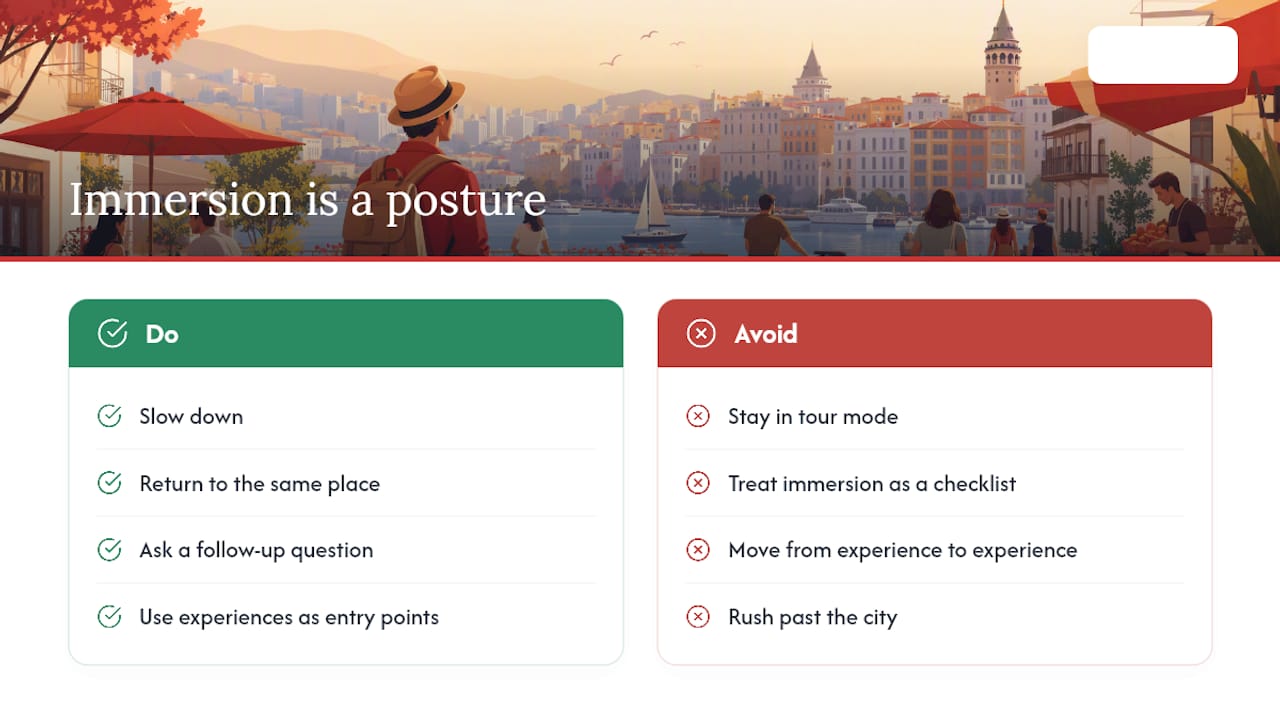
Most travel advice treats immersion as a checklist. It isn’t. It’s a posture.
The travelers we see get the most out of a city are not the ones who do the most activities. They’re the ones who return to the same place twice and notice what changed. They’re the ones who ask a vendor a follow-up question the next day. They’re the ones who let a curated experience be the beginning of a neighborhood relationship rather than its entirety.
We design Rbantours experiences around this principle. A street food tour is not just about eating. It’s about understanding which vendor has been there twenty years, which stall is a family operation, and what the market’s morning rhythm tells you about the neighborhood’s economy. The experience is the entry point. What you do with it afterward is the immersion.
The trap most travelers fall into is what some call “tour mode”: moving from experience to experience without letting any of them land. The remedy is simple but requires intention. Slow down. Return. Ask one more question. The city’s heartbeat is audible once you stop rushing past it.
Rbantours: guided immersion, designed around you
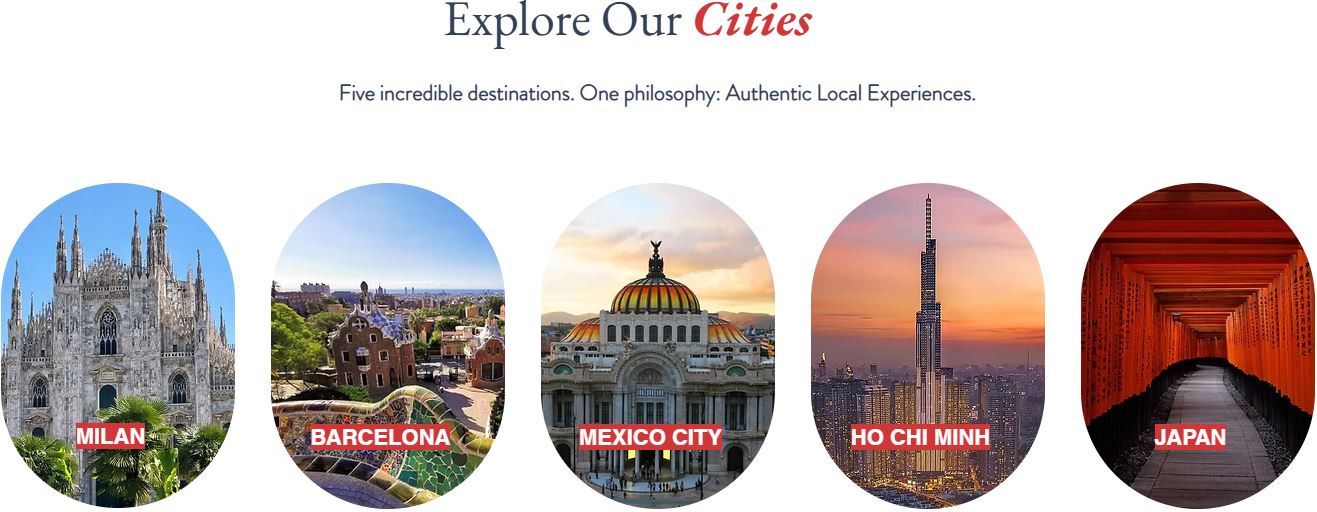
Rbantours designs small-group and private immersive city experiences across Milan, Barcelona, Mexico City, Ho Chi Minh City, and Japan, each built around local hosts, real neighborhoods, and the kind of access that independent travel rarely delivers.
[
Every experience is capped at a small group size to keep interaction genuine. You’ll know your meeting point, your host’s background, and your itinerary before you arrive. Concierge and custom options are available for groups, celebrations, and corporate events. Check walking and accessibility notes on each listing before booking.
Browse Barcelona experiences to see current availability, or book a walking and cultural tour directly to secure your spot.
Sources
City games research (exploratory study) - Uppsala University repository
Experience a City Like a Local in 2026 | A Simple Guide - CurratedBrief
Cultural Immersion in a Foreign City: A Deep Dive into Authentic Travel Experiences - Style is Women
The Role of Local Cuisine in Tourism: A Traveler’s Guide – Wild Foodz by Hotel Entree Brugge
Recommended
Comments