
Flexibility in Travel Experiences: Your 2026 Guide


Flexibility in travel experiences is the deliberate design of adaptable plans that combine essential bookings with open time for spontaneous, personalized exploration. The industry term for this approach is modular itinerary planning, and it is reshaping how travelers engage with destinations worldwide. 72% of dining choices and 65% of transport decisions are finalized after arrival, which proves that most travelers already live this way instinctively. The question is not whether to be flexible. It is how to build that flexibility with intention so your trip feels alive, not accidental.
What are the essential elements of a flexible travel itinerary?
A flexible itinerary is not a blank calendar. It is a structure with two distinct layers: fixed anchors and adaptable modules. Think of it like a building. Flights and accommodations are the load-bearing walls. You do not move them. Daily activities are the interior design. You rearrange them freely based on mood, weather, or a tip from a local at the café around the corner.
The most practical way to build this structure is to separate your commitments by how reversible they are:
Fixed anchors: Flights, intercity trains, and hotel reservations. Book these early and choose options with clear cancellation policies.
Soft commitments: Guided tours, restaurant reservations, and museum tickets. Book these with 24–48 hour cancellation windows wherever possible.
Open slots: Half-days or full days with no plan. These are not wasted time. They are where the best memories happen.
Backup activities: A short list of weather-proof or low-effort alternatives for when plans fall apart. A neighborhood market, a bookshop, a local coffee ritual.
Flexible fare bookings typically cost 10–15% more than standard fares. That premium is essentially travel insurance against changing preferences and disruptions. For most travelers, it is worth every dollar.
Pro Tip: Plan 60% fixed and 40% open time as your baseline ratio. This proven sweet spot prevents fatigue while leaving enough room for the city to surprise you.
The modular approach also makes group travel far less stressful. When one person wants to sleep in and another wants to hit the market at 8:00 AM, a flexible structure accommodates both without conflict. The itinerary bends. The trip does not break.
How can travelers manage spontaneity and unpredictability effectively?
Spontaneity is not the absence of planning. It is the result of planning well enough that you can afford to change your mind. The travelers who handle unpredictability best are the ones who have thought through their options in advance, even if they never use them.
Here is a practical framework for managing the unexpected:
Build a backup list. Before you leave, write down five low-commitment activities per destination. These are your contingency moves when a museum is closed, rain arrives, or you simply need a slower day.
Use multi-modal transport options. Knowing that you can take a bus, a metro, or a rideshare gives you real freedom. Locking yourself into a single transport method creates fragility.
Set a daily spending buffer. Separate your travel budget into core funds (accommodation, transport) and a variable fund for daily spending. Add a contingency line on top. Robust budgeting with separate core and variable funds reduces stress when the unexpected costs money.
Check real-time alerts. Flight delays, transit strikes, and weather shifts happen. Staying informed means you adapt early rather than scramble at the last minute.
Ask locals, not just apps. A hotel concierge, a market vendor, or a tour guide carries knowledge that no algorithm has indexed yet. Their recommendations often lead to the most memorable detours.
Disruption type | Recommended response | Time to adapt |
Weather change | Switch to backup indoor activity | Under 10 minutes |
Transport delay | Reroute via alternative mode | 15–30 minutes |
Venue closure | Pull from backup activity list | Under 5 minutes |
Budget overrun | Draw from contingency fund | Immediate |
Pro Tip: Consolidate all confirmations into one digital tool so every booking, address, and contact is one tap away. Searching through emails during a disruption adds stress you do not need.
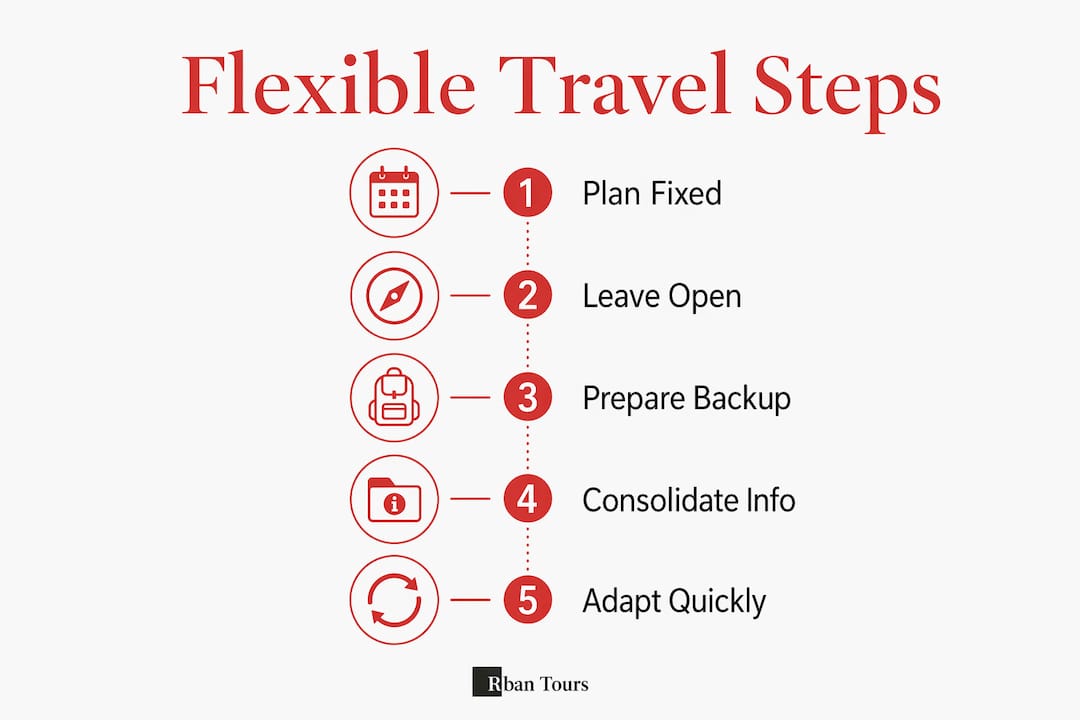
The goal is not to predict every problem. The goal is to reduce the cost of being wrong. When you have backups, buffers, and local contacts, a disruption becomes a detour rather than a disaster.
Why does flexibility lead to more authentic local engagement?
73% of travelers experience stress from overpacked itineraries, and 68% say their best memories come from unplanned moments. Those two numbers tell the same story. The tighter the schedule, the less room there is for the city to speak to you.
Authentic local engagement requires presence. Presence requires time. When every hour is accounted for, you move through a destination like a checklist rather than a curious person. You see the landmark. You do not feel the neighborhood.
“Flexibility is not a symptom of poor preparation. It is the point. Leaving white space in your itinerary is a deliberate act of attention. It signals that you are here to experience the place, not just document it.”
Younger travelers are adopting “no-itinerary” and slow travel approaches precisely because hyper-planning kills the quality of attention. Spending three hours in one neighborhood, eating where the locals eat, and wandering without a destination produces a different kind of memory than sprinting between five attractions in a day.
Practical ways to build authentic engagement into your adaptable travel options:
Cluster activities by neighborhood. Travelers who group activities geographically reduce transit fatigue and naturally create time for unplanned exploration between stops.
Leave mornings open. Mornings reveal the real rhythm of a city. Markets, bakeries, and commuters tell you more about a place than any guided tour.
Follow a local recommendation at least once per day. Ask your guide, your host, or the person next to you at the bar. One genuine tip per day changes the texture of a trip.
Resist the urge to photograph everything. Some moments are better absorbed than archived. Putting the phone down is its own form of flexibility.
Rbantours designs every experience around this philosophy. Local experiences create deeper memories precisely because they are built on human connection, not a fixed script. When you travel with people who know a city’s pulse, you stop being a tourist and start being a guest.
What modern tools support flexible travel planning?
The right tools do not make your trip rigid. They make your flexibility manageable. The difference between a stressful trip and a free one often comes down to how well your information is organized.

Digital itinerary management tools like TripIt unify bookings, push real-time alerts, and reduce the mental load of managing customized travel plans across multiple platforms. Google My Maps lets you build visual, neighborhood-clustered maps you can share and edit on the go. Both tools work best when you feed them your fixed anchors and leave the rest of the day blank.
49% of travelers now use AI tools to discover destinations and tailor trips. AI is particularly useful for generating backup activity lists, researching opening hours, and identifying neighborhoods worth exploring on foot. It is a research assistant, not a replacement for local knowledge.
Useful tools by function:
Itinerary management: TripIt, Google Travel. Both consolidate confirmations and send disruption alerts automatically.
Mapping and clustering: Google My Maps. Build neighborhood-based visual itineraries you can share with travel companions.
AI research: ChatGPT, Perplexity. Use these to generate backup activity lists and research local customs before arrival.
Budgeting: Trail Wallet, TravelSpend. Separate your core and variable funds digitally so you always know your contingency balance.
For travelers who want a genuinely personalized experience without the planning burnout, curated local experiences fill the gap. Rbantours builds personalized, immersive journeys that give you structure where you need it and freedom where it matters. For adventurous travelers who want to add a spontaneous, adrenaline-driven activity to their flexible itinerary, options like hang gliding in Maui show how a single unplanned experience can define an entire trip.
Over 50% of travelers in 2026 plan to increase spending on flexible, personalized experiences like road trips and curated local activities. That shift reflects a broader truth: travelers are no longer buying destinations. They are buying the quality of their own attention.
Key Takeaways
Flexible travel works best when you treat your itinerary as an adaptive framework, not a fixed schedule, anchored by essential bookings and open to spontaneous local discovery.
Point | Details |
Use the 60/40 rule | Plan 60% of your time as fixed and leave 40% open for spontaneous exploration. |
Separate your budget | Keep core, variable, and contingency funds distinct to handle unexpected costs without stress. |
Cluster by neighborhood | Group activities geographically to cut transit time and create natural white space for wandering. |
Build a backup list | Prepare five low-commitment alternatives per destination before you arrive. |
Use tools to organize, not control | Apps like TripIt and Google My Maps manage your fixed anchors so your open time stays truly free. |
Flexibility is a skill, not a personality type
We have watched travelers arrive in Barcelona with color-coded spreadsheets and leave feeling like they missed the city entirely. We have also watched travelers arrive with nothing booked past their first night and spend three days in one neighborhood eating the same tapas, talking to the same people, and loving every moment of it. The difference was not luck. It was intention.
Flexibility in travel is not about being disorganized. It is about knowing which decisions matter and which ones you can make later. Flights matter. The afternoon on Tuesday does not. When you protect your anchors and release your grip on everything else, the city has room to show you something real.
The travelers who come back most energized are rarely the ones who saw the most. They are the ones who were present for what they did see. That presence comes from white space. It comes from a morning with no plan, a wrong turn that led somewhere better, a conversation that lasted longer than expected. Those are not accidents. They are the product of a well-designed flexible itinerary.
We also believe that flexibility pairs best with local knowledge. A great local guide does not just show you places. They read the day with you and adjust. That is exploring cities like a local at its best: a shared, adaptive experience that no rigid tour can replicate.
— Rban
How Rbantours brings flexibility to life in every destination
At Rbantours, we build experiences that fit inside your flexible itinerary without filling it up. Our tours in Barcelona, Japan, and Mexico City are designed to be modular, bookable with generous cancellation windows, and led by local guides who adapt the experience to the energy of the day.
[

Whether you want a vintage shopping tour through Barcelona’s hidden neighborhoods, a street food walk through Mexico City’s markets, or a creative workshop that connects you with local artists, each experience leaves room for the unexpected. We do not hand you a script. We hand you a key to the city and walk alongside you. Browse our full range of curated local experiences and find the ones that fit the open spaces in your itinerary.
FAQ
What is flexibility in travel experiences?
Flexibility in travel experiences is the practice of combining essential pre-booked elements like flights and accommodation with open, adaptable time for spontaneous activities and local exploration. The goal is a trip that responds to real conditions rather than a fixed schedule.
How much of my itinerary should I leave unplanned?
The proven sweet spot is 60% fixed and 40% open time. This ratio prevents fatigue while creating enough white space for unplanned discoveries and authentic local engagement.
Do flexible bookings cost more?
Flexible fare bookings typically cost 10–15% more than standard options. That premium provides protection against disruptions and changing preferences, making it a worthwhile investment for most travelers.
How do I stay organized while traveling flexibly?
Use a digital itinerary tool like TripIt or Google Travel to consolidate all confirmations in one place. Real-time alerts from these platforms let you adapt quickly without scrambling through emails during a disruption.
Why do unplanned moments create the best travel memories?
68% of travelers say their best memories come from unplanned moments. Spontaneous experiences tend to involve genuine human connection and presence, which are the conditions that make memories stick.
Recommended
Comments