
How to Design Your Own Barcelona Itinerary

The most effective way to design your own Barcelona itinerary is to anchor it around a 3 to 5-day framework, lock in timed-entry tickets for the big Gaudí landmarks early, and then build breathing room around those fixed points. Everything else, the wandering, the wine bars, the unexpected conversations, fills itself in.
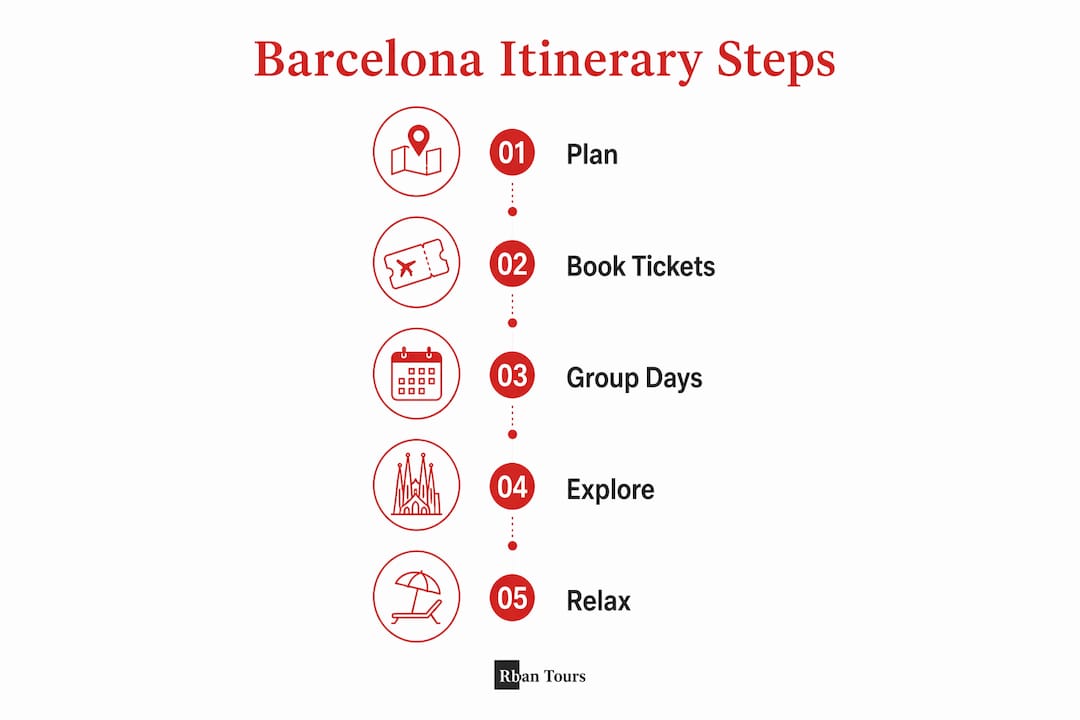
Barcelona rewards the traveler who comes prepared but stays curious. Here is how to start:
Decide your trip length. Three days covers the headline sights. Four or five days lets you absorb neighborhoods, eat slowly, and feel the city’s rhythm rather than just photograph it.
Identify your non-negotiables. La Sagrada Família, Park Güell, Casa Batlló, Casa Milà, the Gothic Quarter, El Born, Las Ramblas, and Barceloneta Beach are the anchors most travelers build around.
Book timed-entry tickets first. La Sagrada Família and Park Güell sell out weeks ahead, especially in peak season. Secure those before you plan anything else.
Map your days by neighborhood. Group sights that sit close together to cut transit time and leave energy for the unexpected.
Mix indoor and outdoor activities. This protects you from weather surprises and keeps the daily pace from feeling relentless.
Leave at least one evening completely unplanned. That is where Barcelona actually lives.
Adapt to your interests. An architecture lover’s itinerary looks nothing like a food lover’s, and both are right.
Pacing is everything. A day that tries to hit La Sagrada Família, Park Güell, Casa Batlló, and Barceloneta Beach will leave you exhausted and underwhelmed by all of them. We will show you how to sequence it so each place gets the attention it deserves.
What does a great 4-day Barcelona itinerary actually look like?
A well-built four-day plan gives you the cultural and architectural heart of the city without burning out by day three. Think of it as two landmark days, one coastal day, and one neighborhood day, each with its own energy and pace.
Day 1: Gothic Quarter, El Born, and Las Ramblas
Start in the oldest part of the city, where the streets are narrow, the stones are ancient, and the atmosphere is genuinely cinematic. The Gothic Quarter rewards slow walking. Plaça Reial, the Roman Temple of Augustus, and the Barcelona Cathedral are all within a short walk of each other.
Morning (9:00–12:00): Walk the Gothic Quarter. Start at Plaça de Catalunya and move south through the medieval lanes. Allow at least two hours.
Midday (12:00–14:00): Cross into El Born. This neighborhood has a different energy: creative, slightly bohemian, full of independent boutiques and excellent coffee. The Basílica de Santa Maria del Mar is one of the most beautiful Gothic churches in Europe and rarely as crowded as the Cathedral.
Afternoon (14:00–17:00): Lunch in El Born, then walk Las Ramblas once. It is worth experiencing, but do not linger. The real Barcelona is on the side streets.
Evening: Dinner back in El Born or the Gothic Quarter. Local restaurants here serve until 10:00 PM or later, which is perfectly normal by Spanish standards.
Pro Tip: Pickpockets are active on Las Ramblas and the metro. Keep your phone in a front pocket and your bag zipped and in front of you. This is not alarmist; it is just the reality of one of Europe’s most visited streets.
Day 2: Gaudí day
This is the day most travelers remember longest. The key is sequencing it so you are not rushing between sites or arriving at the wrong time.
Morning (8:00–11:00): Park Güell first, at opening. The Monumental Zone requires a pre-booked timed ticket, and early arrivals get the terraces before the crowds arrive. Walk down through the Gràcia neighborhood afterward.
Midday (11:00–14:00): Lunch in Gràcia. This village-within-a-city has some of the most authentic and affordable restaurants in Barcelona.
Afternoon (14:00–17:00): La Sagrada Família. Allow a minimum of two hours inside. The nave, the towers, and the stained glass on the Nativity façade are genuinely unlike anything else in the world.
Evening: Walk Passeig de Gràcia to see Casa Batlló and Casa Milà (also called La Pedrera) from the outside. Both offer ticketed evening experiences if you want to go inside after dark, which is a genuinely different and memorable way to experience them.
Day 3: Barceloneta Beach and Montjuïc
A day that moves from the coast to the hills gives you two completely different sides of the city.
Morning (8:30–11:00): Barceloneta Beach early, before the crowds arrive. The neighborhood itself, with its narrow grid of streets and great tapas spots, is worth exploring on foot. If you want a quieter stretch of sand, quieter beaches lie further down the coast past Port Olímpic.
Midday: Seafood lunch near the waterfront. Fideuà, a noodle-based paella, is the local specialty here.
Afternoon (14:30–18:00): Take the funicular up to Montjuïc. The Fundació Joan Miró is one of the best modern art museums in Spain and usually uncrowded compared to the Gaudí sites. The views from the castle at the top are worth the extra walk.
Evening: Head back to Sant Antoni or Eixample for dinner. Bar Calders in Sant Antoni is a local institution for pre-dinner vermut.
Day 4: Neighborhood deep dive
The fourth day is where your itinerary becomes truly yours. Two neighborhoods that reward exploration are Gràcia and Poblenou.
Gràcia feels like a Catalan village absorbed by the city. Its plazas fill with locals in the evening, and the restaurant scene is excellent without being tourist-facing.
Poblenou is Barcelona’s former industrial district, now home to design studios and local brunch spots along Rambla del Poblenou. It shows you a side of the city that most first-time visitors never find.
Spend the morning wandering, have a long lunch, and leave the afternoon open. That is the whole plan, and it is often the day people enjoy most.
Where should you stay in Barcelona?
Your neighborhood choice shapes everything: how far you walk each morning, how much noise you sleep through, and how local your daily life feels. Each of Barcelona’s main areas has a distinct personality.
Gothic Quarter: Central, atmospheric, and convenient for first-timers. The trade-off is noise. Streets that feel magical at noon can feel relentless at 2:00 AM on a Friday.
Eixample: The best all-around base for most travelers. It sits between the Gothic Quarter and the Gaudí landmarks, the metro is everywhere, and the streets are quieter at night. Boutique hotels and apartment rentals are plentiful across a range of budgets.
El Born: Ideal for travelers who want creative energy, boutique shopping, and excellent restaurants within walking distance. Slightly less central but very well connected by metro.
Barceloneta: Works well for beach-focused summer trips. The atmosphere skews young and lively, which is either a feature or a drawback depending on your travel style.
Gràcia: The most local-feeling option. You will need the metro to reach most major sights, but the neighborhood itself is genuinely charming and far removed from tourist-facing Barcelona.
Practical lodging tips:
Book accommodation at least 6–8 weeks ahead for summer travel. Barcelona is one of Europe’s most visited cities, and good apartments in central neighborhoods disappear fast.
Proximity to a metro station matters more than proximity to any specific sight. The metro connects everything efficiently.
Apartments often make more sense than hotels for stays of four days or more, especially if you plan to cook breakfast or keep irregular hours.
Pairing your accommodation choice with your dining preferences adds real depth to the trip. A guide on combining lodging and gastronomy can help you think through that combination before you book.
What practical tips will actually improve your Barcelona trip?
Planning the sights is the easy part. The details that make or break a trip are usually the ones nobody mentions until you are already there.
Booking and timing:
Book La Sagrada Família and Park Güell 3–4 weeks in advance, more in July and August. These are timed-entry tickets, and they sell out.
Do not schedule timed-entry attractions on your arrival or departure days. A delayed flight or a slow customs line can cost you a non-refundable ticket.
Many museums close on Mondays. If you arrive on a Sunday night, plan your Monday around outdoor sights, neighborhoods, or the beach rather than museum visits.
Getting around:
The Barcelona metro runs from 5:00 AM to midnight on weekdays, with extended service on weekends. It is fast, clean, and covers every major sight.
A T-Casual card gives you 10 trips on the metro, buses, and trams. It is the most cost-effective way to get around for a multi-day visit.
Renting a car is strongly discouraged. Parking in the city center runs €20–36 per day, traffic is dense, and many streets in the Gothic Quarter are inaccessible by car entirely.
Eating like a local:
Spanish meal times run later than most Americans expect. Lunch is the main meal, typically from 2:00–4:00 PM. Dinner rarely starts before 9:00 PM.
The menú del día is a three-course lunch offered by most restaurants on weekdays, usually priced at €10–€14. It is the best value meal in the city and the way locals eat.
Avoid restaurants directly on Las Ramblas. The food is overpriced and the quality rarely matches. Side streets in Eixample or Gràcia consistently offer better food at lower prices. Understanding how local cuisine shapes a trip is part of what makes Barcelona so memorable.
Safety:
Pickpockets operate on Las Ramblas, the metro, and crowded tourist areas. Keep valuables in a front pocket, never leave your phone on a restaurant table, and stay aware in busy spots.
Barcelona is a safe city overall. The pickpocket risk is real but manageable with basic awareness.
Pro Tip: Schedule your two biggest Gaudí sites on the same day only if you book them with at least a two-hour gap between them. Back-to-back timed entries with no buffer leave no room for the experience to breathe, and both sites deserve your full attention.
How do you build real flexibility into your day-by-day plan?
The travelers who enjoy Barcelona most are not the ones with the tightest schedules. They are the ones who know which parts of their plan are fixed and which parts are open to whatever the city offers that day.
Keep one activity per half-day as your anchor, not your whole day. If La Sagrada Família is your afternoon anchor, leave the morning genuinely open. You will find something worth doing.
Swap days based on weather. Mixing indoor and outdoor days based on the forecast is one of the simplest and most effective planning moves you can make. Rain forecast? Move your beach day and slot in the Picasso Museum instead.
Use museum closure days strategically. Monday closures at many museums are not a problem if you plan outdoor or neighborhood days for Mondays from the start.
Build in a neighborhood deep dive. Half a day in Poblenou or Sant Antoni, with no agenda beyond walking and eating, often produces the most vivid memories of a trip.
Consider a city pass only if your schedule is attraction-heavy. If you plan to visit three or more paid sites per day, a Barcelona card can save money. If you prefer free neighborhoods and beach time, it probably will not pay off.
Protect at least one evening from planning. A street musician in a Gothic Quarter alley, a tiny wine bar with no sign on the door, a conversation with someone who insists you try the croquetas at a place you would never have found on your own. These are the moments that define a trip, and they only happen when you leave room for them.
Pro Tip: If you are traveling with others, agree on one or two non-negotiable sights per person before you arrive. Everything else becomes a group decision on the day, which keeps the itinerary flexible without anyone feeling like their priorities were ignored.
The best custom Barcelona travel itinerary is not the one that covers the most ground. It is the one that leaves you wanting to come back.
What do local experts say about designing a Barcelona itinerary?
The most consistent advice from people who know Barcelona deeply is also the hardest for first-time visitors to follow: do less, and do it better.
Local guides consistently point to a few logistics that most travel articles gloss over:
Avoid scheduling timed-entry attractions on arrival or departure days. A delayed flight or a slow customs line can cost you a non-refundable ticket. Book 3–4 weeks ahead and keep those days buffer-free.
Skip the car rental entirely. Public transit reaches every major sight, and driving in central Barcelona means navigating one-way streets, expensive parking, and traffic that will eat your sightseeing time.
Eat where locals eat. The best Catalan food is not on Las Ramblas. It is on the side streets of Eixample and Gràcia, where a three-course menú del día costs a fraction of what you would pay at a tourist-facing restaurant.
Go deeper into neighborhoods. Gràcia and Poblenou offer a texture that Las Ramblas and the Gaudí circuit simply cannot. Design studios, local brunch spots, plazas that fill with neighbors rather than tourists. These neighborhoods show you the city’s actual pulse.
Spread out the big attractions. Do not go from La Sagrada Família to Casa Batlló in the same afternoon. Each deserves its own mental space, and the transit between them is time you could spend sitting in a plaza with a coffee.
The best time to visit for comfortable sightseeing weather and fewer crowds is april through june or september through october, with temperatures typically in the 18–25°C range. Summer is vivid and energetic, but the heat and crowds are real factors worth planning around.
For travelers who want to go beyond the standard circuit, Rbantours offers unique Barcelona experiences that connect you with the city’s creative and cultural layers in ways a self-guided walk cannot replicate. From neighborhood food tours to creative workshops, these experiences are built around the same philosophy: live the city like an insider, not a spectator.
Ready to experience Barcelona your way?
[

Designing your own itinerary is the first step. Living it with local knowledge and creative energy is what makes it unforgettable. Rbantours crafts immersive, design-led experiences across Barcelona that go far beyond the standard tourist trail. Whether you want a walking cultural tour through the city’s most storied neighborhoods or a curated evening of bar hopping Barcelona with a local guide who knows where the real night begins, we build each experience around genuine connection and authentic discovery.
Explore the full range of Barcelona tours and find the experiences that match your pace, your curiosity, and your idea of a perfect day in this city.
Key Takeaways
A 3–5 day Barcelona itinerary works best when timed-entry tickets are booked 3–4 weeks in advance, days are grouped by neighborhood, and at least one evening is left completely unplanned.
Point | Details |
Ideal trip length | A 3 to 5-day visit comfortably covers Gaudí landmarks, historic quarters, and coastal areas without rushing. |
Book tickets early | La Sagrada Família and Park Güell require timed-entry tickets booked 3–4 weeks ahead, especially in peak season. |
Group sights by neighborhood | Clustering Day 2 around Gràcia, Park Güell, and La Sagrada Família cuts transit time and keeps energy high. |
Eat off the tourist path | A three-course menú del día on side streets in Eixample or Gràcia costs €10–€14 and delivers far better food than Las Ramblas. |
Leave room for spontaneity | Flexible itineraries with unplanned evening time consistently produce the most memorable Barcelona experiences. |
Recommended
Comments