
Find Milan's Murals by Neighborhood: 100 Free Walls, Maps, and Walks

Milan’s best street art lives in several neighborhoods including Ortica’s Or.Me murals, Isola’s shop-shutter galleries, Porta Ticinese and the Navigli riverside, Leoncavallo’s warehouse walls, and Lambrate’s rail-line canvases. Combine the city’s official free-walls map with a crowd-updated database like Street Art Cities, or skip the guesswork with a local guide. Just know these walls change constantly, with artwork often replaced over time.
TL;DR:
Most murals are located in neighborhoods like Ortica, Isola, Porta Ticinese, and Lambrate, which each have distinct characters and varying ages of street art.
Official and curated projects like Or.Me and Porta Romana Wallart involve community participation and deliberate storytelling, unlike organic graffiti from tagging culture.
Use multiple maps and resources, such as Street Art Cities and the municipal free-walls map, to avoid missing murals that are frequently painted over or replaced.
Best times for photos are in the early morning or late afternoon, with evening visits safe in well-lit areas like the Navigli district.
Guided tours from Rban Tours provide context and local insights, making the viewing experience more meaningful than just following maps alone.
Table of Contents
Where to See Street Art Milan Travelers Actually Want to Find
Milan doesn’t hide its murals in one gallery district. The city’s street art scene spreads across at least six distinct neighborhoods, each with its own character, history, and reason to visit. Here’s the neighborhood breakdown that turns a scattered scavenger hunt into an actual walking route.
Leoncavallo carries the roughest edge of Milan’s scene. This is the neighborhood tied to the city’s centri sociali, the self-managed social spaces that fed decades of underground creative energy. Large-format pieces cover warehouse walls and side streets here, often layered with political messaging. Go during daylight, stick to main routes, and treat it as a cultural site rather than a photo backdrop. It rewards visitors who understand the history behind the paint.
Ortica, home to the Or.Me project, is Milan’s most organized and rewarding street art district. Entire building facades tell stories about local memory, and the murals are dense enough to fill a two-hour walk on their own.
Isola feels like an open-air gallery threaded through daily life. Shop shutters double as canvases, and collaborative pieces cluster around Piazzale Archinto. Look for artist signatures tucked into corners. Many pieces here rotate as new tenants take over storefronts, so what you see is genuinely current.
Porta Ticinese and the Navigli canal pair street art with Milan’s café culture. The Colonne di San Lorenzo draws crowds for architecture, but the surrounding streets, including Via dell’Ironia, hide smaller pieces worth a slow walk. Riverside murals along the canal itself shift with the seasons as the city manages flood barriers and construction.
Porta Romana is quieter but worth the detour. The Wallart project near Piazza Cardinal Ferrari includes hospital-commissioned pieces, a reminder that Milan treats murals as civic tools, not just decoration.
Lambrate holds one of the city’s most historically important works: Blu’s mural at Piazza Monte Titano, painted along the neighborhood’s railway tradition. Blu’s pieces here predate much of Milan’s current mural boom and set the visual language that later artists built on.
A few quick stops round out a longer trip:
NoLo (North of Loreto), a fast-gentrifying zone where new murals appear almost monthly.
Tortona, better known for design fairs but scattered with smaller pieces near its converted industrial buildings.
Or.Me, City Commissions, and the Artists Behind Milan’s Walls
Or.Me, short for Ortica Memoria, is the clearest example of what makes Milan’s mural culture different from typical urban art in Milan elsewhere. Instead of scattered individual pieces, Or.Me is a curated open-air museum built with residents, not just for them. Themes run through the district: memory, labor, women’s history, resistance. Local cultural bodies, including the city’s Ufficio Arte Pubblica, worked directly with artists to shape what got painted and where, which gives the murals a civic weight that unsanctioned graffiti simply doesn’t carry.
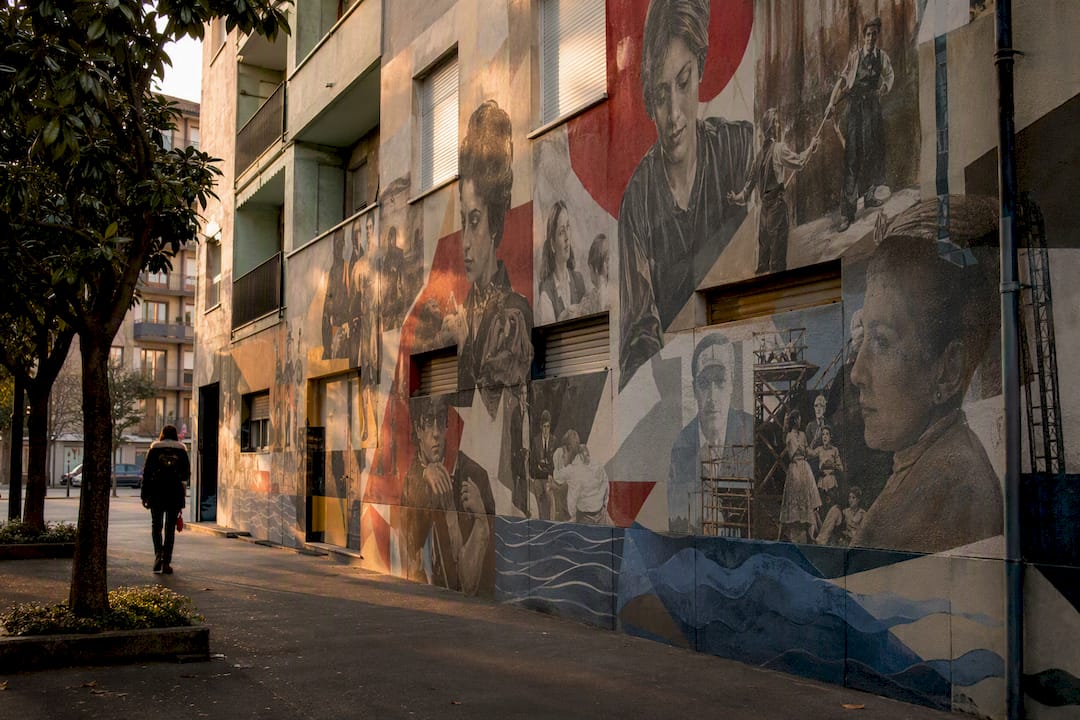
That distinction matters when you’re planning a route. Commissioned projects like Or.Me and the Porta Romana Wallart initiative reflect deliberate storytelling, chosen by neighborhood councils and cultural offices to represent local identity. Unsanctioned graffiti, by contrast, grows organically from Milan’s long history of tagging and centri sociali culture, a foundation that shaped the visual style even commissioned muralists now use.
A handful of names come up again and again once you start exploring:
Blu, whose Lambrate mural predates much of the city’s current scene and remains a reference point for scale and technique.
Ozmo, known for blending classical composition with street-level themes.
Alice Pasquini, whose figurative work often appears in Isola and NoLo.
Peeta, recognized for three-dimensional letter forms that play with perspective.
NemO’s, whose surreal, often unsettling imagery shows up on larger commissioned walls.
Millo, whose oversized child-figure characters have become some of the most photographed pieces in the city.
Or.Me features many large-scale murals across the Ortica district, making it one of the densest concentrations of curated street art in Milan. Knowing which pieces are commissioned and which are pure street expression helps you read the walls the way locals do, as layered history rather than random decoration.
Best Maps and Databases for Planning a Street Art Route
Three resources cover most of what you need, and each has real strengths and real gaps.
Street Art Cities indexes hundreds of mapped artworks in Milan with a searchable, crowd-updated interface. It’s strongest for recent additions but occasionally lags behind fast-moving neighborhoods like NoLo.
Street Art Map Me functions similarly, letting users flag new pieces as they appear, useful for cross-checking Street Art Cities against a second source.
Comune di Milano’s free walls map is the official record. The city designates around 100 “free walls” where artists can paint without prior authorization or fees, and the administration marks these locations on a georeferenced map, removing only offensive content. This is a living policy, not a static list, so the canvas keeps shifting.
Independent projects, like the Milan street art map from Dror Hadadi, compile detailed archives but openly note that coverage is partial and pieces disappear fast.
Cross-check at least two sources before setting out, and save an offline copy of your route. Free-wall status means murals get painted over constantly, so a piece mapped in January may already be gone by summer.
How to Explore Milan’s Murals Like You Live There
Morning and late afternoon light works best for photographing shop shutters and building facades, especially in Isola where reflective surfaces catch harsh midday sun badly. Navigli comes alive in the evening, but stick to well-lit main paths if you’re walking solo after dark.
A short checklist keeps your visit respectful and efficient:
Ask before photographing private shutters that double as someone’s storefront.
Treat commissioned murals like Or.Me as cultural sites, not just backdrops. Give them the same attention you’d give a gallery piece.
Avoid blocking entrances or lingering directly in front of active businesses.
In industrial zones like Lambrate and Leoncavallo, watch for vehicle and rail traffic that locals navigate automatically but visitors often miss.
Photograph what you find immediately. Insiders treat these maps as guides, not guarantees, since works get painted over without warning.
Pro Tip: Tag the artist’s name in your caption if you can identify it from a nearby signature. Milan’s mural community tracks attribution closely, and it’s a small courtesy that muralists genuinely notice.
Pairing a street-art walk with a stop for lunch works well logistically, and it fits perfectly with designing local experiences that blend culture and gastronomy like those described in Defining Culinary Experiences: a Traveler’s Guide. NoLo and Isola both sit near strong food streets, and a street food detour breaks up a long day of walking without losing momentum.
Why We Think Context Changes How You See These Walls
Rban Tours has spent years building experiences around one idea: cities reveal themselves through people, not checklists. Milan’s street art rewards that approach more than most sights in the city. A mural in Ortica reads completely differently once you know it was co-designed with the residents who live behind it. Our Milan tours lean on local hosts who carry that context, the kind that no map pin can convey, so a walk becomes a conversation about the neighborhood’s actual history instead of a hunt for photo spots.
— Rban
Book a Curated Street Art Walk With Rban Tours
Maps get you to the murals. A local host gets you the stories behind them, which artist collective painted which wall, why the city chose Ortica for its memory project, which corners in Isola are worth the extra five minutes. That’s the gap Rban Tours fills for travelers who want more than a self-guided checklist.
[
Our Walking & Cultural Tour moves through Milan’s street art neighborhoods in small groups, led by hosts who know which pieces are new, which are historic, and which back alleys reward a detour. It suits travelers who want context without the planning, easy navigation without staring at a phone map, and a social, low-pressure way to see the city alongside a handful of other curious visitors. Private and custom routes are available if you’d rather build the walk around your own interests, whether that’s a deep dive into Ortica or a broader mix across neighborhoods. Check available dates and book directly through the tour page to lock in your spot.
Sources
FAQ
What Is the Most Famous Street for Art in Milan?
There’s no single famous street, but Via Padova near NoLo and the Ortica district around the Or.Me project draw the most consistent attention from visitors seeking murals.
What Is the Most Artsy Neighborhood in Milan?
Isola holds that reputation for its dense mix of shop-shutter art, collaborative murals, and creative studios woven into daily street life.
Why Is There So Much Graffiti in Milan?
Milan’s graffiti culture grew out of the centri sociali movement and decades of tagging, and the city later formalized that energy by designating around 100 free walls where artists can paint legally without fees.
What Is the Coolest Neighborhood in Milan for Street Art?
Ortica edges out the competition thanks to Or.Me, a curated open-air museum of murals built with residents around themes of memory and local identity.
How Do I Avoid Missing Murals That Get Painted Over?
Cross-check at least two map sources, like Street Art Cities and the municipal free-walls map, since Milan’s free-wall status means pieces change constantly and no single database stays fully current.
Recommended
Comments