
3.5–5 Hour Street Food Route in Ho Chi Minh for Italian Travelers

Start with bánh mì, gỏi cuốn, hủ tiếu, bún thịt nướng, bánh xèo, and a plate of grilled ốc (snails), and you have covered the backbone of Ho Chi Minh City’s street food. Head first to Vĩnh Khánh Street in District 4 for seafood and snails, Nguyễn Thượng Hiền in District 3 for more snail stalls, and the Ben Nghe Street Food Market near District 1 if you want everything under one roof. Most dishes run between fifteen thousand and sixty thousand VND, and a full, satisfying meal rarely tops one hundred thousand VND.
TL;DR:
Most street food dishes cost between 15,000 and 60,000 VND, with full meals typically staying below 100,000 VND, offering high value compared to sit-down restaurants.
Vĩnh Khánh Street in District 4 is the main hub for seafood and snail dishes, which are best enjoyed after 4 pm, with plates ordered in increments for freshness.
Bánh mì is best eaten before 10 am, while bánh xèo and bún thịt nướng are ideal for lunch or early dinner, aligning with their traditional timing.
District 1’s Ben Nghe Street Food Market provides a convenient, varied introduction to Vietnamese street cuisine suitable for first-time visitors.
Booking a guided walk with a local expert enhances the experience by facilitating ordering, navigating language barriers, and offering insights into dishes’ cultural significance.
Table of Contents
Must-Try Street Food Dishes in Ho Chi Minh City
Ho Chi Minh City’s street food scene rewards travelers who know what to order and when. Some dishes belong to breakfast carts, others only appear once the sun goes down, and a few show up at every hour because Saigon never really stops eating.
Here is the essential lineup, with typical prices and the moment of day each one tastes best:
Bánh mì (25,000 to 35,000 VND): a crusty baguette stuffed with pork, pâté, pickled carrot, and herbs, best grabbed fresh from a morning cart before 10am.
Gỏi cuốn (15,000 to 20,000 VND per roll): translucent rice-paper rolls with shrimp, pork, and herbs, served cool, so they work any time but shine as a light midday snack.
Bánh xèo (30,000 to 50,000 VND): a crispy turmeric pancake folded around shrimp and bean sprouts, typically eaten for lunch or an early dinner while it is still hot off the pan.
Hủ tiếu (40,000 to 60,000 VND): a noodle soup with Chinese-Vietnamese roots, common at breakfast stalls across Cholon and District 5.
Bún thịt nướng: rice noodles topped with grilled pork, herbs, and a sweet fish-sauce dressing, a lunchtime favorite that also works as an early dinner.
Bún bò Huế: a spicier, beef-based noodle soup from central Vietnam, usually served for breakfast or lunch.
Bánh tráng nướng: often called Vietnamese pizza, a grilled rice-paper snack loaded with egg, dried shrimp, and scallion oil, mostly an evening or night-market treat.
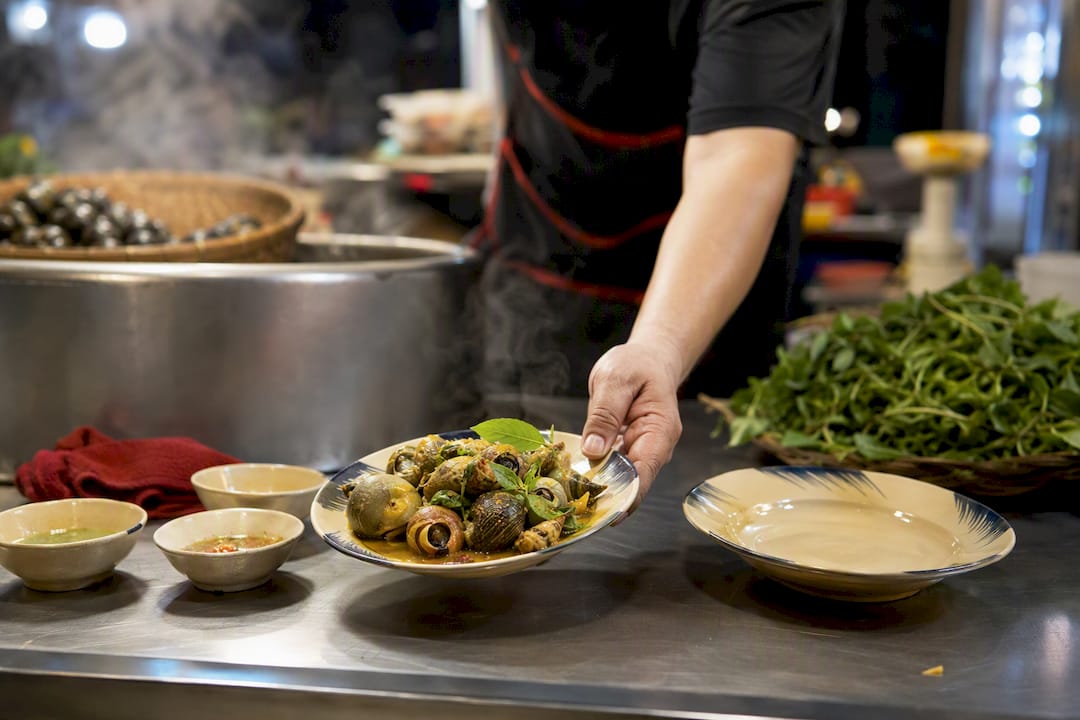
Ốc (snails and shellfish): grilled, steamed, or stir-fried in tamarind or garlic butter, almost exclusively an evening and late-night dish paired with cold beer.
If shellfish, egg, or peanuts are a concern, gỏi cuốn can usually be made without shrimp or peanut sauce on request, and bánh mì vendors will often swap pâté or egg for extra vegetables. Vegetarian versions of hủ tiếu and bún exist too, though they are less common on tourist-heavy streets and easier to find around local markets like Ho Thi Ky.
On average, a single street dish costs between 15,000 and 60,000 VND, and a full, filling meal eaten where locals eat typically lands between 50,000 and 100,000 VND — a fraction of what the same quality would cost in a sit-down restaurant, according to Nomado Travel’s Ho Chi Minh City street food guide.
Two stalls worth flagging by name: Bún Thịt Nướng Hoàng Văn has earned Michelin Plate recognition, and Phở Miến Gà Kỳ Đồng carries a Bib Gourmand nod, both proof that Michelin’s radar reaches well below white-tablecloth prices in this city, according to the Michelin Guide’s coverage of Bib Gourmand street-food spots.
Where To Eat Street Food in Ho Chi Minh City, Street by Street
Every district in Saigon has its own personality, and matching the neighborhood to the dish you want saves time and gets you better food.
District 4 (Vĩnh Khánh Street): the city’s seafood and snail engine room, loud, communal, and best reached from District 1 by a short Grab ride or a 15-minute walk across the canal.
District 3 (Nguyễn Thượng Hiền Street): another snail-focused strip, slightly calmer than Vĩnh Khánh, with plastic stools spilling onto the sidewalk from late afternoon onward.
District 1: home to the tourist-friendly Ben Nghe Street Food Market, roughly 30 stalls covering a wide spread of Vietnamese dishes in one walkable spot, ideal for a first taste without hunting through side streets, according to Tripadvisor’s listing for Ben Nghe Street Food.
District 5 / Cholon: the Chinese-Vietnamese quarter, the strongest early in the morning for hủ tiếu and dim-sum-style snacks before the heat sets in.
District 10 (Ho Thi Ky): a food street tucked behind a flower market, known for seafood barbecue, grilled squid, and bánh tráng nướng, and best visited in the evening when the grills are running full tilt, according to The Street Food Guy’s guide to Ho Thi Ky.
Streets like Vạn Kiếp and Phan Văn Hân round out the map for travelers who want to go further off the tourist track, according to Vietnam Coracle’s rundown of Saigon’s best street-food streets. District 4 and District 10 both peak in the evening, so arrive early if you want a table without a wait.
Ốc and Seafood Streets: How To Order and Eat Safely
Ốc culture is one of Saigon’s most distinct food scenes, and it deserves its own playbook. Vĩnh Khánh Street in District 4 is the heart of it, a strip of plastic tables, buckets of shells, and beer bottles that only really wakes up around 4 or 5pm and runs well past midnight, according to Vietnam Wayfarer’s guide to Saigon’s snail joints. Plates typically run modest prices depending on the shellfish and how it is prepared.
Ordering works best in three steps:
Point at the tank or bucket rather than trying to name every species. Most stalls keep live shellfish on display, and pointing is faster and more accurate than guessing translations.
Order to share. Ốc is a grazing food, so a table of four typically orders four or five different plates and passes them around, grilled snails alongside steamed clams or stir-fried mussels in tamarind sauce.
Pay in cash. Almost no ốc stall takes cards, and small notes make the transaction faster for everyone.
Freshness is easy to judge here: look for stalls with visibly full tanks and a steady churn of locals, since high turnover is the best sign the shellfish moved from tank to grill within hours. A nearly empty tank late in the evening is a signal to walk on.
Pro Tip: Order one plate at a time instead of everything at once. Ốc stalls cook to order, and a staggered order means each dish arrives hot instead of sitting on the table going cold.
When To Go: Timing Dishes Right and What a Meal Actually Costs
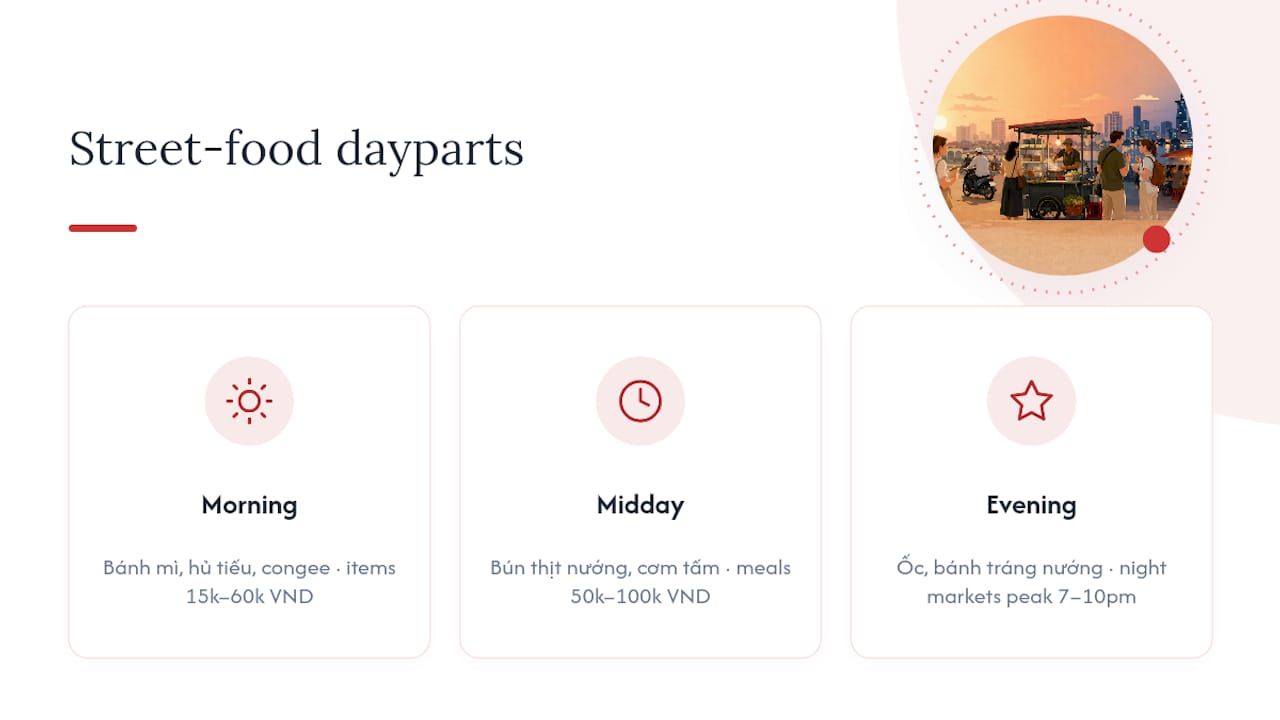
Street food in Ho Chi Minh City runs on a rhythm, and eating the right dish at the wrong hour is the easiest way to end up disappointed. Mornings belong to bánh mì carts, hủ tiếu stalls, and rice congee, most of it gone by mid-morning once the day’s batch sells out. Midday shifts toward bún thịt nướng and cơm tấm, the broken rice plate that fuels half the city through lunch. Evenings bring out ốc, bánh tráng nướng, and the night markets that only really come alive once the heat breaks.
A typical street-food item costs 15,000 to 60,000 VND, and a full meal at a local spot usually totals 50,000 to 100,000 VND, roughly half of what the same order costs in a tourist-facing area of District 1, based on Nomado Travel’s pricing data. Night markets and ốc streets hit their busiest stretch between 7pm and 10pm, which also happens to be when the food is freshest, since vendors are cooking through their evening stock rather than reheating leftovers from earlier in the day.
Eating Like a Local: Practical Tips for Italian Travelers
Bring small VND notes, not large bills, since most stalls cannot break a 500,000 VND note and card readers are rare outside malls. Pack wet wipes and hand sanitizer, since sit-down tables are informal and napkins are often thin paper squares at best.
Dietary needs travel better with gestures and a few keywords than with long explanations. Pointing at ingredients, shaking your head, and saying “Kong” (no) for what you want removed usually works better than a full sentence in English. Understanding a few dining courtesies before you sit down, similar to the etiquette guidance in Linda Mandarin’s overview of dining manners, helps you read the room at a shared plastic table.
Share tables freely; sitting next to strangers at a busy stall is normal, not rude.
Tipping is not expected at street stalls, though rounding up is always appreciated.
Leave when you are done rather than lingering, since tables turn over fast during peak hours.
Use Grab for longer hops between districts rather than flagging unmarked taxis, and confirm the fare in the app before you get in.
Pro Tip: Photograph the menu board or the dish itself before ordering. Showing the photo back to the vendor if there is any confusion is faster than trying to explain in words.
A Self-Guided Street Food Route in 3.5 to 5 Hours
Start in District 1 with a bánh mì breakfast or an afternoon bánh xèo, then Grab or walk toward District 3 for a round of grilled snails on Nguyễn Thượng Hiền, and finish the night in District 4’s Vĩnh Khánh strip for seafood and cold beer.
District 1, 4pm to 5:30pm: bánh mì or bánh xèo, plus a stop at Ben Nghe Street Food Market if you want variety in one place.
District 3, 5:30pm to 7pm: snails and shellfish on Nguyễn Thượng Hiền Street.
District 4, 7pm to 9:30pm: full ốc spread on Vĩnh Khánh Street to close the night.
Budget around 300,000 to 500,000 VND per person for the whole route, tours of this length are common practice according to Nomado Travel’s guide. If it rains, most stalls have plastic sheeting rigged up, so duck under and wait it out rather than canceling the plan.
Why a Guided Food Walk Still Beats Going It Alone
Wandering and following the crowd is genuinely the best way to find Saigon’s best food, and no list, including this one, replaces that instinct. But a curated walk adds something a solo traveler cannot easily replicate: a local host who reads a menu board in seconds, orders in Vietnamese without hesitation, and knows which alley stall is worth the detour tonight versus last month. That local connection is the difference between tasting a dish and understanding why it exists.
Self-guided works well for confident eaters with time to explore. A guided walk works better when language, timing, or simply wanting the story behind the food matters more than saving an hour.
— Rban
Book a Guided Street Food Walk With Rban Tours
A guided street-food experience can be a small-group walk led by a local host who navigates story-led stops, handles ordering in Vietnamese, and notes dietary needs before seating.
[
Compared to piecing together a route yourself, the guided version removes the guesswork of which stall is having a good night and which alley to trust. You skip the language barrier at the ốc counter, get faster seating during peak hours, and walk away with context on dishes you would otherwise just be eating blind. If you want the version of this guide that comes with a host instead of a map, check availability for the Walking & Cultural Tour and book your date directly online.
Sources
Sources used for pricing, neighborhood mapping, and Michelin recognitions include Nomado Travel, Vietnam Coracle, Vietnam Wayfarer, and the Michelin Guide. For planning an evening around Saigon’s markets, see Rban’s guide to Ho Chi Minh’s night markets.
FAQ
What Is the Best Street Food in Ho Chi Minh City?
Bánh mì, hủ tiếu, bún thịt nướng, bánh xèo, and grilled ốc are consistently ranked among the top dishes, with ốc concentrated in District 4’s Vĩnh Khánh Street.
What Are Five Popular Street Foods in Vietnam?
Bánh mì, gỏi cuốn, bánh xèo, hủ tiếu, and bún bò Huế cover the country’s most iconic dishes, all widely available across Ho Chi Minh City’s street stalls.
Which Vietnamese City Is Known for Its Street Food Tours?
Ho Chi Minh City is the country’s most active hub for street-food tours, with routes covering District 1, District 3, and District 4 typically running 3.5 to 5 hours. Rban Tours runs its own walking and cultural tour covering exactly this territory.
What Is the Most Popular Street Food in Italy?
Italy’s street-food scene centers on regional staples like arancini in Sicily, porchetta sandwiches in central Italy, and piadina in Emilia-Romagna, each tied to a specific region rather than one national dish.
How Much Does a Street Food Meal Cost in Ho Chi Minh City?
Individual dishes typically cost 15,000 to 60,000 VND, and a full meal at a local stall usually totals 50,000 to 100,000 VND, roughly half the price of the same order in a tourist-heavy area.
Recommended
Comments