
Responsible Travel: A Guide for Design-Led City Explorers

Responsible travel is the set of choices a traveler makes to minimize harm and maximize benefit for the places and people they visit. The Cape Town Declaration (2002) established this as a shared framework, and the Global Sustainable Tourism Council (GSTC) has since built the industry certification standards around it. Before you book your next locally guided studio visit or artisan workshop, do one thing: check whether the operator publicly lists a sustainability action plan or names the local staff behind the experience.
Table of Contents
What does responsible travel really mean?
The Cape Town Declaration, drafted ahead of the 2002 World Summit on Sustainable Development, gave the travel world its clearest working definition: tourism must actively benefit both visitors and host communities, with every stakeholder taking ownership of that outcome. That framing still holds.
Here is where the language gets useful. Responsible travel describes what you do as a traveler. Sustainable tourism describes what the industry and its systems do. The GSTC sets the certification baseline for operators and accommodations; your job is to choose providers who meet it.
Five core principles to carry into every booking decision:
Stakeholder accountability — operators, guides, governments, and travelers each own a piece of the outcome.
Minimize negative impacts — economic, environmental, and social harm should shrink with every visit.
Maximize local benefit — spending should stay in the community, not leak to international chains.
Cultural respect — engage with local traditions as a guest, not a consumer.
Environmental stewardship — protect the ecosystems and urban fabric that make a destination worth visiting.
Transparency — operators should be able to show, not just claim, what they are doing.
Why responsible travel matters for places, people, and your experience
Keeping money local is the most direct lever a traveler has. When you book a locally owned guide, pay for an artisan workshop, or eat at a neighborhood restaurant, that spending circulates through the community rather than flowing to a multinational. Local artisans stay in business. Neighborhood creative spaces survive. The city’s pulse stays authentic.
For you, the payoff is equally real. Choosing locally owned guides and studio visits opens doors that no mass-market tour can replicate: the ceramicist who shows you her kiln, the vintage dealer who explains the neighborhood’s fashion history, the street-food vendor whose family has run the same stall for three generations.
Transportation accounts for at least 70% of a holiday’s total carbon emissions. Reducing travel distance and choosing overland routes is the single highest-impact decision most travelers can make.
One ethical dimension worth naming directly: travel privilege is real. Acknowledging it helps you make spending choices that support community-centered projects rather than experiences that exploit local labor or wildlife.
How to travel responsibly: a practical checklist
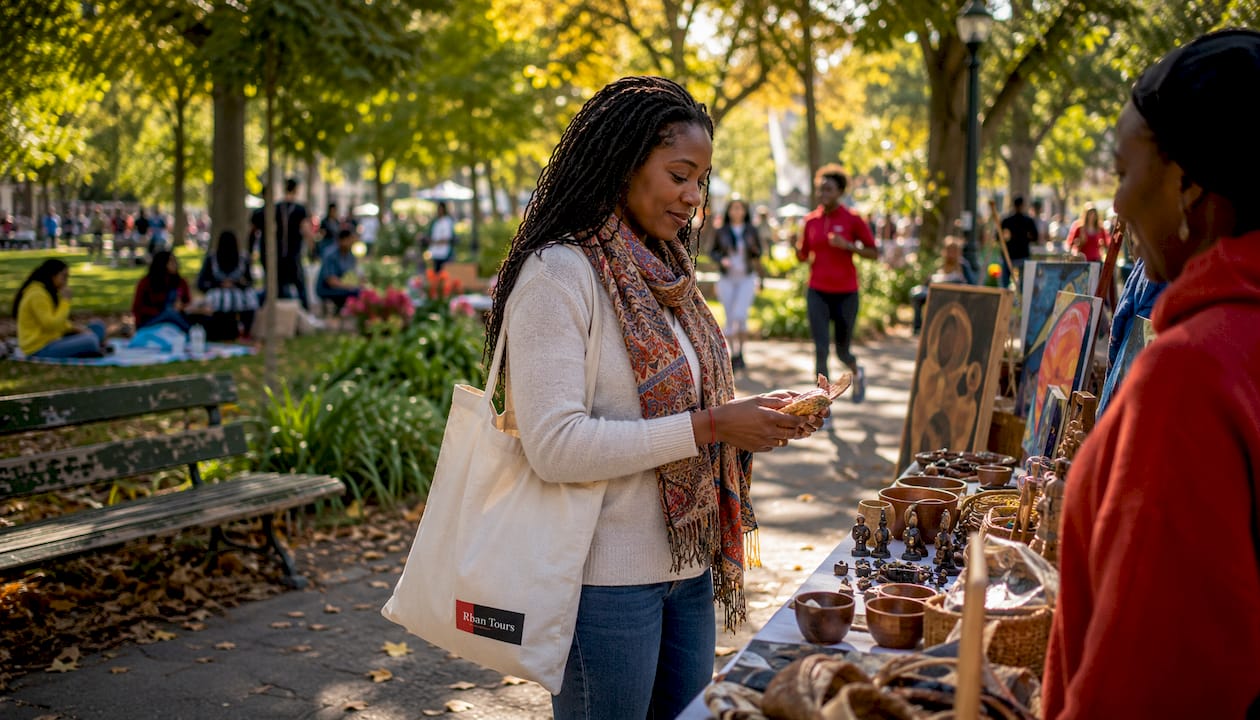
Shape the trip before you book anything else. The order of operations matters.
Before booking:
Choose destinations not suffering from overtourism in peak season; the same visitor can be a burden in one place and a lifeline in another.
Verify the operator lists local staff by name, a sustainability action plan, and transparent revenue flows.
Check for GSTC criteria or equivalent credible certification, not just a green logo.
Book a sustainable boutique hotel that discloses its sourcing and staffing practices.
Transport:
Go overland where practical. European rail averages about 33 gCO₂e per passenger-kilometer versus roughly 160 gCO₂e for flying.
When flying is unavoidable, apply the NERD rule: New aircraft, Economy class, Regular (non-stop) schedule, Direct flight.
Transport mode | Approx. gCO₂e per passenger-km |
Rail (Europe average) | ~33 |
Flying (Europe average) | ~160 |
On the ground:
Stay longer in fewer places rather than hopping between cities every two days.
Spend money at locally owned venues, markets, and studios.
Respect the rhythm of the neighborhood: off-peak hours, local etiquette, smaller footprint.
Spending:
Do | Don’t |
Book a studio visit with a fee that goes to the artist | Attend “cultural shows” with no visible local revenue share |
Pay for a local guide’s knowledge and time | Tip only in ways that bypass the local worker |
Buy directly from artisans at their workshop | Purchase mass-produced “local” crafts from airport chains |
Pro Tip: Allocate your limited budget to local knowledge first. A well-paid local guide or artisan workshop delivers more community benefit per dollar than any souvenir, and the experience itself is the memory you keep.
How do you evaluate tours, workshops, and accommodations?
Transparency is the first filter. A responsible operator can answer these questions without hesitation; one who cannot is waving a red flag.
Questions to paste into your booking message:
“Can you tell me the names or backgrounds of the local guides leading this experience?”
“Do you have a sustainability action plan or community benefit policy I can read?”
“What percentage of your staff are from the local community?”
“Where do you source food, materials, or props used in the experience?”
“Are you certified to GSTC criteria or a recognized equivalent?”
Red flags to watch for: vague claims like “eco-friendly” with no evidence, no local staff visible in photos or bios, tokenistic partnerships that name a charity but show no financial flow, and marketing copy that describes the community as a backdrop rather than a beneficiary. As WWF and other organizations note, there are hundreds of eco-labels in circulation and many are unverified. Credible verification means a named certifying body and public reporting.
The GSTC Tour Operator Standard requires operators to implement a responsible procurement policy that gives preference to local, fair-trade, and environmentally friendly products. That is a concrete bar to hold providers to.
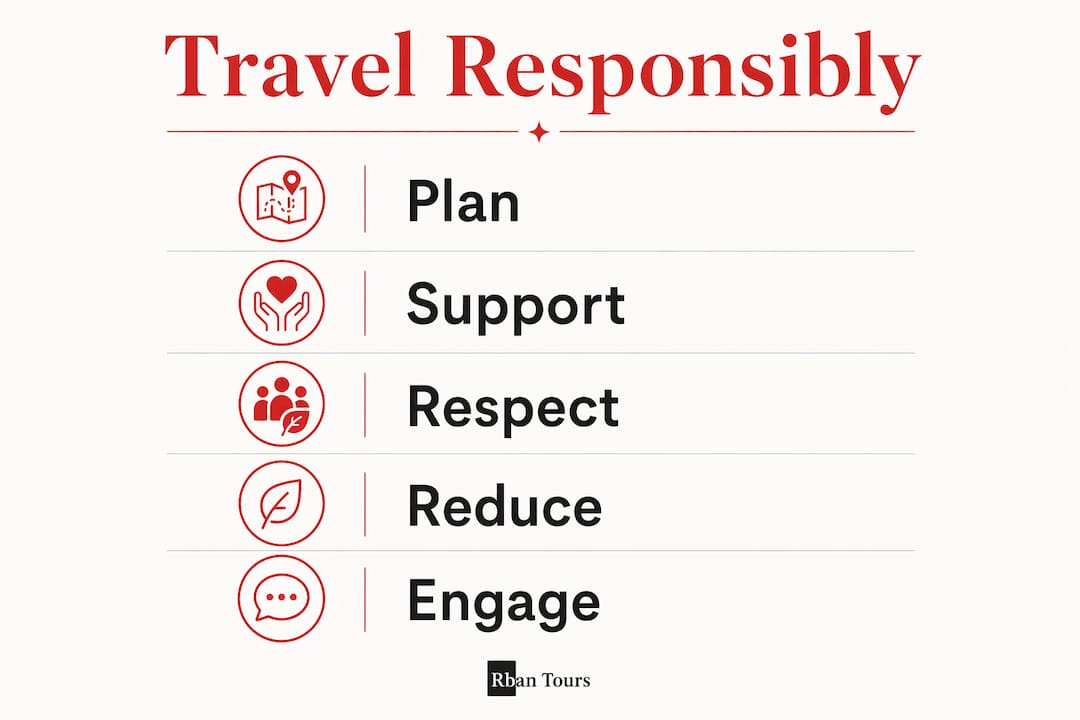
What responsible travel looks like in design-led city experiences
Abstract principles come alive fast when you apply them to the kinds of experiences that actually make a city trip memorable.
Vintage shopping tour: A responsible version is led by a local stylist or market regular who earns a guide fee, visits family-run stalls, and explains the neighborhood’s design history. Ask: “Does the guide live in this neighborhood, and do the vendors set their own prices?”
Artisan workshop: Pottery, natural dyeing, bookbinding. The responsible version pays the artisan a teaching fee above their normal production rate, keeps the group small (typically under ten), and sources all materials locally. Verify the fee structure before you book.
Street-food crawl: A local guide who grew up eating at these spots knows which vendors are family-run and which are tourist traps. Small groups matter here: a crowd of twenty changes the dynamic of a tiny stall.
Studio visit: Visiting a working designer, ceramicist, or printmaker in their actual studio is one of the most direct forms of responsible tourism. Money goes straight to the creator, the group stays intimate, and the experience cannot be replicated at scale.
“Responsible travel opens deeper connections rather than restricting travel: choosing locally owned guides, artisan workshops, and studio visits keeps spending in the community and enhances creative, design-driven experiences.” — ResponsibleTravel.com
Rbantours builds its experiences around exactly this model: local hosts, small groups, and creative collaborators who are active participants in their city’s culture, not performers hired for the occasion.
Common misconceptions and realistic trade-offs
Myth: Responsible travel means expensive eco-lodges and sacrifice. Fact: Staying longer in one place, booking local lifestyle tours, and eating at neighborhood spots often costs less than the tourist-circuit equivalent and delivers far more impact.
Myth: Carbon offsets solve the flight problem. Fact: Offsets are a last resort, not a first action. Shape the trip first: travel less often, stay longer, go overland where possible.
Trade-off to make consciously: One longer trip beats three short city hops for both your experience and the community’s benefit. Depth over frequency is the responsible traveler’s default.
On voluntourism: if a project asks for unskilled labor from short-term visitors, that is a signal the project serves the visitor’s feelings rather than the community’s needs. Look for projects where the community directs the work and the skills gap is real.
Key Takeaways
Responsible travel is the most direct way to ensure your city experiences benefit the people and places that make them worth having.
Point | Details |
Define it by behavior | Responsible travel is what you choose; sustainable tourism is what the industry builds. Both matter. |
Transport is the biggest lever | Transportation accounts for a large share of a holiday’s carbon emissions; opt for overland travel or apply NERD principles when flying. |
Local spending keeps money circulating | Book local guides, artisan workshops, and community-owned venues so tourist dollars stay in the neighborhood. |
Verify, don’t just trust labels | Ask operators for named local staff, a sustainability action plan, and GSTC or equivalent certification. |
Rbantours as a model | Rbantours designs small-group, locally guided city experiences with local creative collaborators at the center. |
Rban’s perspective on practicing what we preach
The gap between “responsible travel” as a concept and responsible travel as a lived experience is wider than most guides admit. Plenty of operators slap a green badge on a mass-market tour and call it sustainable. What actually changes behavior is design: when the experience is built around local knowledge, small groups, and direct creative exchange, responsibility stops being a constraint and becomes the whole point.
At Rbantours, we do not add local flavor as an afterthought. Our vintage shopping tours, street-food crawls, and Paint & Sip workshops are designed from the inside out with local hosts who set the agenda. The creative collaborators we work with in Barcelona, Milan, Mexico City, Ho Chi Minh, and Japan are not vendors we hire for the day. They are the experience. That distinction is what separates a responsible design-led tour from a well-marketed imitation.
The traveler who books with that standard in mind will always come away with something richer than a highlight reel. They come away with a real sense of a city’s creative pulse.
Book a design-led experience that puts local creativity first
Knowing what responsible travel means is one thing. Finding an experience that actually lives up to it is another. Rbantours offers curated, locally guided city experiences across Barcelona, Milan, Mexico City, Ho Chi Minh, and Japan, each designed around small groups, local creative hosts, and authentic neighborhood access.
[

Whether you want to spend an afternoon in a Barcelona artist’s studio, join a street-food crawl through Mexico City’s most vibrant markets, or take a walking cultural tour led by someone who actually lives there, every Rbantours experience is built to keep your spending local and your connection genuine. Browse Barcelona experiences and book your place today.
Sources and further reading
What is responsible tourism? — Responsible Tourism Partnership
What is sustainable tourism? — GSTC
GSTC guidance for travelers
GSTC Tour Operator Standard (PDF)
How to travel better — National Geographic
How to travel regeneratively — Regenerative Travel
Responsible travel tips — WWF
Responsible travel guide — ResponsibleTravel.com
Recommended
Comments