
City exploration explained: Adventure, local culture, and Urbex

Most travelers assume city exploration means booking a hop-on, hop-off bus and snapping photos of famous landmarks. But city exploration is something far richer, more layered, and more alive than that. It is the art of reading a city the way a local does — feeling its rhythm, uncovering its stories, and connecting with the people who shape its soul every single day. Whether you are drawn to creative neighborhood tours, spontaneous street food discoveries, or the edgier world of urban exploration, this guide breaks it all down so you know exactly what you are getting into and how to make every moment count.
Table of Contents
Key Takeaways
Point | Details |
City exploration defined | It means immersive, creative discovery of urban spaces and stories, beyond classic tourism. |
Mainstream vs. Urbex | Experiences range from legal, interactive tours to off-limits adventures with higher risks. |
Ethics matter | Respect for people, places, and laws is crucial to responsible exploration. |
People over places | Genuine connections and participation make city exploration truly memorable. |
Get started safely | Explore with curiosity and choose options that balance adventure, safety, and respect. |
Defining city exploration: More than sightseeing
City exploration, at its core, is the immersive discovery of urban spaces and the stories woven into their streets, buildings, and communities. It is not about ticking boxes on a tourist checklist. It is about engaging with the real heartbeat of a place — the bakery that has been open since 1943, the mural painted by a local artist who grew up in that neighborhood, the jazz bar where regulars gather every Thursday.
What sets genuine city exploration apart from standard sightseeing:
Prioritizing local culture over iconic landmarks, seeking out the everyday rituals and flavors that define a neighborhood
Finding hidden gems that rarely appear in guidebooks, from tucked-away courtyards to rooftop gardens
Human interaction as the primary tool for discovery, talking to shopkeepers, artists, and community members
Creative engagement through workshops, food trails, art hunts, and hands-on activities that connect you to the city’s creative energy
Intentional curiosity rather than passive observation, asking questions, taking detours, and letting the city surprise you
Now, it is important to address a related but distinct concept that often comes up in this conversation. Urbex, or urban exploration, is a specific branch of city exploration focused on accessing man-made structures that are abandoned, derelict, or not normally open to the public. It is a practice built on documentation, photography, and the thrill of discovering forgotten spaces.
Urban exploration (Urbex): The exploration and documentation of man-made structures that are abandoned, derelict, or not normally accessible to the general public. It is distinct from mainstream city exploration and carries its own specific ethics, risks, and subculture.
The gap between a leisurely Barcelona urban experience and a late-night Urbex mission into a crumbling factory is significant. Both are forms of city exploration, but they operate in very different worlds. Understanding this distinction matters before you plan your next adventure.
The spectrum: Mainstream city exploration vs. Urbex
City exploration exists on a wide spectrum. On one end, you have legal, structured, and deeply social experiences — scavenger hunts through colorful city quarters, guided food tours, neighborhood deep-dives with local experts. On the other end sits Urbex, which can involve trespassing and significant legal or safety risks depending on context and location. The meaning of “city exploration” shifts dramatically based on what kind of access is implied.
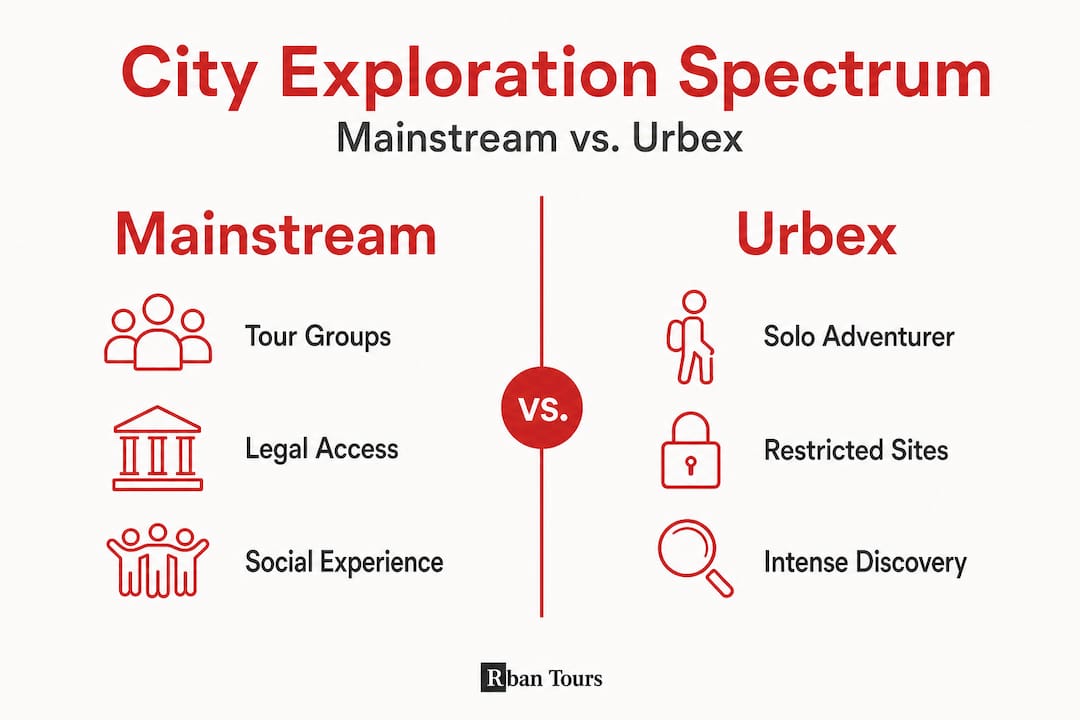
Here is a direct comparison to help you orient yourself:
Feature | Mainstream city exploration | Urban exploration (Urbex) |
Access type | Public spaces, open venues, guided routes | Abandoned, restricted, or off-limits locations |
Legality | Fully legal | Varies — often involves trespassing risk |
Primary motivation | Culture, creativity, connection | Documentation, history, thrill of discovery |
Social aspect | Often group-based, community-oriented | Usually small groups; secretive by nature |
Risk level | Low to moderate | Moderate to high (structural hazards, legal risk) |
Ethical considerations | Respecting local communities and norms | Preservation ethics, non-destruction principles |
Typical activities | Food tours, art trails, workshops, neighborhood walks | Abandoned buildings, tunnels, rooftops, industrial sites |
The examples on the mainstream side include things like joining a vintage market tour through a city’s design district, doing a street art walk with a local guide, or participating in a neighborhood scavenger hunt. These experiences are built for curiosity and connection. You can find tips for making any city tour memorable by focusing on the details that most visitors walk right past.
On the Urbex side, the experience is more solitary and often more intense. Practitioners explore decommissioned hospitals, abandoned railways, and forgotten industrial spaces. Japan, for example, has a rich Urbex culture centered on “haikyo” — the Japanese word for ruins — and the country offers some of the world’s most atmospheric abandoned sites for those drawn to that world. Japan’s urban adventure scene spans both the curated and the off-grid.
Pro Tip: Before visiting any location labeled as an “adventure” or “exploration” spot, research its legal status thoroughly. Some abandoned sites are protected heritage properties, and entering without permission can result in fines or arrest. When in doubt, go guided.
City exploration in practice: Immersion, creativity, and community
So what does modern city exploration actually look like on the ground? It looks like three things working together: immersion, creativity, and community. When these elements align, a city stops being a backdrop and becomes a living experience.
Here is a progression from solo to fully immersive city exploration:
Solo wandering with intention — You pick a neighborhood you know nothing about, leave the map behind, and commit to getting a little lost. You follow your nose to a street market, strike up a conversation with a vendor, and end up spending an hour learning how a family business has operated for three generations.
Themed self-guided exploration — You design your own trail around a specific thread: street art, architecture, coffee culture, or vinyl records. You build a loose itinerary and let discoveries pull you off it. This approach gives structure without rigidity.
Joining a small-group local experience — You sign up for a curated neighborhood tour led by someone who actually lives there. These guides do not just point at buildings; they tell you about the family who built them, the political movement that shaped the street, and the cafe where all the best ideas were born.
Participating in creative city workshops — You sit down with locals in a studio, kitchen, or atelier and make something together. Whether that is a dish, a painting, or a piece of pottery, the act of creating side-by-side dissolves the tourist-local divide almost instantly.
Joining community events and festivals — You time your visit around a local market, cultural celebration, or neighborhood festival. You are not observing the city’s culture; you are inside it.
A useful way to think about the range of activities and what travelers typically seek from them:
Activity type | Primary goal | Social level | Cultural depth |
Guided neighborhood walk | Learning, orientation | Medium | High |
Street food tour | Sensory experience, connection | High | Very high |
Creative workshop (art, cooking) | Creativity, community | Very high | High |
Public art trail | Discovery, aesthetics | Low to medium | Medium |
Interactive city challenge/game | Adventure, fun | High | Medium |
Urbex documentation | History, photography | Low | Very high (niche) |
Exploring Vietnam’s city culture is a strong example of this spectrum in action. In cities like Hanoi and Ho Chi Minh City, you can move fluidly between chaotic sensory food trails in the old quarter, intimate craft workshops in artist studios, and spontaneous alley discoveries that no app will ever map for you.
Responsible exploration, wherever you are, is guided by a principle the Urbex community has long championed: take nothing but pictures, leave nothing but footprints. This ethos of non-destruction and preservation applies just as powerfully to mainstream city exploration as it does to Urbex. Respecting the spaces and people you encounter is what separates the curious traveler from the careless one.
Safety, ethics, and local respect in city exploration
Great city exploration leaves a positive impression on every neighborhood it touches. This is not just idealism; it is practical wisdom. When travelers show up with respect, locals open doors — sometimes literally.
Key rules to live by as a city explorer:
Do:
Research local laws and property boundaries before entering any non-public space
Carry appropriate safety gear if you are venturing into physically demanding environments
Learn a few words of the local language; even basic phrases signal respect and open conversations
Support local businesses, artists, and vendors who make neighborhood culture what it is
Travel with or consult a local guide when exploring neighborhoods outside your cultural familiarity
Document experiences thoughtfully, asking permission before photographing people
Don’t:
Trespass onto private or restricted property, even if it looks abandoned
Remove objects, disturb structures, or damage any part of an environment you explore
Treat local communities as aesthetic props for your social media content
Ignore obvious safety hazards, particularly in physically unstable buildings or sites
Assume that what is acceptable in your home country is acceptable everywhere you travel
The Urbex ethics code centers on preservation: document what you find, disturb nothing, and take no physical souvenirs. This mindset translates beautifully into mainstream exploration too. Every city district has a texture worth protecting, from the weathered tiles of a historic market to the hand-painted sign above a corner shop.
Pro Tip: The most unforgettable city exploration moments usually happen through people, not places. Ask a local where they eat lunch, which street feels most alive on a Saturday morning, or what they love most about their neighborhood. These conversations unlock experiences that no tour operator can package.
Working with local guides changes everything. Mexico City, for example, is a city that rewards deep curiosity. The CDMX local discovery experience is vastly different when you explore Colonia Roma or Coyoacán with someone who grew up there versus someone reading from a script. The difference is alive in every detail.
What most guides miss: City exploration is about people, not just places
Here is something we genuinely believe, built from years of designing immersive city experiences across multiple cultures: the most memorable moments of urban exploration are almost never about the places themselves. They are about the people you meet inside them.
Most travel guides are structured around destinations. They give you addresses, opening hours, and curated photos. What they cannot give you is the woman selling handmade jewelry in a Hanoi alley who tells you about her childhood in the mountains, or the architect in Barcelona who takes you onto a rooftop to show you the view that inspired his entire career. Those encounters are not listed anywhere. They happen because you showed up curious, humble, and open.
We have seen it consistently: travelers who prioritize human connection over location-ticking leave with richer memories. A coffee shop conversation in a Tokyo neighborhood can reshape how you see an entire culture. Joining a community mural project in Mexico City for an afternoon teaches you more about urban identity than any museum exhibit could.
The advice to explore cities like a local is not just a marketing phrase. It is a genuine shift in orientation. It means slowing down enough to notice what is happening around you. It means choosing participation over observation. It means valuing the conversation at the taquería as much as the meal itself.
Curiosity is the essential gear of the city explorer. Humility is the passport. And a willingness to be genuinely surprised, to follow a tip from a stranger or say yes to an unexpected invitation, is what transforms a trip into something you will talk about for years.
Start your own city exploration adventure
City exploration at its richest blends creative energy, cultural depth, and the kind of social moments that stay with you long after you have returned home. If this article has sparked something in you, that pull toward deeper, more connected travel, we want to help you act on it.
[
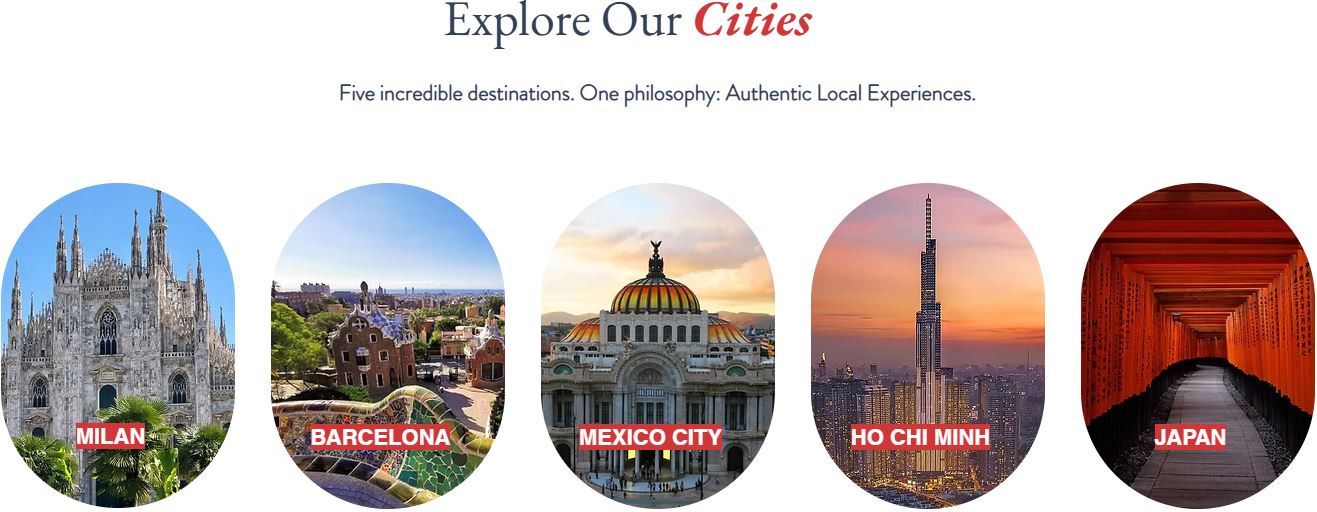
At Rban Tours, we design experiences specifically for travelers who want more than a postcard version of a city. From curated Barcelona exploration experiences that take you through neighborhoods most visitors never see, to urban adventures in Japan that balance the contemporary and the ancient, every experience we build is rooted in local knowledge, creative storytelling, and genuine human connection. Browse our destinations, find the rhythm that calls to you, and step into the city the way it was meant to be experienced — from the inside out.
Frequently asked questions
What does city exploration involve beyond traditional tourism?
City exploration emphasizes immersive experiences, creative challenges, and authentic social interactions with locals, going well beyond standard sightseeing. As urban exploration shows, even the definition of the practice extends into rich subcultures centered on curiosity and discovery.
Is urban exploration (Urbex) legal?
Urbex can involve trespassing and carries significant legal and safety risks depending on the location and context; always research local laws and obtain permission before accessing any restricted area.
How do you stay safe and ethical while exploring cities?
Stay within legal boundaries, respect all property, and engage with local communities thoughtfully. The Urbex principle to take nothing but pictures and leave nothing but footprints applies equally well to everyday city exploration.
What activities count as mainstream city exploration?
Mainstream city exploration includes themed walking tours, local street food hunts, public art trails, neighborhood scavenger hunts, creative workshops, and interactive community events that are fully legal and open to visitors.
Can city exploration be done alone or only in groups?
City exploration works beautifully both solo and in groups. Solo exploration offers deep personal discovery and spontaneity, while group experiences create shared memories and open doors through collective social energy.
Recommended
Comments