
Why local experiences create deeper travel and lasting memories

Most travelers return home with photos but not stories that truly move them. That gap between a pleasant trip and a genuinely transformative one almost always comes down to a single factor: authenticity. Authentic local experiences significantly enhance traveler satisfaction through higher perceived authenticity, driving stronger emotional responses across entertainment, education, and cultural immersion. In this article, we break down exactly why choosing local over generic changes everything, what the research actually says, and how you can make it happen on your next journey.
Table of Contents
Key Takeaways
Point | Details |
Authenticity drives satisfaction | Research shows local experiences create deeper emotional connections and higher satisfaction than standard tours. |
Community impact multiplies | Money spent locally recirculates up to seven times, supporting artisans and sustainable development. |
Cultural preservation matters | Choosing elder-led workshops and creative experiences helps preserve tradition and reduces cultural erosion. |
Travelers have power | You shape the travel landscape with each booking by supporting genuine, community-based activities. |
Practical action is easy | Finding and booking authentic experiences is straightforward with the right questions and trusted platforms. |
What makes local experiences truly special?
There is a real difference between being a tourist and being a traveler. Tourists move through a city’s surface. Travelers sink into its rhythm. That distinction is not just poetic; it reflects a genuine shift in how you engage with a place, its people, and its stories.
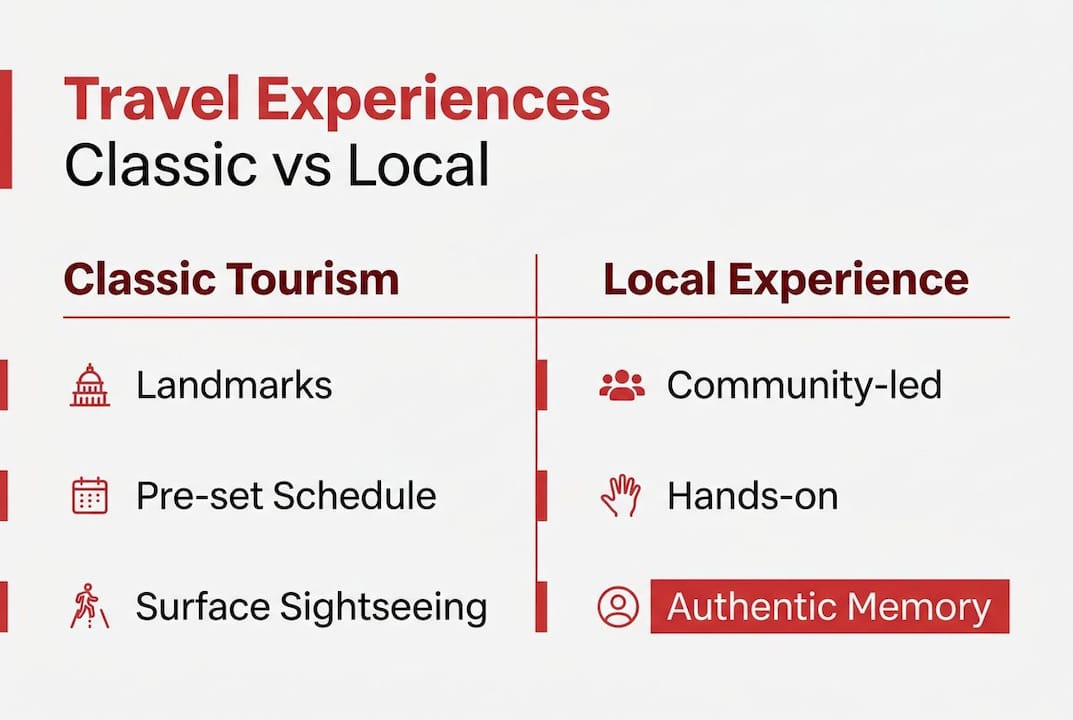
A local experience is one that is designed, led, and rooted in the actual life of a community. Think of a ceramics workshop run by a third-generation artisan in Oaxaca, a street food walk guided by someone who grew up eating at those stalls, or a neighborhood tour led by a resident who knows every mural and its meaning. These are not performances staged for visitors. They are invitations into something real.

Classic tourism | Local experience |
Pre-packaged itinerary | Flexible, community-led |
Landmark-focused | Neighborhood and culture-focused |
Passive observation | Active participation |
Generic narrative | Personal, lived storytelling |
Revenue leaves destination | Revenue stays local |
The immediate benefits travelers report are striking. Discovery feels sharper when you are learning from someone who lives it. Belonging replaces the outsider feeling that so often shadows conventional tours. And the stories you carry home are ones only you could have gathered, because they came from a real conversation, a shared meal, or a skill learned from a master.
Barcelona experiences built around local neighborhoods and creative communities illustrate this beautifully. So does the quiet, layered depth you find in Japan local travel, where tradition and contemporary life coexist in ways that only reveal themselves when you slow down and look closer.
Research confirms that authentic local experiences significantly enhance traveler satisfaction, with authenticity explaining up to 65% of the variance in overall experience quality (R² = 0.650). That is not a small effect. It is the single strongest predictor of how good a trip actually feels.
How authenticity boosts your travel satisfaction
Researchers who study the experience economy describe satisfaction through four dimensions: entertainment, esthetics, education, and escapism. These are not abstract categories. They map directly onto how you feel when a trip goes from forgettable to unforgettable.
Here is how authentic local experiences significantly enhance traveler satisfaction across each dimension:
Dimension | What it means | How local authenticity elevates it |
Entertainment | Enjoyment and engagement | Real stories and unexpected moments beat scripted tours |
Esthetics | Sensory richness of the environment | Authentic settings carry textures, smells, and sounds that staged venues cannot replicate |
Education | Learning something genuinely new | Local guides teach from lived knowledge, not a script |
Escapism | Feeling fully absorbed in another world | Genuine immersion pulls you in completely |
The four dimensions work together. When one rises, the others tend to follow. A cooking class taught by a local grandmother in a real kitchen hits all four simultaneously: you are entertained by her stories, surrounded by beautiful sensory details, learning real technique, and completely absorbed in a world far from your daily routine.
Entertainment: Seek experiences where the guide or host has a personal stake in the story they are telling. Passion is contagious, and it transforms a walk through a neighborhood into something memorable.
Esthetics: Choose settings that are genuinely part of local life, not purpose-built for tourists. A market, a workshop, a family courtyard.
Education: Ask what you will actually learn, not just see. Skills, history, and context all deepen satisfaction.
Escapism: Limit distractions. Put the phone away for stretches. Let yourself be fully present in the moment.
Exploring Barcelona cultural tours or Mexico City local guides through this lens transforms what might be a pleasant afternoon into a memory you will still be describing years later.
Pro Tip: Before booking any “local” experience, check whether the host or guide actually lives in the neighborhood they are showing you. Read reviews for mentions of personal stories, surprise moments, and genuine interaction. These signals are far more reliable than polished marketing copy.
Supporting creative communities and preserving culture
Choosing local does not only benefit you. It sends ripples through entire communities in ways that matter deeply and last long after you have returned home.
When travelers invest in locally led experiences, creative communities gain:
Sustainable income that supports artisans, guides, and small business owners directly
Skill preservation as demand for traditional crafts, recipes, and practices grows
Youth engagement as younger generations see economic value in their cultural heritage
Cultural pride that reinforces community identity and resists homogenization
Reduced dependence on large tourism operators who extract value from destinations
One of the most compelling trends shaping travel right now is what researchers and travel platforms are calling “grandma tourism.” This is the growing preference for experiences led by older locals who carry deep, irreplaceable knowledge of their traditions. 76% of travelers would book grandma-inspired local experiences led by older community members, and the numbers back up that enthusiasm.
“Workshops and classes bookings have risen 250% from 2023 to 2025, reflecting a powerful shift toward hands-on, human-centered travel.”
Elder-led workshops and homestays do something that no museum exhibit can fully replicate. They connect you with living tradition. A grandmother teaching you her family’s liqueur recipe is not just sharing a drink; she is sharing a lineage, a set of values, a way of understanding the land and the seasons. That knowledge lives in her hands and her memory, and when you participate, you become part of its continuation.
Our homemade liqueur workshop is a perfect example of this kind of exchange. So is a walking cultural tour where the guide’s personal relationship with the neighborhood shapes every step of the journey.
Pro Tip: When looking for genuinely community-supported activities, search for experiences that mention specific local partners, family involvement, or proceeds that go back to a named artisan or community group. Vague claims of being “locally inspired” are not the same as actual community ownership.
The economic and ethical advantage of going local
Here is a number worth sitting with: money spent at local businesses circulates up to 7 times in the destination community, compared to just 2.5 times when spent at chain businesses or large international operators. That multiplier effect is not a minor distinction. It is the difference between a destination that thrives and one that slowly hollows out.
When you pay a local guide, book a family-run workshop, or eat at a neighborhood restaurant, that money flows to the guide’s family, to the market vendor who supplies the ingredients, to the landlord of a local building, and back into the community’s economy. It circulates, builds, and creates resilience.
Practical ethical reasons to choose local:
Environmental sustainability: Local operators typically have smaller footprints and deeper investment in protecting their environment
Fair wages: Money goes directly to the people doing the work, not through layers of corporate intermediaries
Cultural respect: Local operators set the terms of engagement with their own traditions
Community agency: Locals retain control over how their culture and spaces are represented
Long-term destination health: Communities that benefit from tourism are more likely to welcome visitors and preserve what makes them special
You can verify where your money goes by asking direct questions before booking. Who leads this experience? Are they from this neighborhood? Does any portion of the fee support a community initiative? Transparent operators will answer these questions easily and enthusiastically.
Vietnam cultural immersion experiences offer a vivid illustration of this principle in action. When travelers choose locally guided experiences in Hanoi or Hoi An over mass-market tours, the economic and cultural difference for those communities is tangible and immediate.
Finding, booking, and making the most of local experiences
Understanding why local experiences matter is only half the journey. The other half is knowing how to find and choose the right ones.
Start with peer reviews, not marketing. Read what past travelers actually wrote. Look for specific details: the guide’s name, a story they shared, a moment that surprised them. Generic praise is a warning sign.
Seek platforms with transparent local partnerships. The best experience companies name their local collaborators and explain how they work together.
Ask your accommodation for genuine recommendations. A locally owned guesthouse or boutique hotel often has the best insider knowledge of real neighborhood experiences.
Look for small group sizes. Authentic local experiences rarely work at scale. If a tour accommodates 40 people, ask whether it can still feel personal.
Check for community involvement. Does the experience involve local families, artisans, or institutions? That involvement is a strong signal of authenticity.
The risks of getting this wrong are real. Over-commercialization can turn a once-genuine neighborhood into a performance of itself, where everything is staged for visitors and nothing is real anymore. Authenticity is an emotional process that fosters genuine resonance, but it is also fragile. Over-commercialization and poor visitor management can erode it quickly, which is why local governance and thoughtful traveler behavior both matter.
When you do find the right experience, participate fully. Ask questions. Learn a few words in the local language. Accept the unexpected. The moments that feel slightly outside your comfort zone are often the ones that stay with you longest.
CDMX tours and Mexico City unique experiences are great examples of how a city’s creative pulse can be accessed through the right local connections, turning a visit into something genuinely alive.
Pro Tip: Before booking, ask these three questions: Who designed this experience and where are they from? How long have they been running it? What happens if I want to go off-script or ask questions? The answers will tell you almost everything about whether the experience is truly local.
Why embracing the local transforms both you and your destination
We want to say something that most travel guides skip over entirely. Going local is not a box you check. It is not a filter you apply when searching for tours. It is a posture, an ongoing relationship with a place and its people that requires something from you in return.
Many travelers approach authenticity as a product to be purchased. They book the “local” experience, take the photos, and move on. But authenticity is an emotional process that requires openness, vulnerability, and a willingness to be changed by what you encounter. That is not always comfortable. Sometimes it means sitting with confusion, or admitting you know very little about a place you thought you understood.
The travelers who get the most from local experiences are the ones who arrive with genuine curiosity rather than a checklist. They let the guide lead. They follow the conversation wherever it goes. They accept that the best moments are often unplanned.
There is also a responsibility that comes with this. Thoughtful travelers contribute to destination resilience. Careless ones, even well-meaning ones, can accelerate cultural erosion. When you choose a deep cultural tour over a mass-market option, you are voting with your spending for the kind of travel ecosystem you want to exist. That vote matters more than most people realize.
We have seen it firsthand across every city we work in. The neighborhoods that maintain their character and creative energy are the ones where travelers and locals have built genuine relationships over time. That is the real reward of going local. Not just a better trip, but a better world to travel in.
Ready to start your local experience journey?
We design every Rban Tours experience from the inside out, starting with the local community and building outward to create something that feels genuinely alive. Whether you are drawn to the creative energy of Barcelona local experiences or want to lose yourself in the color and craft of a Paint & Sip workshop surrounded by local artists, we have built something worth showing up for.
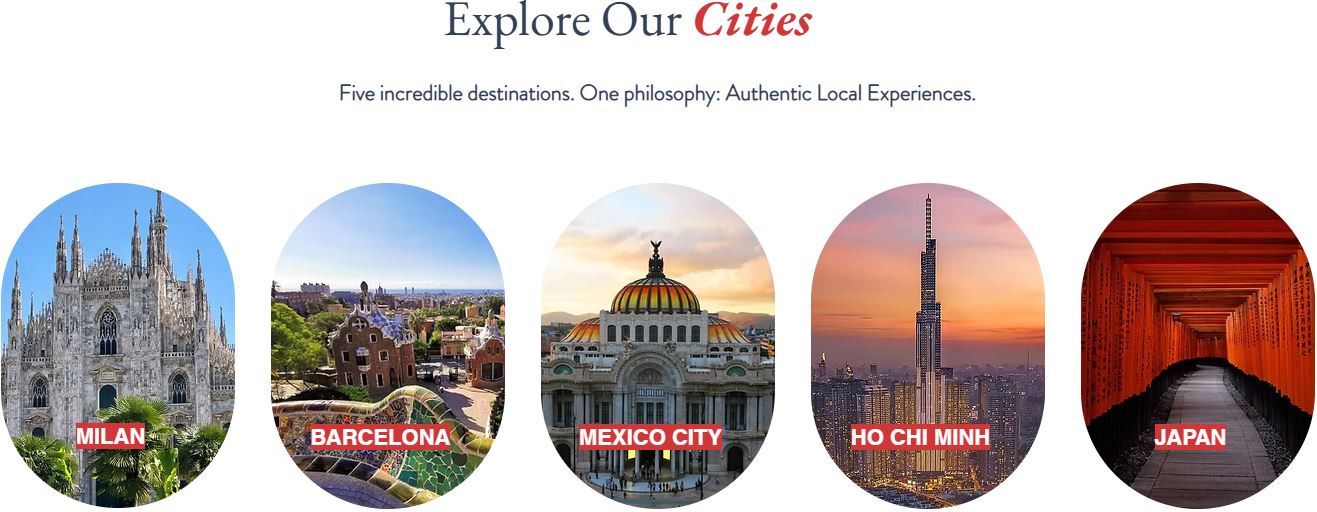
Our experiences span Italy, Barcelona, Mexico City, Vietnam, and Japan, each one shaped by the people who actually live there. Booking is simple, group sizes are intentional, and every detail is designed to make you feel like an insider from the first moment. Explore our full range of experiences and find the one that matches where you are headed next.
Frequently asked questions
What counts as an authentic local experience while traveling?
Authentic local experiences are activities designed, led, and deeply rooted in the local community, such as traditional workshops, meals with families, and guided tours by residents. Research confirms that authentic local experiences significantly enhance traveler satisfaction through higher perceived authenticity and richer emotional engagement.
Do local experiences cost more than standard tours?
Local experiences range in price, but the added value comes from personal connection and direct economic benefit to the community rather than just the activity itself. Often, you get significantly more depth and meaning for a comparable or lower price than mass-market alternatives.
How can I tell if a “local” experience is actually authentic?
Look for experiences designed and run by local residents, with transparent information about community involvement, and read peer reviews for specific personal details. Authenticity is an emotional process that shows up in genuine resonance, not polished marketing language.
What impact does booking with local guides have on the community?
Booking local experiences multiplies economic benefits and helps preserve culture, with money circulating up to 7 times more in local economies than through chain businesses or large international operators.
Are “grandma tourism” and elder-led workshops really more popular in 2026?
Yes. 76% of travelers prefer learning from older locals, and bookings for workshops and classes have increased 250% since 2023, reflecting a powerful and growing appetite for human-centered, tradition-rooted travel.
Recommended
Comments