
The Role of Flexibility in City Tours: 2026 Guide

Flexibility in city tours is defined as the ability to adjust schedules, activities, and pacing in real time to match a traveler’s evolving interests and energy. It is no longer a bonus feature. 58% of travelers now list flexible change and cancellation policies as a core requirement, and 74% seek experiences that allow personal expression. The role of flexibility in city tours has shifted from convenience to expectation, driven by a generation of travelers who want to feel a city’s pulse rather than simply check off its landmarks. Personalization, cultural immersion, and AI-powered planning tools are reshaping what urban exploration looks like in 2026.
How does flexibility enhance cultural immersion in city tours?
Flexible city tours produce deeper cultural engagement because they let you linger where the city actually speaks to you. A rigid group tour moves you past a Barcelona market in twelve minutes. A flexible one lets you spend forty minutes talking to the vendor who has sold saffron from the same stall for three decades. That conversation is the experience.

66% of travelers actively seek deeper immersion in local cultures. That number signals a clear shift away from surface-level sightseeing toward what industry professionals now call “destination living.” Flexible touring options make that shift possible by removing the pressure to move on before you are ready.
The ability to skip less appealing attractions matters just as much. When you are not obligated to stand in front of a monument that holds no meaning for you, your attention and energy go to the places that do. Satisfaction climbs because the experience reflects your actual curiosity, not a pre-packaged version of it.
Spontaneous exploration during open time is where the most memorable moments happen. A side street in Mexico City, a local coffee shop in Tokyo, a street art alley in Barcelona. None of these appear on a fixed itinerary. All of them define a trip.
Pro Tip: Before any city tour, identify two or three neighborhoods or experiences that genuinely excite you. Share them with your guide or operator. A good flexible tour builds around your real interests, not a generic highlight reel.
Factor | Flexible City Tours | Fixed Itinerary Tours |
Time at each stop | Adjustable based on interest | Predetermined, non-negotiable |
Cultural depth | High, driven by personal curiosity | Moderate, driven by group schedule |
Spontaneous discovery | Built into the experience | Rare or discouraged |
Traveler satisfaction | Higher, reflects personal engagement | Variable, depends on group alignment |
Skipping unappealing stops | Possible and encouraged | Not an option |
What are the economic and practical benefits of flexible scheduling?
Flexible scheduling is one of the most underrated money-saving tools in travel. Domestic economy travel costs rose approximately 13% year-over-year in Q2 2026. That increase makes timing decisions more financially significant than ever. Shifting a city tour by one or two days to avoid peak pricing can produce real savings without sacrificing any experience quality.
Beyond cost, flexibility directly reduces travel fatigue. Flexible tours reduce burnout that rigid schedules routinely cause, because they allow for recuperation within the trip itself. Rest is not wasted time. It is what allows you to be fully present when you do explore.
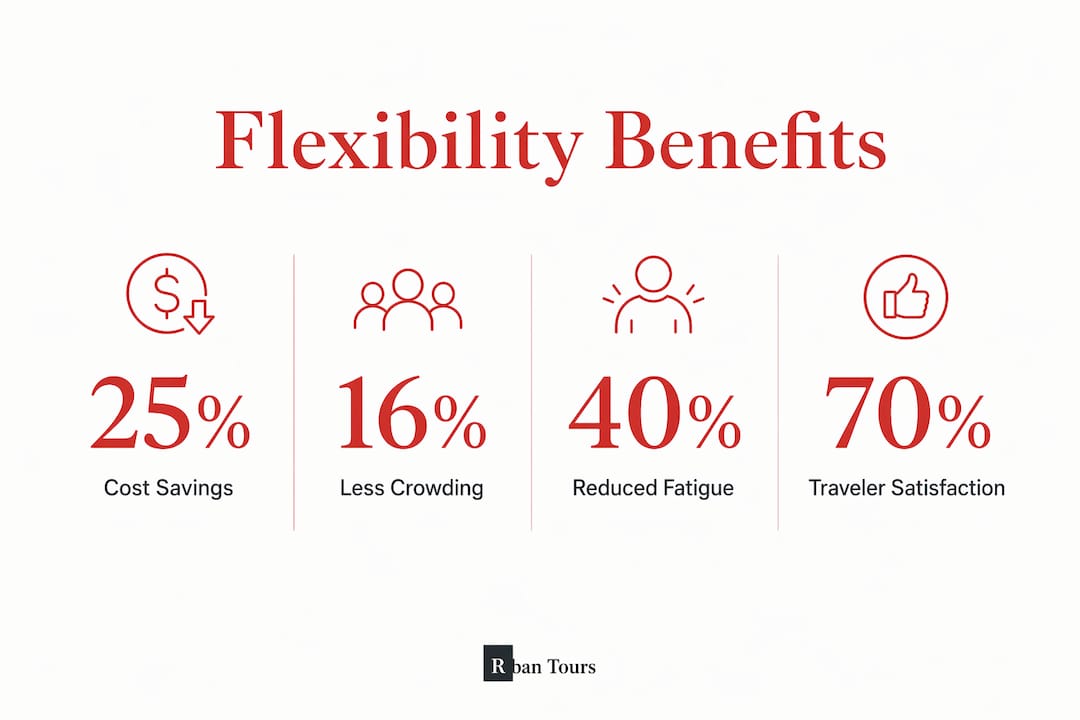
The practical benefits extend to crowd management as well. 16% of Americans actively seek less-crowded destinations in 2026. Flexible scheduling lets you visit popular sites during off-peak hours, which improves both the experience and your photographs.
Flexibility is now a fundamental feature of modern travel, supported by transparent, adaptive frameworks that include travel protection and real-time assistance. Providers who build these systems into their offerings give travelers a safety net that turns unexpected disruptions into manageable detours rather than ruined plans.
Key practical benefits of flexible city tour scheduling include:
Cost savings: Shifting activities to off-peak times reduces entry fees, dining costs, and accommodation rates.
Crowd avoidance: Visiting popular sites at non-standard hours improves access and atmosphere.
Stress reduction: Open time in an itinerary removes the anxiety of running behind schedule.
Weather adaptability: Flexible tours adjust for rain, heat, or unexpected closures without derailing the day.
Travel protection alignment: Flexible bookings pair naturally with cancellation and change policies that protect your investment.
Pro Tip: Build at least one completely unscheduled half-day into any multi-day city tour. Use it reactively. The best version of that time will reveal itself once you are already inside the city’s rhythm.
How is technology enabling real-time flexible city tour planning?
AI-driven itinerary planning is the most significant structural change in urban tourism right now. Neural itinerary models using time-aware and adversarial learning improve planning performance by 7.3% in F1 value. These models generate personalized, authentic paths that adapt dynamically to a traveler’s available time and stated preferences.
The practical implication is significant. A traveler who has three hours in Barcelona’s Gothic Quarter gets a different, optimized route than one who has six. The model adjusts in real time, not just at the planning stage. Tested across four major cities, the same technology showed 8.2% recall and 5.5% accuracy improvements in Q1 2026. That means the recommendations are getting sharper and more personally relevant with each iteration.
Apps and personalized travel platforms are already integrating these capabilities. The result is a tour experience that feels less like a product and more like a conversation. You tell the system what you care about. It builds around that in real time.
Technology Feature | What It Does | Traveler Benefit |
Time-aware planning | Adjusts route to available hours | No wasted time or rushed stops |
Adversarial learning | Tests and refines recommendations | More accurate, personal suggestions |
Real-time adaptation | Updates itinerary as conditions change | Responds to weather, crowds, mood |
Preference modeling | Learns from past choices | Increasingly tailored experiences |
The challenge is that technology alone does not create cultural connection. It creates the conditions for it. A well-designed AI itinerary still needs a human guide or a thoughtfully curated experience to deliver the emotional resonance that makes a city tour memorable. The best operators use technology as a foundation, not a replacement for genuine local knowledge.
How do guides and operators balance structure and flexibility?
The best city tour guides function as cultural curators, not timetable enforcers. Their job is to read the group, adapt the narrative, and know when to linger and when to move. That skill is what separates a memorable tour from a forgettable one.
Walking tours are generally capped at 2–3 hours to maintain engagement. That constraint is not arbitrary. Attention and physical energy both decline after that window, and the quality of cultural absorption drops with them. Skilled operators design within that limit while building in genuine flexibility at each stop.
Effective flexible tour design follows a clear structure:
Anchor the tour with two or three fixed highlights. These give the experience shape and ensure every traveler leaves with the city’s defining moments.
Build open time around those anchors. Free exploration between fixed stops is where personal discovery happens.
Brief the guide on group interests before departure. A five-minute conversation before the tour starts allows the guide to weight the narrative toward what the group actually cares about.
Avoid the overscheduling trap. The myth that more stops equals more value is the most common pitfall in tour design. Buffer time prevents decision fatigue and creates space for spontaneity.
End with an open recommendation. The best guides close by pointing travelers toward one local experience they can pursue independently. That gesture extends the tour’s value beyond its official end time.
Tailored city tour experiences that combine education, entertainment, and open exploration consistently outperform rigid formats on satisfaction metrics. The structure gives travelers confidence. The flexibility gives them ownership. Both are necessary.
Key takeaways
Flexible city tours produce deeper cultural engagement, lower stress, and higher satisfaction because they align the experience with the traveler’s actual interests rather than a fixed group schedule.
Point | Details |
Flexibility is now expected | 58% of travelers require flexible policies; it is a baseline feature, not a premium add-on. |
Cultural immersion improves | Adjustable time at stops and open exploration produce more authentic, memorable engagement. |
Smart scheduling saves money | Shifting activities to off-peak times reduces costs and crowds in a 13% higher-cost travel environment. |
AI planning sharpens personalization | Time-aware models improve itinerary accuracy by 7.3%, making real-time adaptation scalable. |
Structure and flexibility coexist | Anchoring tours with fixed highlights while building in open time creates the optimal experience balance. |
Why flexibility will define city tours for years to come
We have watched traveler behavior shift in a way that feels permanent, not cyclical. The travelers who come to us at Rbantours are not looking for a checklist. They want to feel something real. They want to eat where locals eat, wander where locals wander, and leave with stories that do not sound like everyone else’s.
What we have learned is that the biggest enemy of a great city tour is not a bad itinerary. It is an overpacked one. We have seen groups arrive exhausted by day two because every hour was accounted for. The moments they remember most are almost always the unplanned ones. The spontaneous stop at a street food cart in Mexico City. The unexpected conversation with a ceramics artist in a Barcelona side street. Those moments only happen when there is room for them.
The technology side of this is genuinely exciting. AI-powered planning tools are making it possible to offer personalized tour experiences at a scale that was not realistic five years ago. But we are careful not to let the tool become the experience. A perfectly optimized route is still just a route. What fills it with meaning is the human layer: a guide who knows when to talk and when to step back, a neighborhood that surprises you, a meal that changes how you think about a place.
Our honest belief is that the tours that will matter in the next five years are the ones that treat flexibility as a design principle, not a policy. Build it into the structure from the start. Give travelers ownership of their time. Trust that when people feel free to engage on their own terms, they engage more deeply.
— Rban
Discover flexible city tours with Rbantours
At Rbantours, we design every experience around the idea that the best city moments cannot be scheduled. They can only be made possible.
[
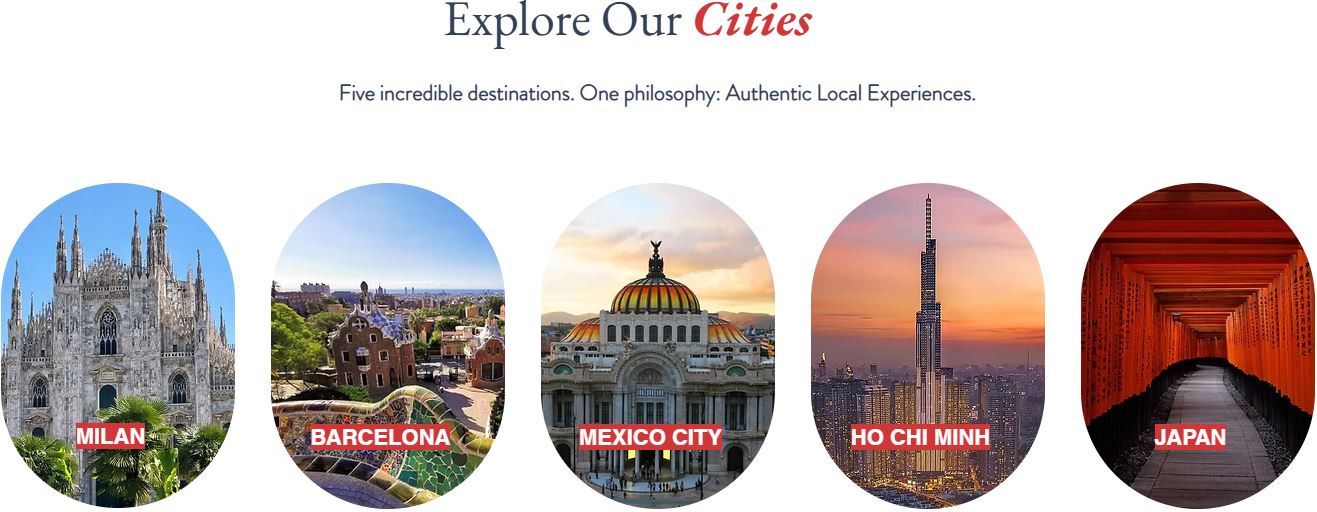
From walking cultural tours through Barcelona’s living neighborhoods to fully customizable days in Mexico City, each Rbantours experience is built with flexibility at its core. Our local guides adapt in real time to your interests, energy, and curiosity. You choose the depth. We provide the access. Explore our full range of Barcelona experiences and find the format that fits how you actually want to travel.
FAQ
What is the role of flexibility in city tours?
Flexibility in city tours allows travelers to adjust schedules, pacing, and activities in real time to match personal interests. It produces deeper cultural engagement and higher satisfaction compared to fixed group itineraries.
Why do travelers prefer flexible tours over fixed itineraries?
74% of travelers seek experiences that allow personal expression and customization. Flexible tours reduce burnout, improve cultural immersion, and let travelers spend time where it genuinely matters to them.
How long should a flexible city walking tour last?
Walking tours are most effective at 2–3 hours in duration. Beyond that window, physical and mental engagement decline, reducing the quality of cultural absorption regardless of how good the content is.
Can AI tools actually improve city tour personalization?
Yes. Time-aware neural itinerary models improve planning performance by 7.3% in F1 value and adapt routes dynamically to a traveler’s available time and preferences. The technology makes personalization scalable across diverse destinations.
How do you avoid overscheduling on a city tour?
Build at least one unscheduled block into every full day of touring. Expert guidance consistently points to buffer time as the key factor in preventing decision fatigue and creating space for the spontaneous moments that define a trip.
Recommended
Comments