
Skip the Rush: Design-Led 3/5/7-Day Mexico City Plans for Italians


Pick your trip length, put one anchor per day, and build from a 3, 5, or 7-day template. That single rule keeps Mexico City’s sprawl from swallowing your vacation whole. Below you’ll find the actual day-by-day templates, the booking moves that save you hours, and the customization method we use at Rban Tours when a traveler asks us for something no template could ever give them.
TL;DR:
Sticking to one main anchor experience per day helps prevent travel fatigue and minimizes time-consuming cross-town transit.
The 3-day itinerary covers core neighborhoods, but adding days allows for museums, day trips, and food-focused experiences without rushing.
Booking popular attractions like Casa Azul and the Anthropology Museum at least a week in advance ensures availability during peak months and weekends.
Neighborhood selection influences travel time and comfort, with Condesa or Roma ideal for walking, and Polanco better for museum access and luxury stays.
Avoid scheduling back-to-back long excursions like Teotihuacán and a full city day; incorporate lighter afternoons for rest and better pacing.
Table of Contents
Itinerario Su Misura Città Del Messico: Where Real Planning Starts
A tailor-made itinerary for Mexico City isn’t a rigid list of stops. It’s a rhythm: one main anchor experience per day, built around your energy, your interests, and how much walking your feet can take. Most guides sell you a checklist. We think the better starting point is a template flexible enough to bend without breaking, because Mexico City rewards travelers who move at its pace instead of fighting it.
Three days covers the essentials. Five days lets you breathe and add a day trip. Seven days give you room for real depth, museums you actually linger in, and a proper excursion beyond the city limits. Three days is the realistic minimum for a first visit focused on Centro Histórico, Chapultepec, and Coyoacán, with four to five days recommended once you want to add Teotihuacán or Xochimilco without rushing.
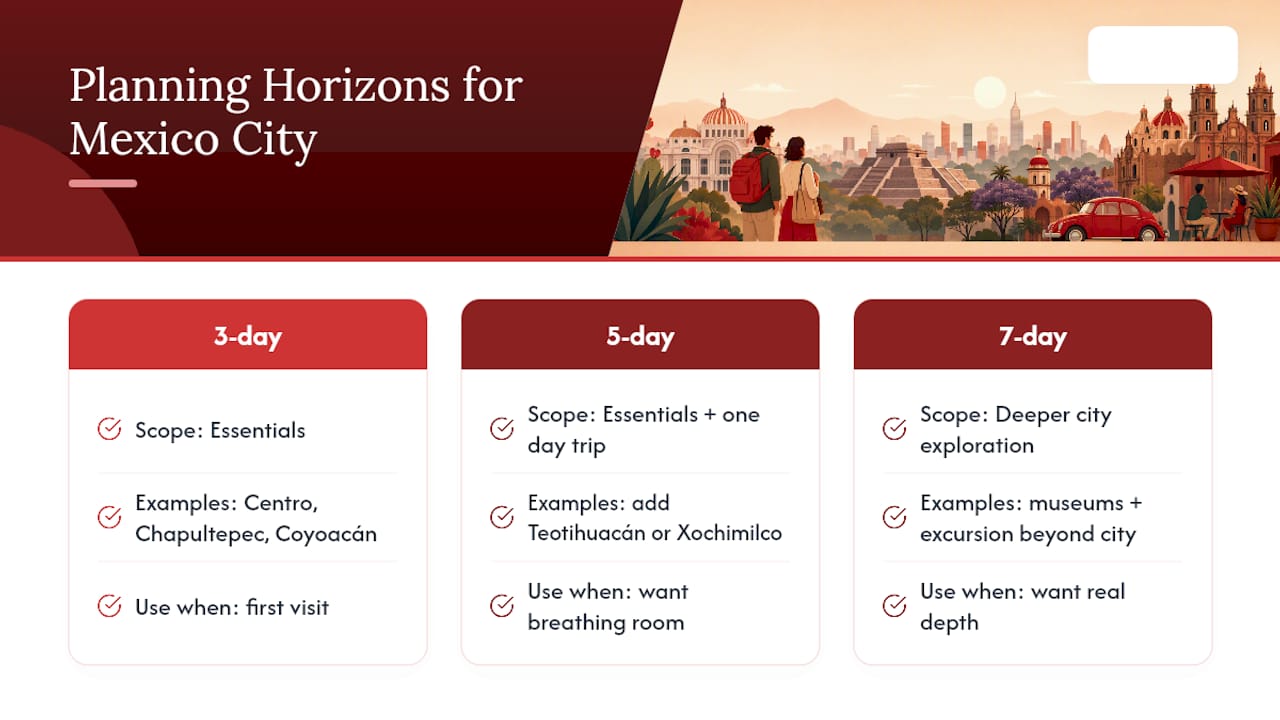
A 3-Day Mexico City Itinerary With Real Timing
Three days is tight but workable if you commit to one district per day and resist the urge to zigzag across town chasing extra sights.
Day 1, Centro Histórico. Start at the Zócalo by 9:00 AM before the plaza fills with vendors and school groups. Give Templo Mayor 45 minutes, the Metropolitan Cathedral 30 minutes, and save the early afternoon for Palacio de Bellas Artes, where the Tiffany glass curtain alone justifies the entry fee. Budget four to five hours total, then rest before an early dinner.
Day 2, Chapultepec. The Museo Nacional de Antropología deserves a full three hours minimum. It’s the best anthropology museum in the Americas, and rushing it is the single most common regret we hear from first-time visitors. Pair it with a walk through Chapultepec Park and, if energy allows, the Castillo. Taxi or Uber between the museum and your hotel; walking the park’s edges after dark isn’t worth the risk.
Day 3, Coyoacán. Reserve your Frida Kahlo Museum ticket at least a week ahead, since Casa Azul sells out its timed slots fast, especially on weekends. Arrive at opening, spend 90 minutes inside, then wander the Coyoacán market for tacos and a coffee. If you’re not exhausted, a short Xochimilco detour works as a late-afternoon add-on, though it’s better suited to the five-day version below.
Start big museums early. Crowds and heat both build through the day, and you’ll want the mental energy for Diego Rivera’s murals before your third hour of walking catches up with you.
A 5-Day Mexico City Itinerary With Teotihuacán and Food
Two extra days change everything. You get one full day outside the city and a day built entirely around eating, which for Mexico City is not a lesser priority than sightseeing.
Days 1 to 3 follow the 3-day structure above: Centro Histórico, Chapultepec, and Coyoacán.
Day 4, Teotihuacán. Leave by 8:00 AM whether you book a guided tour or arrange your own transfer. The pyramids get brutal under midday sun, and a guide who knows the site’s history turns two piles of stone into a lesson on an empire that predates the Aztecs by centuries. Plan for a full day, including transfer time. Self-driving or public transport works but eats into your museum time back in the city; a private guide simplifies the logistics considerably.
Day 5, food and markets. Mercado de San Juan for exotic ingredients and a sit-down lunch, Mercado Roma for a more polished food-hall feel, or a taquería crawl through Roma Norte if you’d rather wander than plan. Late morning start, since markets get going slowly and you don’t want to rush the best stalls.
The mistake we see most: cramming Teotihuacán and a full city day into back-to-back schedules with no buffer. That combination guarantees a burned-out Day 6, even on a five-day trip. Keep at least one lighter afternoon between a major excursion and your next big museum stop, and treat your food day as genuine rest disguised as sightseeing.
A 7-Day Mexico City Itinerary With Puebla and Deep Museum Time
Seven days is where Mexico City stops feeling like a checklist and starts feeling like a place you understand.
Days 1 to 5 follow the 5-day structure, but stretch the Anthropology Museum visit across a slower morning and add an afternoon dedicated to Mexico City’s mural circuit, including the murals inside the Secretaría de Educación Pública building.
Day 6, Puebla and Cholula. Leave by 7:30 AM. The drive runs roughly two hours each way, so an early departure protects your afternoon in Puebla’s Talavera-tiled Centro Histórico and the Great Pyramid of Cholula, which is larger by volume than any pyramid in Egypt despite looking, at first glance, like a hill with a church on top. Head back before evening traffic thickens on the highway.
Day 7, flex day. Use it for whatever your pace demanded you skip: a second pass through Roma Norte, a cooking class, or simply a slow morning before your flight.
If your trip falls between November and January, the monarch butterfly reserves near Valle de Bravo become a strong alternative day trip, though they require an earlier start and a longer drive than Puebla. Tolantongo’s hot springs work as a longer overnight detour rather than a same-day trip. Both are seasonal enough that you should confirm access before locking them into a fixed schedule, and both replace, rather than add to, the Puebla day.
How to Customize Any of These Templates
The one-anchor-per-day rule isn’t just a scheduling trick. It’s the reason travelers who follow it come home rested, and travelers who don’t come home describing Mexico City as exhausting rather than exhilarating. Guides consistently recommend one main anchor daily specifically to avoid the long cross-city commutes that eat entire afternoons.
To adapt any template above, swap anchors without breaking the rhythm:
Replace a museum day with a market or food-tour day if you’re traveling with kids or simply prefer eating to standing in galleries.
Swap Coyoacán’s Frida Kahlo focus for a vintage-shopping half-day through Roma Norte and Juárez if fashion and design pull you more than art history.
Trade a second museum day for a nightlife-focused evening anchor, shifting your morning start later to compensate.
If altitude hits you harder than expected, drop one anchor entirely on day two or three and replace it with a slow morning and a single light activity.
Pro Tip: Book your single hardest-to-get reservation, usually Casa Azul or a top restaurant, within the first 48 hours of confirming your trip. That one booking becomes the fixed point everything else gets scheduled around.
Before you lock the schedule, run a short checklist: timed museum tickets confirmed, dinner reservations set for anything popular, and day-trip departure times fixed the night before. Rainy season afternoons (roughly May through October) also argue for scheduling outdoor anchors in the morning and saving museums or markets for after 2:00 PM.
Which Neighborhood Should You Base Yourself In?
Your hotel location determines how much of your itinerary gets eaten by transit, so this decision matters more than most travelers realize before they arrive.
Roma Norte and Condesa suit travelers who want to walk to dinner, wander tree-lined streets, and stay close to the food scene. Expect mid-range nightly rates, and a 15 to 20 minute ride to most Centro Histórico anchors.
Polanco fits travelers prioritizing luxury hotels and museum-heavy days, since it sits close to Chapultepec. Rates run higher, but you’ll save time reaching the Anthropology Museum.
Centro Histórico works if history is your main draw and you don’t mind noise. It’s budget-friendly and puts you inside walking distance of the Zócalo, though evenings feel quieter than Roma or Condesa.
Coyoacán delivers a village feel with cobblestone streets and lower rates, but it’s a 25 to 35 minute ride from most other anchors, a real factor when planning your neighborhood base.
Whichever base you pick, check your daily anchor’s distance from your hotel before finalizing the schedule. A 10-minute difference in ride time, multiplied across five or seven days, adds up to hours you’d rather spend eating tacos.
Practical Planning Tips for Italian Travelers
Mexico City sits at roughly 2,240 meters of altitude, and that height changes how your body handles both fatigue and alcohol. Expect to tire faster during your first two days, and go easy on mezcal until you’ve acclimatized.
Travel during the dry season, November through April, to avoid the afternoon storms that define the rainy months from May or June through October.
Use Uber or DiDi at night or with luggage; the Metro works fine by day but gets uncomfortably crowded and isn’t ideal after dark.
Rent an Ecobici for short, flat circuits inside Roma, Condesa, or Coyoacán, but skip it for longer cross-town rides.
Carry electrolyte packets (electrolitos, sold at every corner store) and drink more water than feels necessary.
Keep a photo of your passport and hotel address on your phone, avoid flashing expensive jewelry or electronics on the street, and stick to app-based rides rather than hailing a random taxi.
Book Casa Azul and the Anthropology Museum before you land, and reserve tables at popular restaurants at least a few days out. Some museums and cultural sites offer reduced or free entry on specific days, often Sundays, which is worth checking against your schedule if you’re traveling on a tighter budget. The city’s official cultural calendar also lists festival dates and late-opening museum nights that can reshape a template around something unrepeatable, if the timing lines up with your visit.
Why Design-Led Itineraries Beat Generic Checklists
Templates get you organized. They don’t get you a Mexico City that feels like yours. At Rban Tours, every itinerary we build starts from the same one-anchor-per-day logic laid out above, then gets reshaped around whatever pulls a specific traveler in: a guided food evening through Roma Norte, a vintage-shopping afternoon in Juárez, or a private guide walking you through Teotihuacán at a pace no bus tour would allow.
A good itinerary isn’t the one with the most stops. It’s the one that leaves you with three or four days you’ll actually remember in detail, instead of a blur of museum lines and traffic.
The templates above give you the skeleton. What turns a skeleton into a trip worth telling friends about is the texture: who’s guiding you, how much room there is to linger, and whether the plan adjusts when your feet, or your interests, change halfway through the week.
An Editorial Take on Building Better Mexico City Itineraries
Most Mexico City guides treat the 3, 5, and 7-day templates as fixed scripts, and that’s the core mistake. A template is a starting sketch, not a contract. The travelers who enjoy this city most are the ones willing to trade a “must-see” museum for an extra hour at a market stall because that’s genuinely where their curiosity took them that morning.
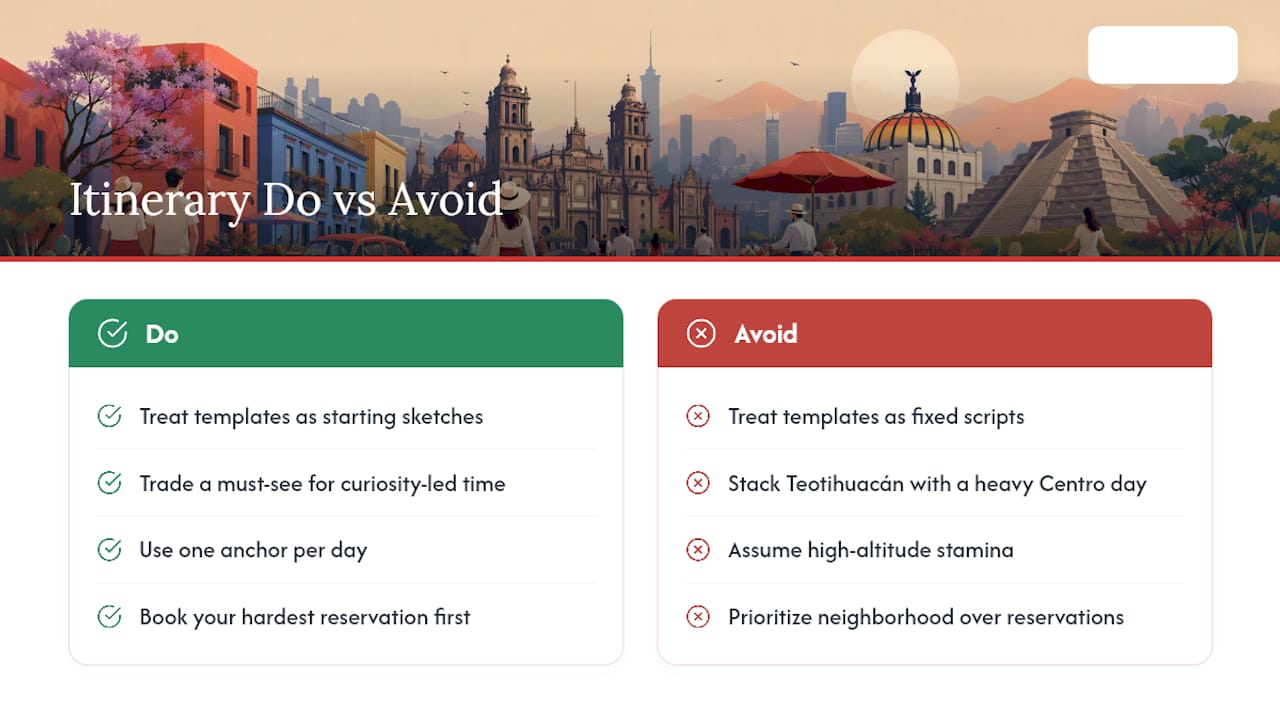
Conventional advice also underplays altitude and pacing. Plenty of itineraries stack a full Teotihuacán day directly against a heavy Centro Histórico day, assuming stamina that most travelers, especially on their first trip, simply don’t have at 2,240 meters. The one-anchor-per-day rule exists precisely to prevent that kind of scheduling optimism from ruining day four.
If there’s one thing to prioritize above all else, it’s booking your hardest reservation first and building outward from it. Everything else, including which neighborhood you sleep in, matters less than protecting that single fixed point on your calendar.
— Rban
Turn Your Template Into a Custom Mexico City Trip
Rban Tours exists for the moment a template stops being enough, when you want a Teotihuacán morning led by a guide who actually explains what you’re looking at, a street-food evening with an Italian-speaking host who knows which stall does the best al pastor, or a vintage-shopping afternoon through Roma Norte curated by someone who’s already found the good racks.
[

Take the 5-day template above as an example. We can convert Day 4 into a private guided Teotihuacán excursion timed to avoid both the crowds and the worst of the midday sun, or turn Day 5’s food wandering into a hosted evening through three or four spots you’d never find scrolling reviews on your phone. Every experience gets built around your pace, your interests, and how much walking you actually want to do that day.
If you’re ready to turn a template into a real plan, start with our Walking & Cultural Tour and tell us your trip length. We’ll shape the rest around it.
Sources
FAQ
What Is a Good 3-Day Mexico City Itinerary?
Split your time by neighborhood: Centro Histórico on day one, Chapultepec and the Anthropology Museum on day two, and Coyoacán with the Frida Kahlo Museum on day three, booking Casa Azul tickets at least a week ahead.
Where Can I Find an Italian-Speaking Guided Tour in Mexico City?
Some companies offer curated experiences in Mexico City with hosts who can guide Italian-speaking travelers through food tours, vintage shopping, and day trips, adapting the pace and language to your group.
What Does a 7-Day Mexico City Itinerary Look Like?
A 7-day plan extends the 5-day version with deeper museum time, a full mural-focused afternoon, and a day trip to Puebla and Cholula, leaving one flexible day for whatever you skipped earlier in the week.
Is There a 12-Day Mexico City Itinerary?
Twelve days works best as the 7-day template plus a multi-day extension, such as an overnight in Puebla, a Oaxaca add-on, or a slower second week spent revisiting neighborhoods at a more relaxed pace rather than adding new ones every day.
How Far in Advance Should I Book Frida Kahlo Museum Tickets?
Book Casa Azul tickets at least a week before your visit, since timed entry slots regularly sell out, especially on weekends and during peak dry-season months between November and April.
Recommended
Comments