
3 Booking Checks Italian Planners Need for Barcelona Team Building
- Rban Tours

- Aug 31
- 8 min read
Prioritize five formats: gastronomic workshops for warm-up energy, urban gymkhanas for large mixed groups, sailing regattas for leadership cohesion, creative workshops for low-pressure bonding, and cultural installations for multilingual teams. Each works because it matches a specific objective rather than a generic idea of “fun.” Book a curated local partner like Rbantours to handle logistics, language, and invoicing before you commit dates.
TL;DR:
Outdoor formats like sailing regattas and gymkhanas require careful capacity management, often needing fleet or subgroup coordination for larger groups.
Gastronomic workshops are ideal for teams of 10 to 25 at 50 to 120 euros per person, while cultural experiences suit larger groups with minimal language barriers.
Booking should occur between March and May or September and November to avoid summer heat and supplier closures, with contingency plans for weather included upfront.
Verify that providers have experienced facilitators, include debriefs, and can invoice correctly for Italian companies to prevent logistical issues.
Partnering with a curated local operator like Rbantours ensures smooth logistics, proper invoicing, and immersive, well-hosted experiences tailored to specific objectives.
Table of Contents
Team Building Barcellona Idee: The Full Catalogue by Objective
Most Italian HR teams default to the same two moves: a paintball afternoon or a long dinner with open bar. Neither builds much beyond a shared hangover. Barcelona rewards planners who pick a format for what it is supposed to achieve, not for what looks good on an invitation. The city’s mix of dense urban core, working port, and nearby hills means the same three days can hold a cooking class, a sailing regatta, and a mural workshop without anyone spending an hour on a bus.
Gastronomic formats anchor most Italian corporate trips because food is a shared language before the activity even starts. Cooking workshops built around Catalan classics like paella or crema catalana run best with groups of 10 to 25, priced between 50 and 120 euros per person depending on ingredients and whether wine is included. Tapas routes through the Gothic Quarter or El Born work well for larger groups using subgroups and a common final stop. Wine tastings in Penedès, less than an hour from the city, suit smaller executive groups of 8 to 15 who want a half-day escape with a sommelier-led session.
Nautical and active formats deliver the sharpest leadership metaphors of any category. Sailing regattas cap most monohulls at 12 people per boat, so a group of 40 needs a coordinated fleet, not a single oversized boat. Catamaran outings scale more easily for groups up to 30 to 40 since one vessel can carry the whole team for a coastal cruise rather than a race. Kayak trips along the Barceloneta coastline fit small teams of 8 to 12 who want something physical without the technical demands of sailing. Prices for premium nautical experiences run from 80 to over 200 euros per person, according to Meetreal’s Barcelona activity guide.
Cultural and urban formats cover the widest range of group sizes. Urban gymkhanas, whether app-based or paper-map versions, handle anywhere from 15 to 150 people because teams move independently through the city. Architecture tours built around Gaudí’s Sagrada Família or Park Güell work well for groups seeking a lighter, guided pace. Museum-based experiences at venues like Paradox Museum Barcelona suit mixed-language groups particularly well, since the challenges rely on visual and sensory installations rather than spoken instructions.
Creative and social formats tend to produce the calmest, most inclusive sessions of any category. A paint & sip session gives everyone a glass of wine and a canvas, with no skill required and no one left out. Street-art mural workshops let a team paint one collaborative wall piece, ideal for groups of 15 to 30 who want a physical keepsake. Percussion workshops using Afro-Cuban or Catalan rhythms work for almost any group size and need zero prior musical experience. Improv and comedy sessions push people out of their comfort zone in a controlled, low-stakes way.
For low-cost and large-group scenarios, app-based gymkhanas remain the most budget-friendly option in the 50 to 90 euro per person range for outdoor formats. Sports tournaments (five-a-side football, beach volleyball) scale cheaply since equipment costs stay flat regardless of headcount. Volunteer or social-impact half-days, packing meals or restoring a public space, cost less than most entertainment formats and often land better in post-event surveys than a party ever does.
Gastronomic workshops: 10 to 25 people, 50 to 120 euros per person, best for warm-up energy on day one.
Sailing regattas: 12 per boat, fleet-based scaling for larger teams, best for leadership offsites.
Urban gymkhanas: 15 to 150 people, 50 to 90 euros per person, best for large mixed-department groups.
Paint & sip and mural workshops: 15 to 30 people, best for low-pressure creative bonding.
Volunteer half-days: any group size, lowest cost band, best for values-driven teams.
Which Three Options Should You Bring to Stakeholders?
Present three curated shortlists tied to the objective HR is actually trying to hit, then let the team vote on the final pick. A vote takes ten minutes and buys enormous goodwill compared with a top-down decision nobody asked for.
To celebrate a milestone (year-end, product launch):
A rooftop paint & sip session followed by tapas, roughly 3 hours, indoors with an outdoor terrace option, ideal for relaxed recognition without a formal agenda.
A catamaran sunset cruise for up to 40 people, half-day, fully outdoor, weather-dependent but memorable.
A private cooking class ending in a shared dinner, 4 hours, indoors, works even in winter.
To integrate new hires or merge departments:
An urban gymkhana across the Gothic Quarter, 3 to 4 hours, outdoor, forces mixed small groups by design.
A percussion workshop, 2 hours, indoors, breaks down hierarchy fast since nobody has done it before.
A Paradox Museum group visit, 90 minutes to 2 hours, indoors, low language barrier for multinational teams.
To develop leadership behavior:
A sailing regatta with fleet coordination, half-day, outdoor, direct parallels to delegation and role clarity.
A cooking competition split into rival brigades, 3 hours, indoors, tests communication under mild time pressure.
A volunteer half-day with a shared goal and no hierarchy, 3 to 4 hours, outdoor or indoor depending on the project.
How Do You Choose the Right Activity for Your Team?
Start with the objective, not the activity. An experts’ recommendation worth following is to define what the day needs to accomplish first, then treat the format as the tool that gets you there, not the goal itself.
Filter every shortlist candidate against four questions: Does it match the stated objective? Can everyone physically participate, including anyone with mobility limits? Does the language dependency work for a mixed Italian and Spanish or English-speaking group? Is the venue accessible from where your team is staying?
When vetting a provider, ask directly: How many years has your facilitator run corporate sessions? Is a structured debrief included, or does the day just end when the activity does? What insurance coverage applies to nautical or physical activities? Can you issue an invoice with proper VAT documentation for an Italian company?
Confirm facilitator experience and request references from past corporate groups.
Ask whether a debrief is built into the price or billed separately.
Verify insurance coverage before booking anything nautical or high-activity.
Get invoicing terms in writing before the deposit, not after.
Red flags that predict a forgettable event: a provider who cannot describe how the debrief works, vague pricing that changes after you ask for a group quote, and zero mention of a backup plan for weather.
Pro Tip: Ask every Barcelona provider one blunt question before booking: “What happens if it rains?” The answer tells you more about their professionalism than their brochure does.
Planning Logistics: Seasonality, Budgets, and Scaling
Book between March and May or September and November. Both windows offer mild weather and full supplier availability, according to Meetreal’s seasonal guidance. Avoid mid-July through August for outdoor formats. Heat routinely pushes past 30°C, prices climb, and some suppliers reduce capacity or close entirely for their own summer break. If summer dates are unavoidable, schedule outdoor activities for early morning or late afternoon and move anything strenuous indoors during peak heat.
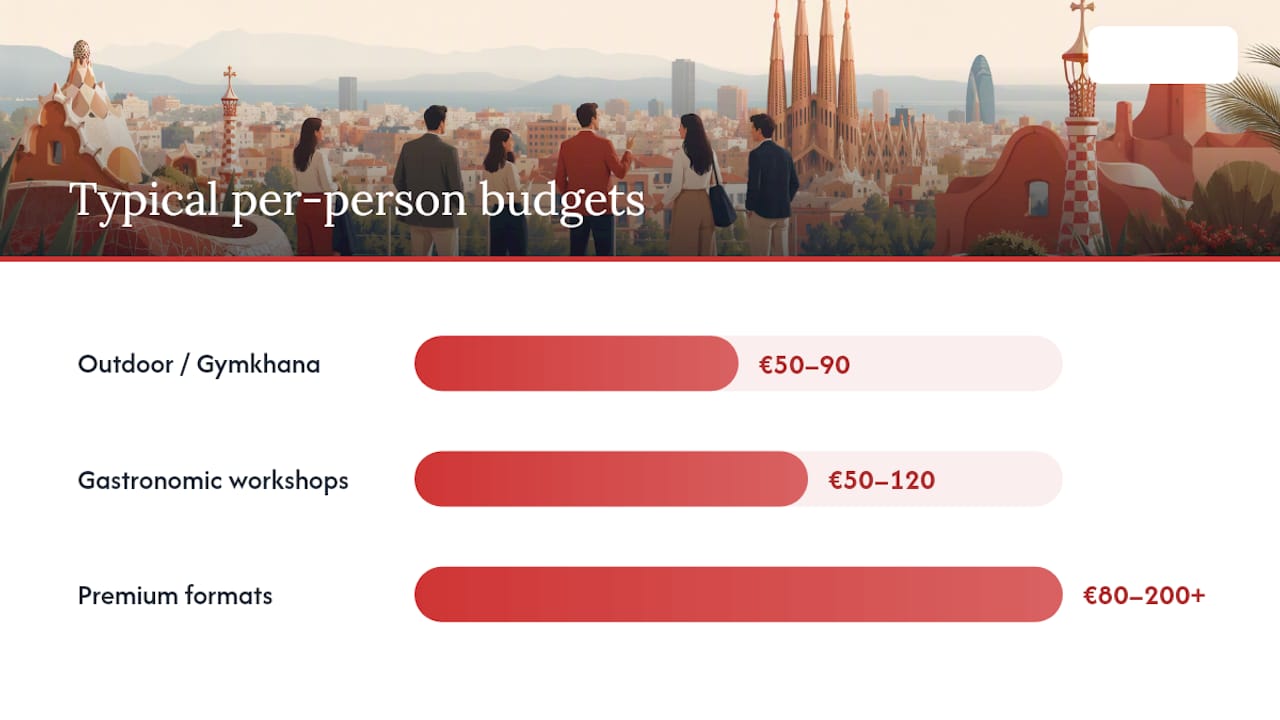
Budget by format, not by headcount alone. Outdoor and gymkhana-style formats run 50 to 90 euros per person, typically covering the activity and a facilitator. Gastronomic workshops run 50 to 120 euros per person, usually including ingredients and instruction but not always wine. Premium formats like sailing or a private chef dinner run 80 euros and up, sometimes well past 200, and often bundle transport.
Scaling changes the logistics, not just the price. Regattas need fleet coordination once you pass 12 people per boat. Gymkhanas split cleanly into subgroups with staggered start times. Cooking classes cap around 25 to 30 per kitchen space, so anything larger needs either a bigger venue or parallel sessions.
Confirm weather contingency in writing before deposit.
Request a single consolidated quote covering activity, facilitator, and transport.
Ask how the provider handles fleet or subgroup coordination for groups over 25.
Why Choose a Curated, Design-Led Partner for Barcelona
Rbantours builds corporate experiences around what a Barcelona day is supposed to feel like: local, well-hosted, and genuinely memorable rather than generic. The lineup spans bar-hopping routes through El Born, paint & sip sessions for creative bonding, hands-on culinary workshops, and hybrid agendas that combine a morning activity with a long, unhurried local lunch.
[
For Italian planners, the operational details matter as much as the activity itself. Rbantours provides a single point of contact for the whole booking, Italian-language support throughout planning, proper VAT-compliant invoicing, and post-event photos and reporting your HR team can actually use for internal communications. Facilitators integrate directly into each format, so the debrief that turns an afternoon into a real cohesion exercise happens as part of the day, not as an afterthought.
If your group also wants a food-forward option, pairing a culinary experience built around structured tasting with a Rbantours workshop gives the day both variety and depth. Check availability and get a custom quote through the Rban Tours Barcelona page before locking your dates, especially if you’re targeting the March to May or September to November windows when good suppliers book up fast.
What Every Italian Planner Should Confirm Before Booking
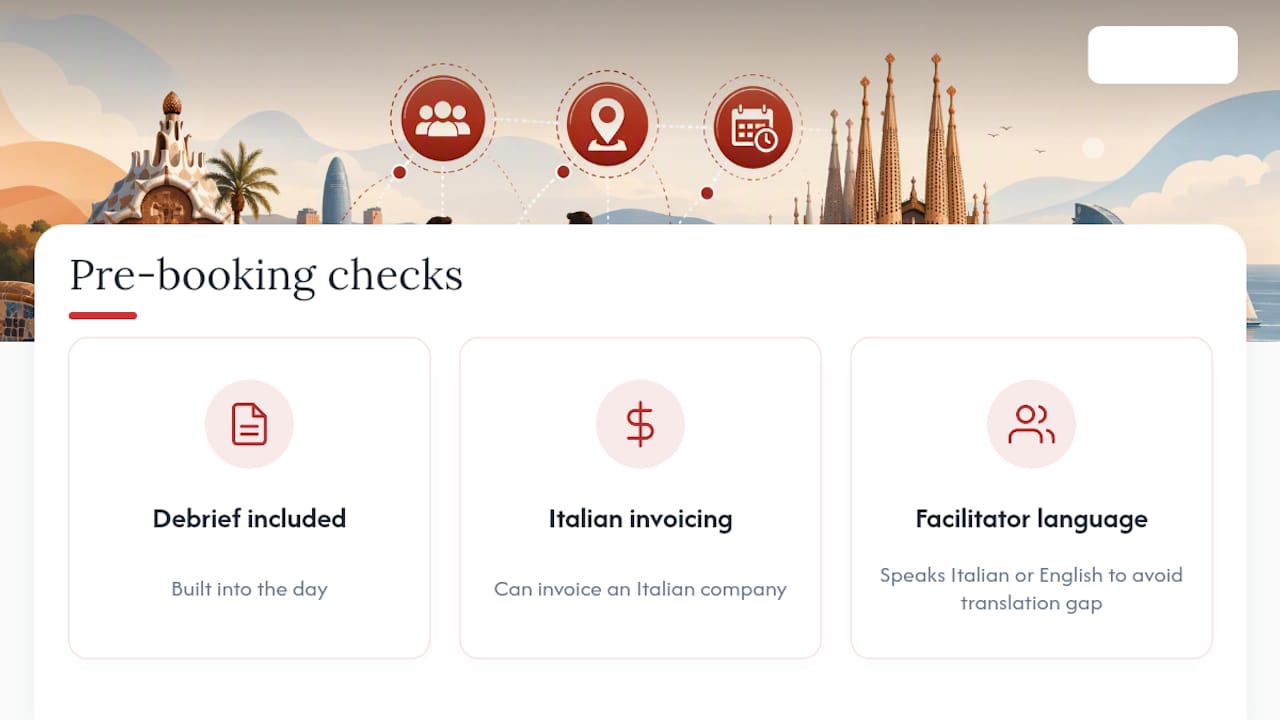
Confirm three things before any deposit leaves your budget: whether a debrief is built into the day, whether the provider can invoice properly for an Italian company, and whether the facilitator speaks enough Italian or English to run the session without a translation gap. Missing any one of these turns a promising activity into a logistics headache mid-trip.
One small habit consistently improves outcomes: send the facilitator a two-line brief on your team’s actual dynamic (recent reorg, new merger, a long stretch without an in-person gathering) before the event, not on arrival. A facilitator who understands the room in advance runs a sharper debrief.
A mid-sized Milan-based firm once split a two-day Barcelona trip between a sailing regatta and a shared cooking class, using the fleet-coordination approach for their 30-person group. The format switch, from competitive to collaborative, gave the debrief two very different angles to draw from.
— Rban
Sources
Recommended
Comments