
Unlock rich culture: why join guided tours in Japan

Japan stops you in your tracks. The layered rituals, the quiet reverence inside ancient temples, the sensory explosion of a night market in Osaka — it all feels both magnetic and just out of reach. Many travelers arrive convinced that wandering independently is the most authentic way to experience it. But without the language, the cultural context, or the insider connections, you often end up skimming the surface of a country that rewards those who go deeper. Guided tours in Japan don’t limit your freedom. They expand it — opening doors that most solo travelers never even find.
Table of Contents
Key Takeaways
Point | Details |
Cultural access | Guided tours unlock curated experiences and insider access to authentic Japanese culture often hidden from solo tourists. |
Expert guidance | Local guides interpret traditions and customs, ensuring you understand and appreciate the depth of Japanese culture. |
Logistics made easy | Tours handle all travel details, eliminating stress around transport, bookings, and navigating language barriers. |
Community and connection | Joining a group creates lasting friendships and shared memories with fellow travelers. |
What makes guided tours in Japan unique?
Now that we’ve set the stage, let’s explore what truly sets guided tours apart in Japan.
Japan is a destination that punishes guesswork. A wrong turn in Kyoto might land you in a tourist trap. A misread etiquette cue at a traditional ryokan can create awkward tension. Guided tours exist precisely to eliminate that friction and replace it with genuine discovery.
Our guided Japan experiences are built around curated itineraries that go far beyond the standard sightseeing checklist. We’re talking about introductions to local ceramicists working in family studios, visits to neighborhood shotengai (shopping streets) that rarely appear in travel blogs, and access to seasonal festivals where a local face at your side makes all the difference.
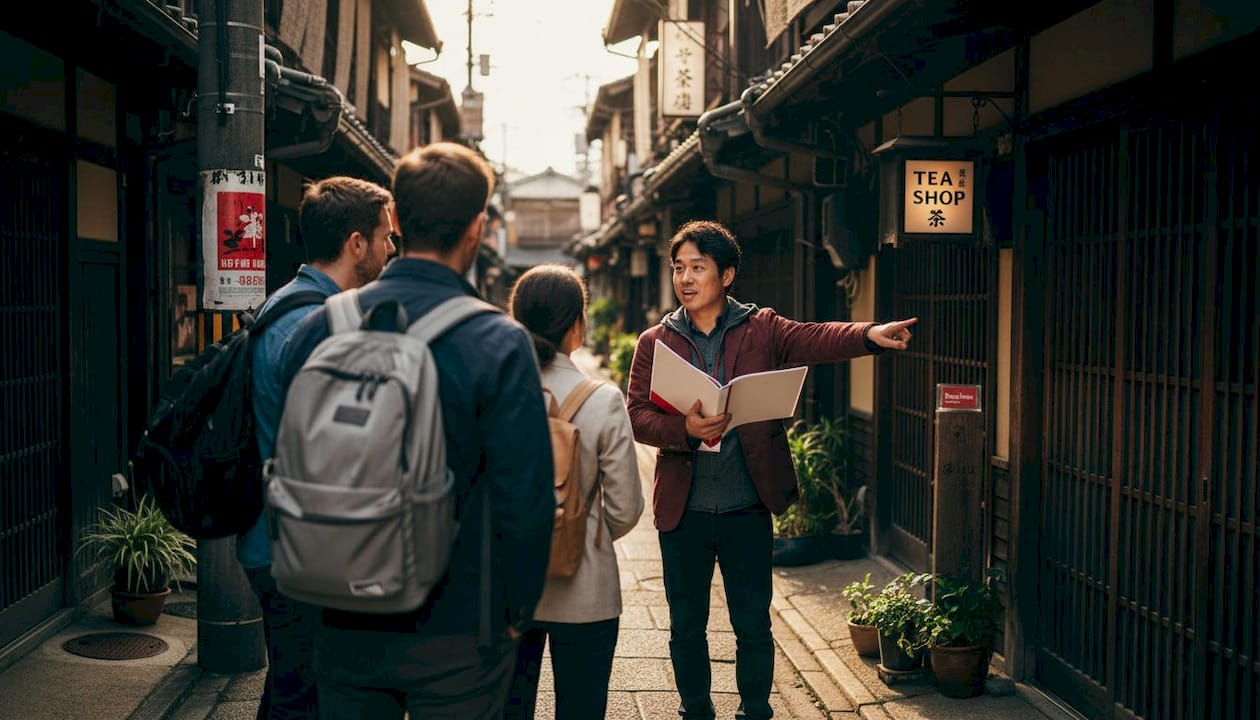
What separates a great guided tour from a mediocre one is context. Japan is rich with ritual and symbolism. Watching a tea ceremony without understanding its roots in Zen philosophy is like seeing a painting with your eyes closed. A knowledgeable guide transforms the experience, helping you feel the rhythm of what you’re witnessing rather than just observing it from a distance.
Small groups matter enormously here. When you’re traveling with eight people instead of forty, your guide can adapt, pause, and connect you with a local artisan in a way that simply isn’t possible with a bus tour. You become a guest, not a spectator.
Here’s what sets our tours apart:
Insider access to local traditions, workshops, and venues not listed in guidebooks
Cultural context provided in real time, so rituals and etiquette make sense
Small group sizes that create genuine connection with hosts and local residents
Direct navigation support through complex cultural and social moments
Flexible pacing that honors your curiosity rather than rushing past it
The most extraordinary moments in Japan happen off the beaten path. A hidden alleyway in Shinjuku, a lacquerware workshop in a quiet mountain town, a pre-dawn visit to a shrine before the crowds arrive — these are the experiences guided tours are designed to find for you.
Understanding what makes a city tour memorable isn’t just about logistics. It’s about the human layer that transforms a location into a lived experience.
How local guides unlock authentic Japanese culture
Having seen what makes guided tours special, discover how local experts bring Japanese culture to life.
Japan has a cultural depth that rewards patience and knowledge. For a first-time visitor, certain social codes can feel invisible until you accidentally break one. Shoes at a tatami threshold. The proper way to receive a business card with two hands. The unspoken rules of an izakaya, where ordering the wrong drink at the wrong moment can feel disorienting. Local guides serve as cultural interpreters, fluent not just in language but in feeling — the unspoken rhythms of daily life that define what it means to be in Japan.
Exploring cities like a local is less about finding hidden spots on a map and more about understanding why those spots exist and what they mean to the people who live there. A great guide doesn’t just lead you to a temple. They tell you about the monk who rebuilt it after the war, the neighborhood kids who play near the stone lanterns on weekends, and the significance of the incense smoke you’re standing in.
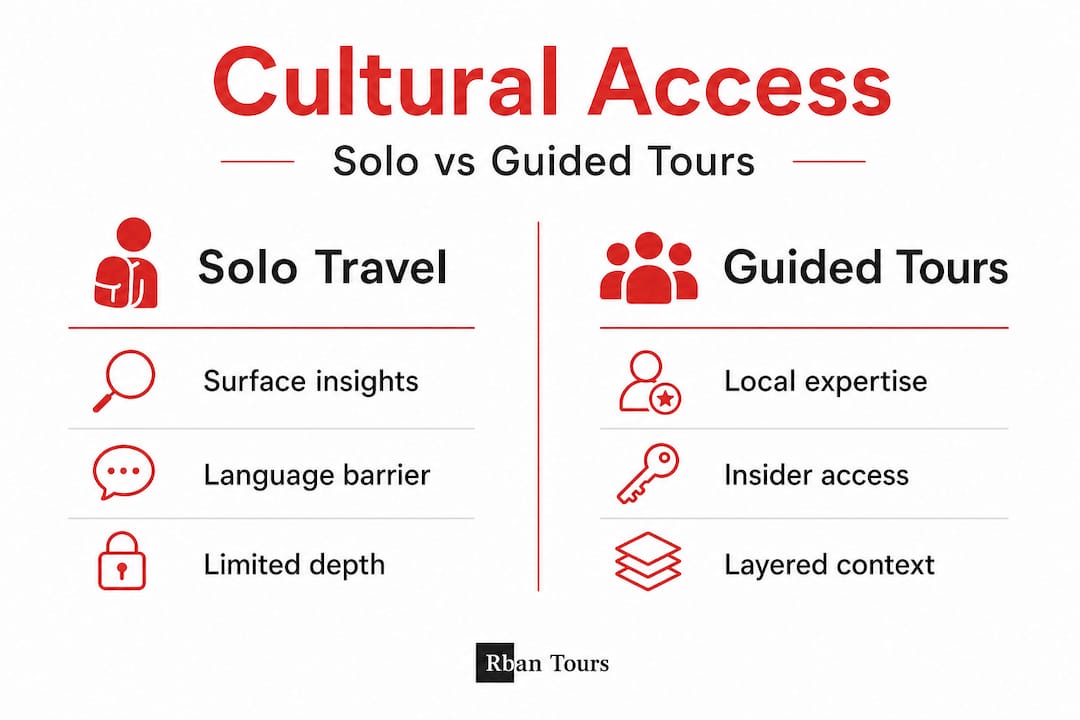
Here’s an honest comparison of what the two experiences typically look like:
Experience | Traveling solo | Guided tour |
Cultural depth | Surface level without research | Layered, real-time context provided |
Local access | Limited to public spaces | Curated access to artisans, locals, venues |
Language barriers | Frequent and often stressful | Managed by bilingual guides |
Time efficiency | High planning overhead | Streamlined with flexibility built in |
Etiquette confidence | Trial and error | Guided with confidence from day one |
The difference is stark. And it’s not about capability. Even seasoned travelers find that Japan’s cultural nuance is a moving target. What was acceptable in Tokyo last decade has shifted. Regional customs differ dramatically between Kyoto and Osaka, between rural Tohoku and urban Fukuoka. A local guide stays current.
Pro Tip: Don’t just listen to your guide — ask questions that go beyond the surface. “Why does this neighborhood feel different from the last one?” or “What would a local your age do on a Sunday here?” These prompts unlock the stories that never make it into travel magazines, and they’re the memories you’ll carry home long after the Instagram posts fade.
We’ve applied this philosophy across everything we do, from memorable tour design in Japan to our approach in Barcelona. Authentic travel isn’t geography-specific. It’s a mindset.
What you gain from group tours: camaraderie and shared memories
Beyond cultural insight, guided tours also offer meaningful social connections — let’s see how.
Solo travel in Japan is genuinely wonderful. But there’s something irreplaceable about sharing a moment of awe with someone standing right beside you. When you gasp at your first view of Mount Fuji at sunrise, or burst out laughing as you fumble through a ramen tasting challenge together, those shared reactions bond people fast. Group tours create a unique social ecosystem where strangers become collaborators in discovery.
The fear that joining a tour means being surrounded by people you have nothing in common with is understandable. But memorable cities experiences attract travelers with similar values: curiosity, openness, and a desire for depth over speed. The people you meet on a well-curated tour are almost always your kind of people.
Research consistently shows that shared novel experiences accelerate social bonding faster than routine interaction. Travel is perhaps the most powerful context for this. You’re out of your comfort zone. So is everyone else. That shared vulnerability creates connection quickly.
Here’s how group travel actively enhances your Japan trip:
Icebreaker activities built into the itinerary (craft workshops, communal meals, creative challenges) lower social walls immediately
Group dining at local izakayas and shared plates encourages conversation and laughter in a natural, unpressured way
Team-based workshops like pottery, calligraphy, or textile dyeing give everyone a shared focus and a shared story
Reflective moments at cultural sites spark deeper conversations that wouldn’t happen traveling alone
Ongoing community often extends beyond the trip, with group chats and reunion plans born from a single week in Japan
Studies on travel behavior suggest that a significant portion of group tour participants report forming friendships that extend well beyond the trip itself. These aren’t just travel acquaintances. For many, they become part of their wider social world. There’s real power in that.
How guided tours simplify logistics and planning in Japan
If you’re worried about the complexities of traveling in Japan, consider how guided tours ease every step.
Japan’s public transport system is legitimately impressive. The Shinkansen runs on time to the second. IC cards work across most major cities. But navigating it as a visitor — especially with luggage, limited Japanese reading ability, and an unfamiliar regional rail network — is a genuine challenge. Add to that the need to book certain temple gardens weeks in advance, the etiquette of navigating a traditional inn, and the reality that Google Maps doesn’t always account for local walking customs, and you have a planning burden that can consume your trip before it begins.
Guided tours absorb that burden entirely. Every logistical detail — transport, venue access, timing, reservations — is handled before you arrive. This frees your mental bandwidth for what actually matters: being present.
Here’s a clear look at how the two approaches compare:
Planning element | Independent planning | Guided tour |
Booking requirements | Multiple platforms, advance research | Single booking, all-inclusive |
Time spent planning | 10 to 20+ hours pre-trip | Minimal, often just arrival info |
In-language support | Self-managed with apps | Real-time human support |
Emergency help | Navigated alone | Guide assists immediately |
Flexibility | Fully self-directed | Structured with built-in free time |
The personalized travel journeys we design don’t just streamline logistics. They sequence experiences in a way that builds emotional momentum. A morning in a local market followed by an afternoon indigo dyeing workshop followed by a neighborhood dinner isn’t accidental. It’s curated to let Japan reveal itself to you in layers.
Pro Tip: When researching tours, look specifically for ones that build unstructured free time into the itinerary. The best guided experiences give you a framework and then trust you to wander. A few hours of free exploration in a neighborhood your guide has already introduced you to is an entirely different experience from arriving cold. You notice more. You feel braver. You find your own version of the place.
Our vintage shopping tour is a perfect example of this balance. We introduce you to the rhythm of a neighborhood, point you to the right side streets, and then let you explore at your own pace. Structure and freedom aren’t opposites in good tour design. They’re partners.
Why the real value of guided tours in Japan goes beyond sightseeing
Stepping back, let’s reflect on what truly sets guided travel apart in Japan and why it matters.
We hear a version of the same thing regularly: “I prefer to travel independently because it feels more authentic.” We understand that instinct completely. There’s real pleasure in figuring things out on your own. But here’s the honest truth we’ve learned through years of designing immersive Japan tours: most of what makes Japan extraordinary is invisible without context.
The temple you stumble upon solo might be beautiful. But the same temple, visited with a guide who knows the founding monk’s story, the significance of the carved deity above the gate, and the local festival that brings the neighborhood to life there every autumn — that temple becomes a living thing. You don’t just visit it. You feel it.
The assumption that guided tours are for people who don’t know how to travel is outdated and, frankly, backwards. The most experienced travelers we meet are often the most enthusiastic about guided experiences, because they know exactly what they’re gaining: time, depth, and access that no amount of solo research can replicate.
Great travel isn’t about proving your independence. It’s about getting as close to the soul of a destination as possible. In Japan, where so much lives beneath the surface, a trusted local guide is the most direct route there.
The most memorable travel moments don’t come from perfect planning. They come from letting go of your itinerary and trusting someone who genuinely loves where they live to show you what that feels like.
We’ve seen it happen on every tour. The moment a traveler stops consulting their phone and starts actually looking. That shift happens faster with a great guide beside you. It’s not magic. It’s just what genuine connection to place feels like.
Ready to experience Japan differently? Start with Rban Tours
With this understanding, you may be ready to try a guided experience firsthand.
We’ve spent years crafting Japan itineraries that honor both the depth of Japanese culture and the curiosity of modern travelers. Every experience is designed to feel intimate, intentional, and genuinely alive.
[
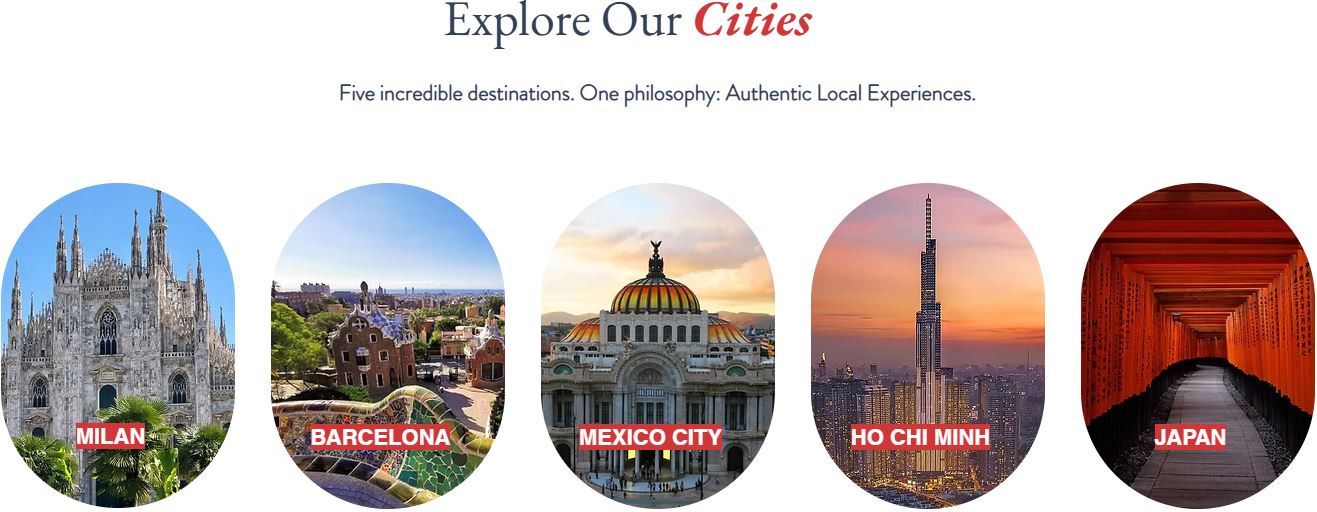
Our local guides aren’t just knowledgeable. They’re passionate storytellers, community connectors, and creative collaborators who bring each neighborhood’s rhythm to life. From Japan cultural experiences that take you inside the creative pulse of Tokyo or Kyoto to walking and cultural tours that weave together food, design, history, and human connection, every Rban tour is built to leave you with more than photos. It leaves you with a real sense of having lived the destination. Browse our Japan experiences and find the one that speaks to where your curiosity is pointing right now.
Frequently asked questions
Are guided tours in Japan suitable for solo travelers?
Yes, guided tours offer a safe, social way for solo travelers to meet like-minded people and experience Japan with confidence, removing the isolation that can come from navigating an unfamiliar culture alone.
Will I miss out on local experiences if I join a tour?
Not at all. Quality guided tours typically provide deeper local access and more meaningful encounters than most independent travelers can arrange on their own, including entry to venues and communities that aren’t publicly advertised.
How do guided tours handle language barriers in Japan?
Professional guides communicate in English and actively help you navigate everything from train ticketing to nuanced social customs, making the entire experience feel fluid rather than stressful.
Are small group tours better for cultural immersion?
Small group tours allow guides to personalize the experience and create genuine moments with local hosts and artisans, making cultural immersion feel authentic rather than scripted or rushed.
Recommended
Comments