
What Is City Storytelling? A Guide for Urban Explorers

City storytelling is defined as the conscious act of communicating a city’s identity and values to shape how people perceive, inhabit, and connect with urban environments. It goes far beyond tourism brochures or civic marketing. Urban narrative, as practitioners call it, functions as critical mental infrastructure that determines how residents feel at home, how visitors find meaning, and how planners build consensus. When a city tells its story well, every street corner, market stall, and crumbling wall becomes part of a living text. When it tells that story poorly, or not at all, the city fragments into disconnected experiences that leave no lasting impression.
What is city storytelling made of? Core components and techniques
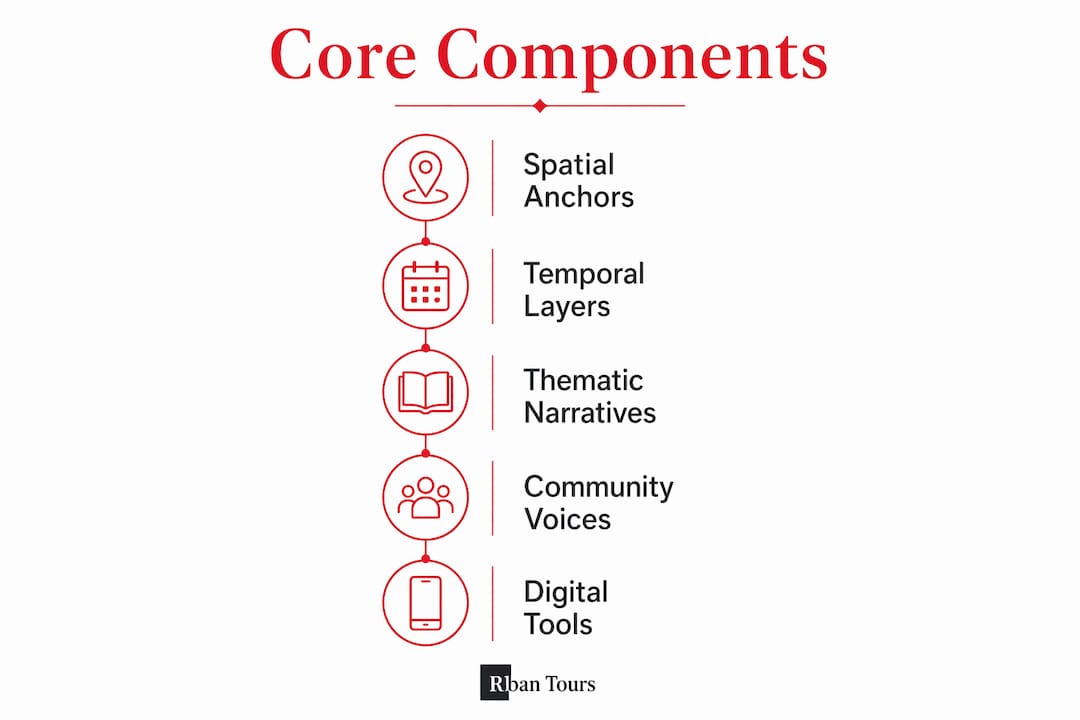
Effective city storytelling relies on five structural elements that work together to create a coherent urban narrative. Narrative mapping uses spatial anchors, temporal markers, thematic layers, interactive elements, and documented sources to give stories both geographic and emotional grounding. Each element carries a specific job.
Spatial anchors pin stories to physical locations. A specific plaza, a doorway, a tiled staircase each becomes a reference point that makes abstract history feel tangible.
Temporal markers place events in time, showing how a neighborhood evolved from one era to the next and why that change matters now.
Thematic layers group stories by subject, such as migration, craft, or resistance, so that visitors and residents can follow a thread that resonates with them personally.
Interactive elements invite participation. Digital maps, QR codes embedded in signage, and audio guides turn passive observers into active readers of the city.
Documented sources anchor the narrative in verifiable history, oral records, and community testimony, which builds trust and prevents myth from crowding out fact.
Tools like GIS StoryMaps and open-source digital mapping platforms make this structure accessible to community groups, not just urban planners. A neighborhood association in Mexico City, for example, can plot the oral histories of its oldest residents onto a shared map and publish it for anyone to explore. That act of spatial storytelling preserves cultural heritage and gives younger generations a reason to stay connected to place.
Pro Tip: Avoid exposition dumping. History that does not advance understanding of the city’s present should be cut or woven into present-day details. A cracked mosaic on a wall tells more than a paragraph of dates.

How does city storytelling function as governance in urban planning?
City storytelling is not decoration applied after decisions are made. Narrative in urban planning functions as a decision-making framework that precedes and shapes physical development. It aligns stakeholders, builds public consent, and carries a city’s vision across decades of changing administrations and shifting budgets.
“The first material of any city is meaning.” Neglecting narrative in development projects risks fragmented outcomes that lack public trust and long-term coherence.
When a district gets labeled “dangerous” or “authentic” in dominant urban stories, those labels shape policy and investment decisions directly. Developers read the narrative. Politicians respond to it. Residents either embrace or resist it. The story is never neutral.
Participatory storytelling addresses this power imbalance by collecting diverse voices before plans are drawn. Cities that involve residents in narrative building tend to produce development projects with stronger community support. The risks of skipping this step are real:
Public opposition to projects that feel imposed rather than co-created
Loss of cultural identity when dominant narratives erase minority histories
Investor confusion when a city’s stated vision conflicts with its lived reality
Missed opportunities to attract visitors and residents who connect with authentic stories
Narrative governance treats storytelling as a long-term infrastructure investment, not a communications task. A city that builds its narrative deliberately creates a foundation that physical infrastructure alone cannot provide.
How can cities be treated as characters to deepen urban narratives?
Cities make the most compelling stories when they are treated as dynamic characters rather than static backdrops. Assigning emotional states to a city, its moods, contradictions, and temperament, gives storytellers a tool that resonates on a psychological level with audiences.
Think about how Barcelona feels restless and sensual at the same time. Or how Kyoto carries a quiet formality that occasionally breaks into something wild and colorful during festival season. These are not accidents of geography. They are the result of accumulated stories, architecture, ritual, and social behavior layered over centuries. A skilled storyteller reads those layers and reflects them back to the audience.
Treating a city as a character produces several concrete benefits:
Emotional coherence: Visitors and residents understand the city’s “personality” and know what to expect, which deepens trust and affection.
Plot-driven engagement: When a city has a character arc, its contradictions become interesting rather than confusing. A neighborhood in decline becomes a story of tension and potential, not just a problem to fix.
Identity anchoring: Residents who see their city as a character with depth feel more connected to its future. They become protective of its story.
Richer visitor experiences: Travelers who understand a city’s emotional register engage more deeply with local culture and spend more time in meaningful exploration.
The psychological depth that comes from character-based thinking also helps storytellers handle a city’s contradictions honestly. Every great city contains multitudes. Pretending otherwise produces a flat, promotional narrative that no one believes.
What are best practices for engaging communities through city storytelling?
Community engagement is where urban narrative becomes real. The most technically sophisticated story map means nothing if the people who live in a neighborhood do not recognize themselves in it. Community storytelling projects like Story Corners collect personal experiences from residents and weave them into living digital archives that grow over time.
Start with listening. Before collecting stories, hold open sessions where residents share what they value, what they fear losing, and what they want visitors to understand. This shapes the narrative before a single word is written.
Collect oral histories on video and audio. Text alone loses the rhythm and emotion of a person’s voice. A grandmother describing her street in 1970s Barcelona carries more weight than any written summary.
Build a living archive. Static exhibits go stale. Digital platforms that accept ongoing contributions keep the narrative current and give community members a reason to return and add their own chapter.
Distribute across channels. A story told only on a website reaches a fraction of its potential audience. Signage, guided tours, social media, and culinary experiences all carry narrative and reinforce each other.
Measure engagement, not just reach. Comments, contributions, return visits, and tour bookings tell you whether the story is landing. Raw view counts tell you very little.
The 2025 CityStory Project demonstrated that resident-led storytelling builds empathy across social groups and strengthens local belonging in ways that top-down civic campaigns rarely achieve. That result matters for planners, tour operators, and anyone who wants a city’s story to feel alive.
Engagement method | Primary benefit |
Story Corners and oral history collection | Captures authentic voices and lived experience |
Living digital archives | Keeps narrative current and community-owned |
Multi-channel distribution | Reaches residents and visitors across touchpoints |
Guided narrative tours | Creates real-time emotional connection to place |
Pro Tip: Narrative consistency across all touchpoints, from street signage to digital guides, is what builds trust. A unified tone and visual language signal that the story is intentional, not accidental. Consistent narrative design is the difference between a city that feels coherent and one that feels scattered.
Key Takeaways
City storytelling is the foundational practice that shapes how residents, visitors, and planners perceive and engage with urban environments across every touchpoint.
Point | Details |
City storytelling as infrastructure | Urban narrative functions as mental infrastructure, not marketing, shaping public trust and development decisions. |
Five core narrative components | Spatial anchors, temporal markers, thematic layers, interactive elements, and documented sources create coherent story maps. |
Governance role | Narrative precedes physical development and aligns stakeholders when built participatively and consistently. |
Cities as characters | Assigning emotional depth to cities creates richer, more believable stories that resonate with both residents and visitors. |
Community engagement | Resident-led storytelling through oral histories and living archives builds empathy and authentic cultural identity. |
Why city storytelling is the most underrated urban skill
We have spent years watching cities invest millions in architecture and infrastructure while treating narrative as an afterthought. The results are predictable. Beautiful buildings with no story feel cold. Revitalized neighborhoods with no narrative identity attract visitors who leave without understanding what they experienced.
What we have learned, working across destinations from Barcelona to Mexico City to Vietnam, is that story is the first thing a city needs to get right. Not the last. When we design an immersive city experience, we start by asking what the city is feeling right now. What is its mood this season? What contradiction is it living through? Those questions produce experiences that visitors remember for years.
The practitioners who get this right are not always the ones with the biggest budgets. They are the ones who listen first, who treat residents as co-authors, and who understand that a city’s story is never finished. The most exciting thing about urban narrative in 2026 is that the tools to tell it well are more accessible than ever. The only thing missing, in most cities, is the decision to take it seriously.
— Rban
City stories you can live with Rbantours
Rbantours builds every experience around the idea that a city’s best stories are told by the people who live them. Our curated city experiences in Barcelona, Mexico City, and beyond are designed to put you inside the narrative, not outside looking in.
[

From walking cultural tours that trace a neighborhood’s emotional history to creative workshops where the city’s colors and textures become your medium, each Rbantours experience is a chapter worth reading. We work with local guides, artists, and community storytellers to make sure every tour reflects the real pulse of the destination. If you want to understand a city the way its residents do, this is where that experience begins.
FAQ
What is city storytelling in simple terms?
City storytelling is the deliberate practice of communicating a city’s identity, history, and values through narrative to shape how people experience and connect with it. It functions as mental infrastructure, not just marketing.
How does narrative mapping work in urban storytelling?
Narrative mapping plots stories onto geographic locations using spatial anchors, temporal markers, and thematic layers, often through tools like GIS StoryMaps or digital platforms. The result is a layered, interactive record of a city’s history and culture.
Why does city storytelling matter for urban planning?
Storytelling in urban planning builds public consent and aligns stakeholders before physical development begins. Cities that neglect narrative risk fragmented projects that lack community trust and long-term meaning.
How can visitors engage with a city’s story?
Visitors engage through guided narrative tours, oral history archives, interactive digital maps, and experiences that connect local culture to place. Rbantours designs experiences specifically to put travelers inside a city’s living story.
What makes a city a compelling character in storytelling?
A city becomes a compelling character when storytellers assign it emotional states, contradictions, and a temperament that evolves over time. That depth makes the city feel alive and gives audiences a reason to care about its future.
Recommended
Comments