
What Sets Boutique Tours Apart from Standard Travel

Boutique tours are defined as small-group, personalized travel experiences that prioritize authentic local access, flexible itineraries, and meaningful human connection over mass-market sightseeing. The industry term for this approach is “curated travel,” and it represents a fundamental departure from the fixed schedules and anonymous crowds of traditional group tourism. What sets boutique tours apart is not simply smaller numbers. It is a complete rethinking of how a destination is experienced, from the first planning conversation to the final day on the ground. We built Rbantours around exactly this philosophy, and what we have seen firsthand confirms what the research consistently shows: travelers who go boutique rarely go back.
How do boutique tours differ from traditional group tours?
The most immediate difference is group size. Boutique tours average 12 participants compared to 30 or more on traditional tours. That gap changes everything about the pace, the access, and the quality of attention each traveler receives. A group of 10 moves through a Kyoto temple district differently than a group of 40. You hear the guide. You ask questions. You linger.
Beyond numbers, the operational model is structurally different. Boutique operators specialize in 1 to 3 regions rather than offering surface-level coverage across 50 to 100 countries. That depth of regional focus means the operator knows which family-run trattoria in Rome has been open since 1962, or which mezcal producer in Oaxaca welcomes small groups for a private tasting. Large companies cannot replicate that knowledge because their model depends on scale, not specificity.
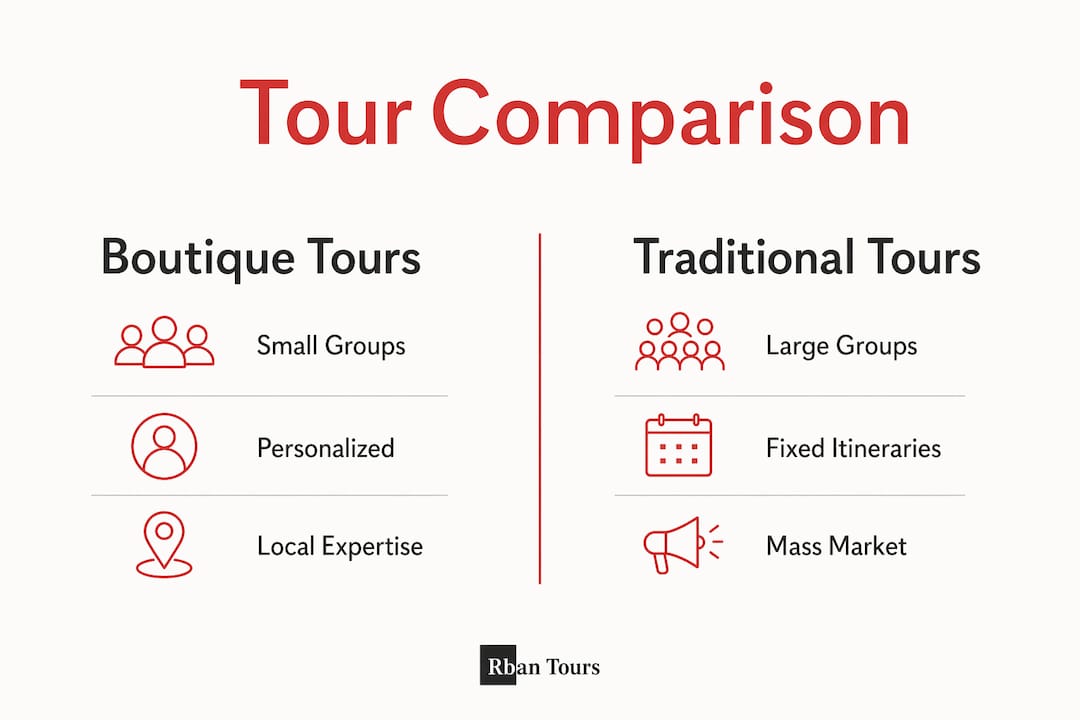
Here is a direct comparison of how the two models stack up:
Feature | Boutique tours | Traditional group tours |
Group size | 4 to 12 travelers | 30 or more travelers |
Itinerary flexibility | Real-time adjustments allowed | Fixed schedule, limited changes |
Regional specialization | 1 to 3 destinations | 50 to 100+ countries |
Guide relationship | Matched by temperament and interest | Assigned by availability |
Support access | Direct, 24/7 with one contact | Call centers and third-party agents |
Local partner vetting | Personally vetted by operator | Contracted through intermediaries |
The flexibility column deserves special attention. Traditional tours run on logistics. Boutique tours run on people. When a traveler wakes up exhausted or the weather shifts, a boutique operator adjusts. A traditional tour does not.
Pro Tip: Ask any tour operator how many destinations they cover. If the answer is more than 10, the depth of local knowledge drops significantly. Specialists always outperform generalists in travel.
What unique benefits do travelers gain from boutique tours?
The advantages of boutique tours go well beyond comfort. They change the quality of what you actually experience. Boutique travel starts from traveler intent, not from a checklist of landmarks. This “inside-out” approach means your energy, your curiosity, and your pace shape the itinerary rather than the other way around.
Here are the core benefits that distinguish boutique travel from standard tours:
Personalized itineraries built around you. Before booking, boutique operators conduct detailed discovery conversations to understand your travel mood, interests, and rhythm. The result is an experience designed for you specifically, not for an average traveler.
Access to hidden local gems. Boutique operators know the spots that do not appear in guidebooks. A street food market that locals actually use. A ceramics workshop run by a third-generation artisan. A rooftop bar that requires a local introduction.
Real-time support from someone who knows you. Travelers benefit from 24/7 access to a single point of contact who already knows their preferences. When something goes wrong, there is no hold music and no ticket number. There is a person who picks up.
Avoidance of traveler burnout. Boutique tours adjust timing to avoid peak crowds, prioritizing your energy over a checklist. Seeing fewer things deeply is more satisfying than rushing through 12 sites in a day.
Guides matched to your personality. Guides are selected for temperament fit, not just knowledge. A history-obsessed traveler gets a different guide than a food-focused one, even on the same route.
“The real value of boutique travel lies in post-booking support: direct, personal access to the operator on the ground, not through call centers.” — Caramel Trail
That quote captures something most travelers only discover after their first boutique experience. The support does not end at checkout. It travels with you.
In what ways do boutique tours tailor the experience to individual needs?
Personalization in boutique travel is not a marketing phrase. It is a process. It begins before you book and continues throughout the trip. Boutique operators start with detailed discovery conversations to map your preferences, pace, and what kind of traveler you actually are. Are you someone who needs two hours at a single museum, or someone who prefers a fast-moving morning with a long, slow lunch? That distinction shapes everything.
The personalization extends across several dimensions:
Activity density. Some travelers want four experiences per day. Others want two, done deeply. Boutique operators build the schedule around your preferred rhythm, not a standard template.
Guide matching. As noted above, guides are paired by personality and interest, not just language or availability. This creates a connection that makes the experience feel like traveling with a knowledgeable friend rather than following a stranger with a flag.
Real-time flexibility. Boutique operators permit real-time itinerary adjustments, meaning you can add a cooking class you heard about at breakfast or skip a site that no longer interests you. The itinerary is a living document, not a contract.
Solo traveler and niche interest support. Boutique tours work especially well for solo travelers, who benefit from the social warmth of a small group without the anonymity of a large one. They also serve niche interests, from culinary deep dives to textile history, that mass-market tours never address.
Pro Tip: When evaluating a boutique operator, ask specifically how they handle a change request mid-trip. The answer reveals everything about their actual flexibility versus their marketing language.
The role of personalization in travel is not cosmetic. It determines whether a trip becomes a memory you carry for years or a series of photos you forget to look at.
How does local expertise make boutique tours more authentic?
Local expertise is the engine behind every boutique tour benefit. Without it, small group size is just a smaller bus. With it, the entire character of a destination opens up in ways that standard tours cannot reach.
What boutique operators know | What this unlocks for travelers |
Which local vendors are genuinely excellent | Meals and products that reflect real local culture |
When and where crowds peak | Timing that preserves the atmosphere of a place |
Which guides connect with specific traveler types | Conversations that go beyond scripted commentary |
How to solve logistics problems on the ground | Fast, calm resolution when things go sideways |
Boutique operators personally vet every hotel, guide, and driver rather than relying on contracted intermediaries. That vetting process is what separates a genuinely good recommendation from a paid placement. When Rbantours sends you to a specific ramen shop in Tokyo or a specific mezcal bar in Mexico City, it is because someone from our team has been there, eaten there, and decided it is worth your time.
This depth of knowledge also means boutique operators can design experiences that go beyond the tourist circuit entirely. Think of a culinary experience built around a neighborhood market that locals shop at every morning, or a creative workshop led by an artist who actually lives and works in the city. These are not add-ons. They are the point. The soul of a destination lives in its daily rhythms, and boutique operators know how to read those rhythms because they are embedded in them.
Key takeaways
Boutique tours deliver a fundamentally different travel experience by combining small group sizes, deep local expertise, and genuine personalization that standard tours are structurally unable to offer.
Point | Details |
Small group size changes everything | Groups of 4 to 12 create access, pace, and attention that 30-person tours cannot replicate. |
Personalization starts before booking | Discovery conversations shape itineraries around your mood, interests, and energy, not a template. |
Local expertise unlocks hidden access | Personally vetted partners and deep regional knowledge open doors that guidebooks do not list. |
Real-time flexibility is a core feature | Boutique operators adjust itineraries mid-trip, treating the schedule as a living plan, not a contract. |
Support travels with you | Direct, 24/7 access to a single contact who knows your preferences transforms how problems get solved. |
Why boutique travel is worth every penny of the difference
Here is something we have learned from years of designing experiences across Barcelona, Mexico City, Tokyo, and beyond: most travelers underestimate how much of a trip is lost to logistics, crowds, and mismatched energy. They come home with photos but not with the feeling they were chasing.
The common misconception about boutique travel is that it is simply more expensive. Sometimes it is. But the comparison is not boutique versus budget. It is boutique versus a trip where you spend three days in places that were not right for you, eating at restaurants chosen by a committee, and waiting for 28 other people to board a bus. When you frame it that way, the value calculation shifts.
What we find most meaningful is the relationship model. On a boutique tour, the operator has skin in the game. They personally recommended that guide, that hotel, that restaurant. If it falls short, they hear about it directly. That accountability produces a quality of care that no large company can manufacture through a customer satisfaction survey.
The travelers who resonate most with boutique travel are the ones who want to travel “inside-out,” as Rothschild Beyond describes it. They are not checking destinations off a list. They are trying to understand a place, feel its pulse, and leave with something that changes how they see the world. That is exactly the kind of travel we design for at Rbantours, and it is why small group travel consistently produces the most meaningful memories our guests share with us.
— Rban
Discover boutique-style travel with Rbantours
Rbantours designs every experience around the principles that define great boutique travel: small groups, deep local knowledge, and the flexibility to make each trip genuinely yours. Whether you are drawn to the creative energy of Barcelona’s neighborhoods, the layered street culture of Mexico City, or the quiet precision of Japan, we build experiences that let you feel the heartbeat of each city rather than just pass through it.
[
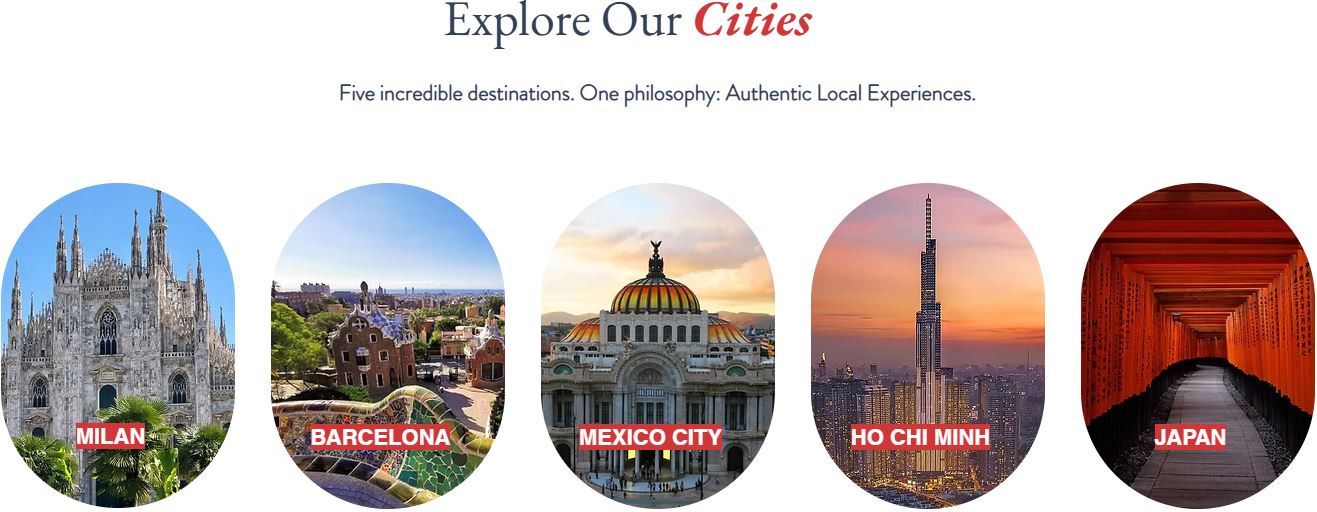
From vintage shopping tours and street food explorations to Paint & Sip workshops with local artists, every Rbantours experience is designed to connect you with the real pulse of a destination. Our groups stay small, our itineraries stay flexible, and our local partners are people we know personally. If you are ready to travel beyond the standard tour, we are ready to design something worth remembering.
FAQ
What is the typical group size for a boutique tour?
Boutique tours typically include 4 to 12 participants, compared to 30 or more on traditional group tours. This smaller size allows for personalized attention, flexible pacing, and access to venues and experiences that large groups cannot enter.
Are boutique tours more expensive than standard tours?
Boutique tours often carry a higher per-person cost, but the value includes personalized itineraries, vetted local partners, real-time flexibility, and direct support throughout the trip. The comparison is not just price per day but the quality and depth of what you actually experience.
How do boutique operators personalize the travel experience?
Boutique operators begin with detailed discovery conversations before booking to understand your interests, pace, and travel mood. Guides are matched by temperament and interest, and itineraries can be adjusted in real time based on your energy and preferences.
What makes boutique tours better for solo travelers?
Solo travelers benefit from the social warmth of a small, curated group without the anonymity of large tours. The single point of contact model also means solo travelers have direct, personal support throughout the trip rather than navigating issues through a call center.
Can boutique tour itineraries be changed mid-trip?
Yes. Real-time itinerary adjustments are a defining feature of boutique travel. Unlike traditional tours with fixed schedules, boutique operators treat the itinerary as a flexible plan that adapts to your mood, energy, and discoveries along the way.
Recommended
Comments