
Why Tour with Local Hosts for Richer Travel


Most travelers assume a tour is a tour. You book it, show up, and someone walks you through the highlights. But that assumption costs you the best parts of any city. Understanding why tour with local hosts matters is the difference between skimming the surface of a destination and actually feeling its pulse. Local hosts don’t just show you places. They give you context, connection, and access that no travel app or generic bus tour can replicate.
Table of Contents
Key Takeaways
Point | Details |
Local hosts create real connections | Guide skills like storytelling and cultural interpretation turn sightseeing into emotionally meaningful experiences. |
Community tourism supports livelihoods | Choosing local hosts directs your travel spend into sustainable employment and cultural preservation. |
Safety and logistics improve significantly | Local hosts provide real-time decision-making, health monitoring, and access to off-the-beaten-path locations. |
Personalization changes everything | Flexible, host-led tours adapt to your pace and interests in ways fixed itineraries never do. |
Quality matters when choosing a host | Trained, communicative local guides consistently outperform well-meaning but unprepared hosts. |
Why tour with local hosts for authentic cultural connections
There is a meaningful difference between visiting a place and understanding it. Local hosts are cultural facilitators. They translate not just language, but meaning. When a host in Mexico City explains the significance of an altar during Día de Muertos rather than just pointing at it, the experience shifts from observation to participation.
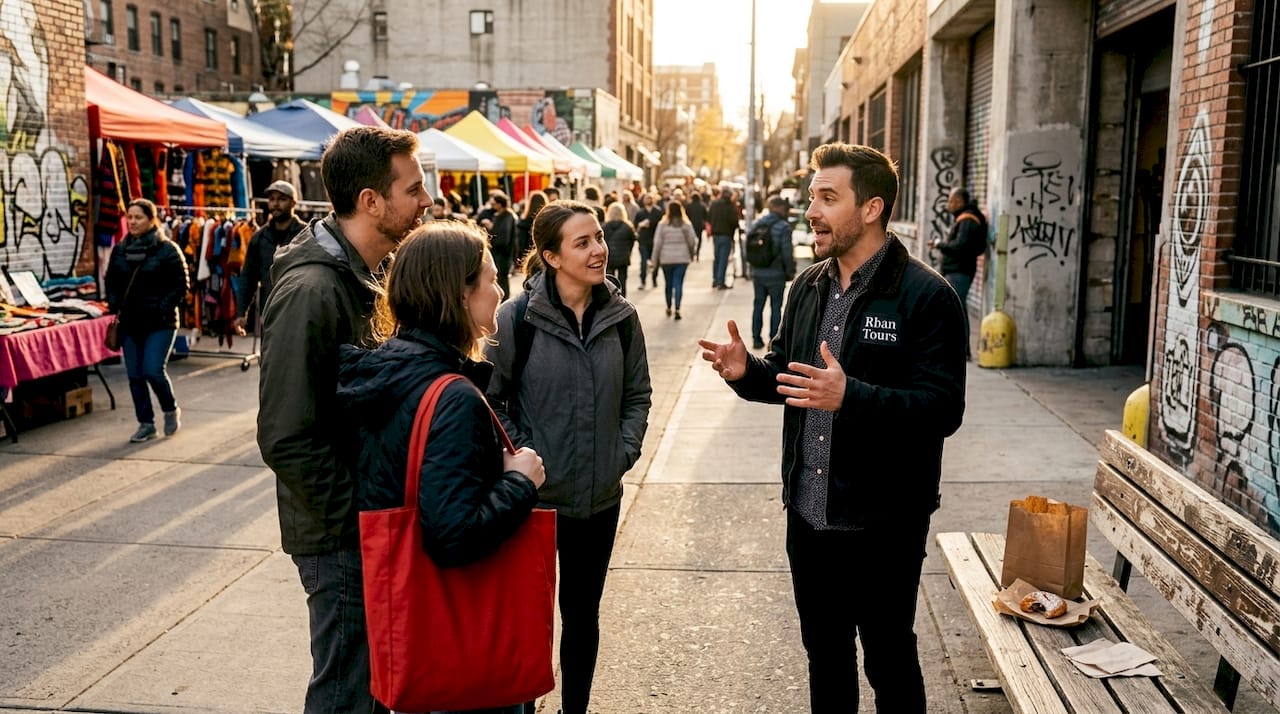
Research confirms this effect. A qualitative study in Bandarban, Bangladesh found that tour guide service quality, specifically cultural interpretation, communication, and hospitality, directly improves emotional connection, repeat visit intentions, and positive word-of-mouth. The guide is not a delivery mechanism for facts. The guide is the experience itself.
What makes local hosts genuinely different comes down to a few specific qualities:
Storytelling rooted in lived experience. A local host in Barcelona doesn’t describe the Gothic Quarter from a script. They tell you about the bar their grandfather used to drink at, the corner where street artists still gather at dusk, the shortcut only residents know.
Cultural interpretation that creates meaning. Knowing that a temple exists is not the same as understanding what it means to the people who built it and still visit it.
Bilingual communication that connects. Guide storytelling and bilingual skills act as bridges that emotionally connect travelers to destinations and encourage lasting loyalty.
Hospitality that feels personal. The difference between a practiced presentation and a genuine welcome is something you feel immediately.
When Antigua and Barbuda launched its first Culinary Crawl, the experience worked precisely because it brought visitors to local restaurants in a single evening, each one a window into community identity rather than a tourist-facing facade. That kind of closeness between visitor and resident does not happen by accident. It requires a host who genuinely belongs to the place.
Pro Tip: When booking a local host, ask one specific question before committing: “What is something about this city that most visitors never notice?” The answer will tell you everything about how much depth that guide can actually offer you.
Supporting local communities through host-led tourism
Choosing a local host is not just a personal preference. It is a decision with real economic weight. Community-based tourism creates tangible pathways to sustainable livelihoods through employment and cultural participation, which directly benefits the residents of the places you love visiting.
A survey of 320 residents across three community-based tourism settings in Vietnam analyzed through PLS-SEM found that community participation mediates how tourism resources translate into stable livelihoods, operating through both social-institutional and economic channels. In plain terms: when travelers choose local hosts, the money and the meaning stay in the community.
This matters for a few interconnected reasons. Local hosting creates stable jobs that preserve culture alongside income, rather than separating the two. When residents earn from sharing their traditions, language, and knowledge, they have every reason to protect and continue those traditions. The alternative, where outsiders manage tours of local culture for profit, does the opposite.
There is also a social cohesion dimension that rarely gets discussed. Research shows that meaningful local participation, not symbolic inclusion, is what makes sustainable community tourism actually work. When a neighborhood in Vietnam or a street market in Oaxaca thrives because travelers chose a local guide, the community grows more connected internally too. It reinforces identity rather than eroding it.
Key insight: Sustainability in community-based tourism depends on active local governance and equitable benefit-sharing. The mere presence of tourists does not guarantee livelihood improvements. Your choice of who guides you is what tips the balance.
The advantages of traveling with locals, then, go well beyond your own experience. Your choice of guide is a vote for the kind of tourism that builds rather than extracts.
Safety, logistics, and insider access
Here is something most travel content glosses over: local hosts make you safer. Not in a vague, general sense. In a very specific, practical one.
In Nepal’s Himalayas, local trekking guides monitor health, create adaptive plans in real time, and coordinate emergency responses in ways that prevent serious risks for travelers. Altitude sickness, sudden weather changes, trail route decisions. These are not situations where a downloaded map helps you. A trained local guide with emergency experience does.
Beyond safety, local guides provide access to secret locations and cultural experiences that simply don’t appear in any guidebook. The family-run izakaya in Kyoto that doesn’t advertise. The rooftop bar in Hanoi that locals use as their neighborhood living room. The unmarked door in a Barcelona alley that opens into one of the city’s best concept stores. You don’t find these places by searching. You find them through someone who already knows.
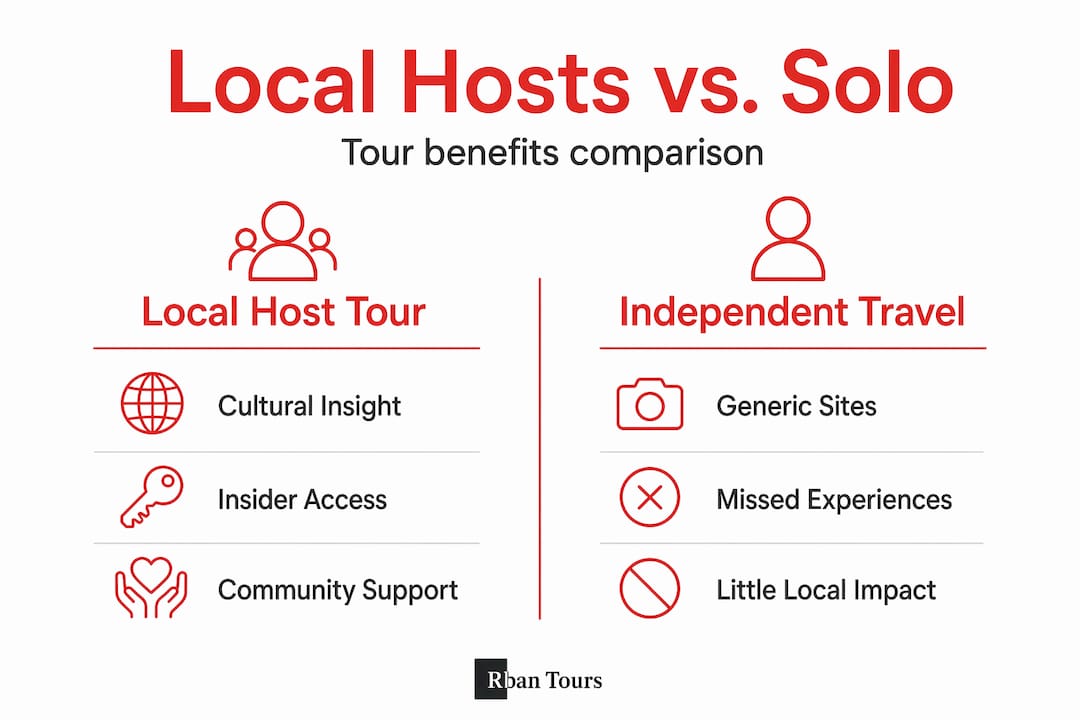
Here’s a direct comparison of what you get when you choose a local host versus independent travel:
Factor | Local host tour | Independent travel |
Safety in unfamiliar terrain | Real-time guidance, health monitoring, emergency coordination | Self-managed with limited local knowledge |
Cultural access | Off-the-beaten-path locations, local rituals, hidden venues | Tourist-facing highlights and well-known sites |
Navigation and timing | Host handles logistics and optimizes timing | Trial and error, often missing peak experiences |
Language barriers | Host bridges communication naturally | Risk of misunderstanding or missed nuance |
Overall trip value | Higher depth per hour, lower risk of wasted time | Higher flexibility, higher likelihood of gaps |
The cost comparison deserves its own moment. A local guide tour costs more upfront. But independent travelers frequently encounter navigation errors, timing mistakes, and missed experiences that accumulate into real losses of time and money. The host pays for itself in what you don’t lose.
Pro Tip: For how local hosts enhance travel in physically challenging environments like trekking or diving, prioritize guides with documented emergency training. A locally guided dive in Bali, for instance, connects safety competence directly to richer, more confident exploration.
How to choose the right local host
Not every person who calls themselves a local guide delivers what that title implies. Guide quality varies significantly, and untrained local hosts may underdeliver despite having authentic backgrounds. Knowing how to choose wisely is the practical skill that makes everything else in this article work.
Follow this process before booking:
Verify communication skills early. Exchange a message before booking. A host who responds thoughtfully, asks about your interests, and explains their approach is already demonstrating the communication quality that research links to improved tourist experiences. Slow, vague, or template responses are a real signal.
Look for flexibility in the itinerary. The best local host travel experiences are built around you, not a fixed script. Ask whether the tour can be adjusted. A confident, experienced guide welcomes that conversation. A rigid one doesn’t.
Assess cultural depth, not just fun factor. Reviews that only mention “so much fun” tell you less than reviews that mention something specific the guide shared, like a story, a ritual, a neighborhood the reviewer never would have found alone. That specificity is where real cultural value lives.
Ask about their relationship to the community. Does the host live in the neighborhood they’re showing you? Do they source food from local vendors? Do they collaborate with local artisans? Exploring cities with locals means your guide’s connection to the place should be genuine and ongoing, not just historical.
Respect the culture you’re entering. The best hosts will brief you on local etiquette. Dress codes, photography norms, how to behave in sacred spaces. Pay attention to those briefings. A traveler who disrespects local customs undermines both their own experience and the community’s willingness to keep sharing.
One thing most travelers miss entirely: the debrief. After a local host experience, ask your guide what they wish more visitors understood about their city or culture. The answers are often the most memorable part of the whole day. Meaningful travel and lasting memories are built in those unscripted moments.
My honest take on what local hosts actually change
I’ve watched travelers move through beautiful cities without really seeing them. Not because they weren’t curious, but because they were experiencing the curated version. The version designed for consumption rather than connection.
What I’ve learned from years of building local host experiences is that the transformation isn’t subtle. Travelers who spend time with a genuine local host don’t just leave with better photos or a more interesting dinner story. They leave with a different relationship to the destination. They come back. They recommend it to people they care about. They feel, sometimes for the first time, that they actually visited rather than just passed through.
The uncomfortable truth I’ve encountered is this: many travelers book a “local” experience and still end up with something polished, sanitized, and fundamentally safe. Real local host travel experiences involve a level of cultural honesty that can surprise you. The guide who tells you a neighborhood is complicated, not just charming. The street food vendor who explains exactly why that dish matters to their family. That friction and depth is not a flaw. It’s the point.
What I’d push back on is the idea that any local automatically makes a great host. The research is clear that guide competencies in cultural facilitation and real-time adaptation are what actually move the needle. Authenticity of background combined with skill of delivery is the combination worth seeking.
Don’t settle for someone who merely lives there. Find someone who can share it.
— Rban
Experience cities the Rbantours way
Ready to feel the real heartbeat of a city?
[

At Rbantours, we design every experience from the inside out. Our local hosts aren’t tour guides in the traditional sense. They’re creatives, food lovers, artists, and neighborhood insiders who share their cities through the lens of genuine life. From Barcelona experiences that weave through markets, concept stores, and corners most visitors never reach, to Mexico City tours that connect you with the creative energy and culinary rhythm of CDMX, every Rbantours experience is built around meaningful connection. We also collaborate with local venues and artisans to keep your travel spend inside the communities that make these cities worth visiting. Explore our walking and cultural tours and start planning the trip that actually stays with you.
FAQ
Why tour with local hosts instead of using a travel app?
Local hosts offer cultural interpretation, real-time adaptation, and access to places that no app can replicate. Research shows that guide skills like storytelling and cultural facilitation significantly improve emotional connection and overall tourist satisfaction.
How do local host tours support communities?
When travelers choose local hosts, their spending flows directly into community-based employment and cultural preservation. Survey data from Vietnam shows that community participation is a key pathway through which tourism creates sustainable livelihoods.
Are local host tours safer than independent travel?
Yes, particularly in physically demanding or unfamiliar environments. Local guides in Nepal’s Himalayas, for example, provide health monitoring and emergency coordination that prevent serious risks travelers would otherwise face alone.
What should I look for when choosing a local guide?
Prioritize communication quality, cultural depth, flexibility, and a genuine connection to the community they’re showing you. Authentic cultural immersion comes from guides who combine local knowledge with the skill to share it meaningfully.
Do local host tours cost more than independent travel?
The upfront cost is often higher, but independent travelers frequently lose value through navigation errors and missed experiences. Local guides reduce wasted time and improve the depth of every hour you spend in a destination.
Recommended
Comments